


Commercial Tripod Turnstile: Best Models and Buying Guide for 2026

A commercial tripod turnstile is one of the most effective access control investments a commercial building can make — and one of the most commonly mis-specified. The right model handles your peak rush hour without bottlenecks, integrates with your visitor management system, and looks at home in a professional lobby. The wrong one creates noise complaints, slow queues, and a maintenance headache within 18 months.
This guide gives you the full picture. You'll learn what commercial-grade actually means, which Turboo models fit which building zones, and how to specify the right configuration for your site.
What Makes a Tripod Turnstile "Commercial Grade"?
The term "commercial grade" is used loosely by many suppliers. Here is what it actually means for a commercial tripod turnstile — broken into the four criteria that matter in a building management context.
1. Cycle-Rated Mechanism
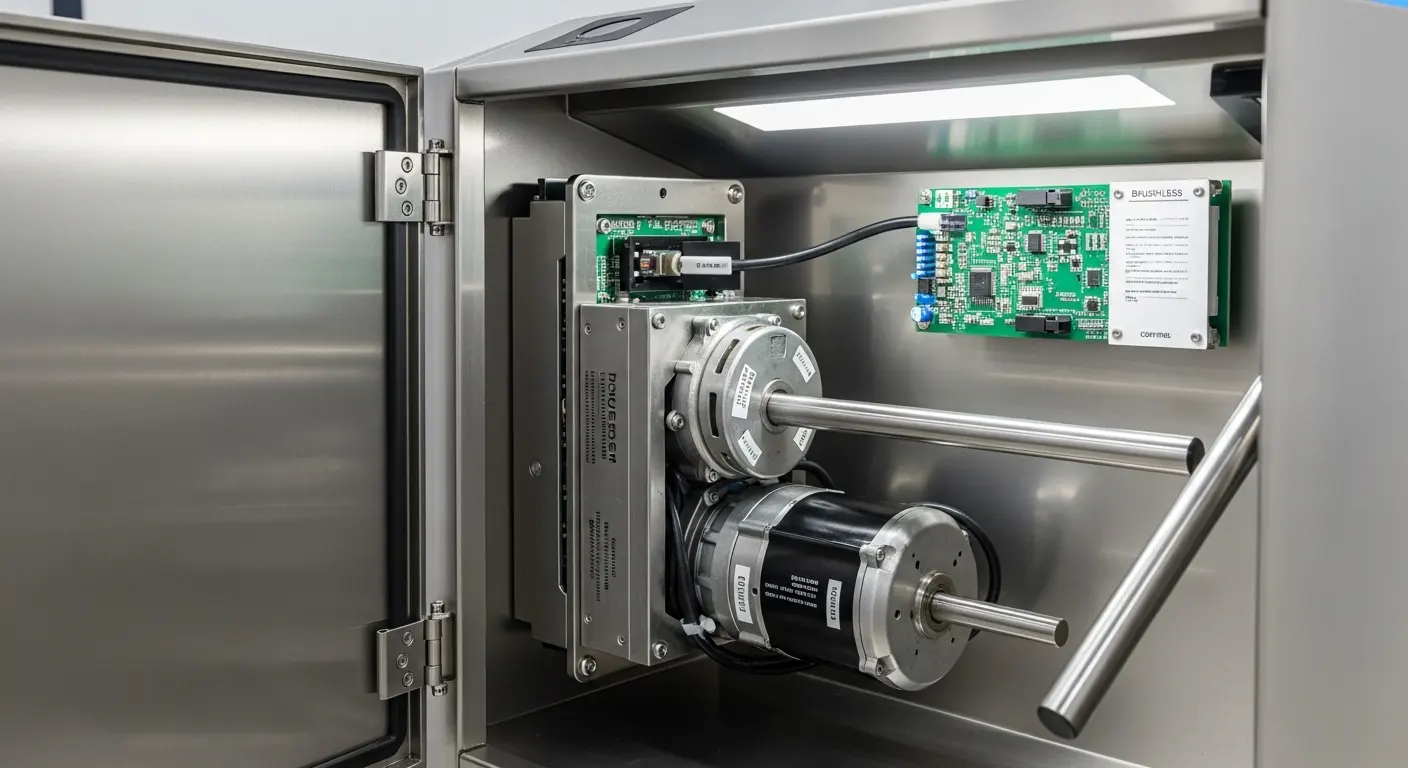
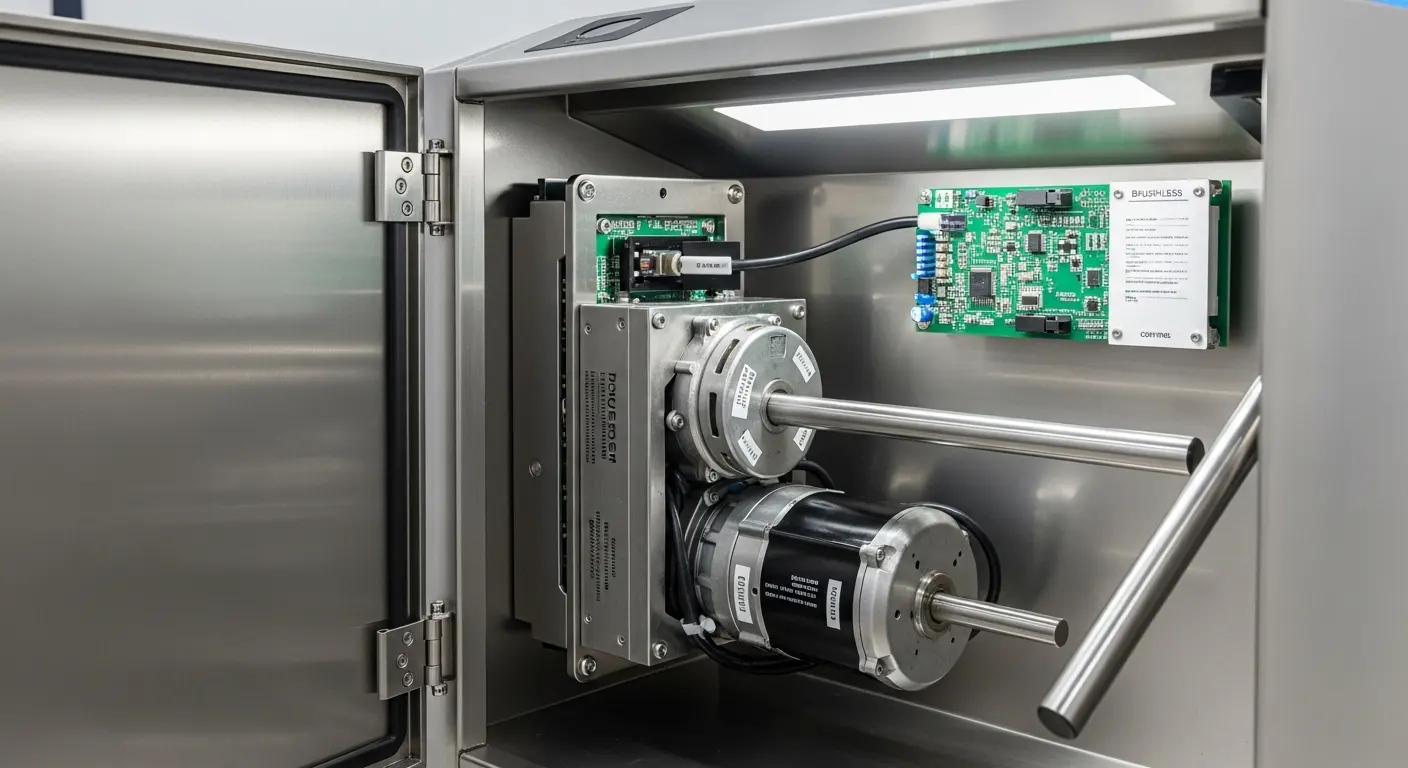
A commercial site typically processes 300–1,500 passes per day across its main entry points. Over five years, that adds up to 500,000 to 2.7 million arm rotations per lane. Therefore, a commercial-grade mechanism must be rated for at least 3 million cycles — not the 1 million rating common in entry-level residential or low-traffic units. Turboo's commercial models use brushless motor mechanisms rated for 5 million+ cycles.
2. SUS304 Cabinet Construction
Commercial lobbies demand a material finish that resists fingerprints, cleaning agents, and daily physical contact without surface degradation. SUS304 stainless steel handles all three. Wall thickness of 1.2mm minimum — and 1.5mm for the top panel — prevents denting under the casual impact loads that occur in high-traffic entry points daily.
3. Low Noise Operation
Commercial buildings — especially office towers and corporate campuses — have a professional acoustic standard. A commercial tripod turnstile must operate quietly. Turboo's brushless motor mechanisms produce operation noise at or below 45dB, which is below normal office ambient sound levels.
4. Integration-Ready Electronics
A commercial-grade unit connects without friction to visitor management software, HR attendance platforms, and building management systems. This requires RS485 communication support alongside dry contact, plus an open SDK for API integration with third-party platforms.
For a full overview of Turboo's product range for commercial deployments, explore the complete tripod turnstile catalogue.
How to Calculate How Many Lanes You Need
This is the step most buyers skip — then regret during the first rush hour.
The formula is straightforward:
Required lanes = Peak hourly footfall ÷ Gate pass rate per hour
A semi-automatic commercial tripod turnstile processes 25–35 persons per minute — approximately 1,500–2,100 per hour. A full automatic model achieves 35–50 per minute — approximately 2,100–3,000 per hour.
Example: A 15-storey office tower with 2,400 employees. Peak morning arrival is 8:00–9:00 AM, with 70% arriving in that window — 1,680 people. Using full automatic gates at 2,500 passes per hour per lane: you need at least 1 lane with comfortable buffer — but a 2-lane configuration handles the flow without congestion and provides redundancy if one unit goes offline for service.
Furthermore, always add one lane beyond minimum calculation. A commercial building lobby with one gate is a single point of failure. Two or three lanes provide both throughput comfort and operational continuity.
Zone-by-Zone Model Selection for Commercial Buildings
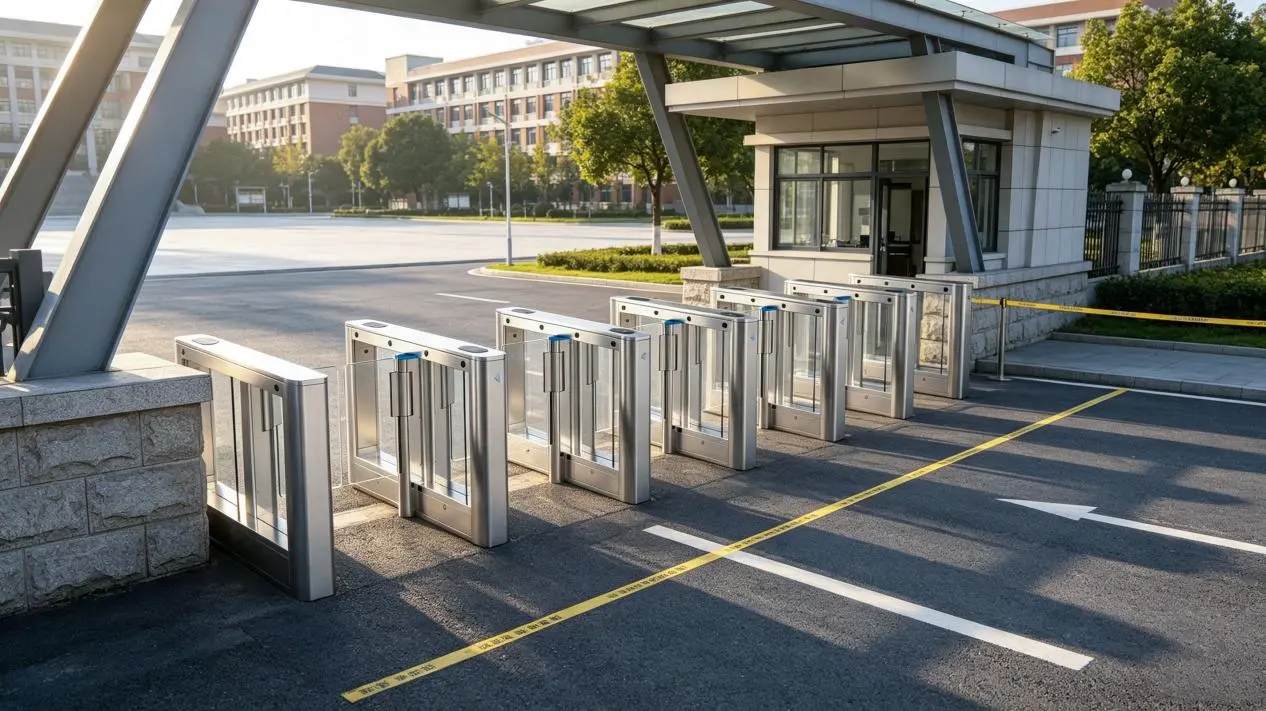
A commercial building is not a single access control environment. It has distinct zones — and each zone has different performance, aesthetic, and security requirements for a commercial tripod turnstile.
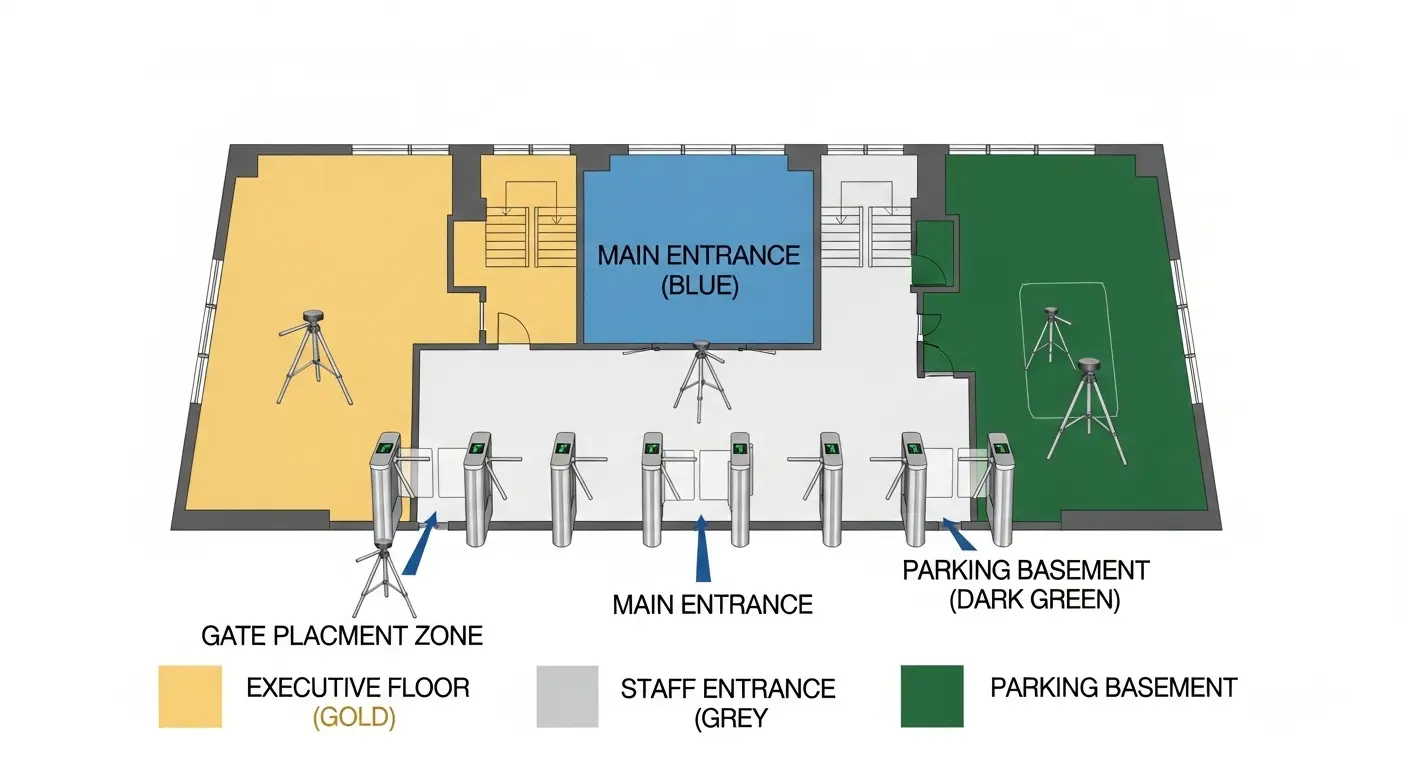
Main Entrance Lobby
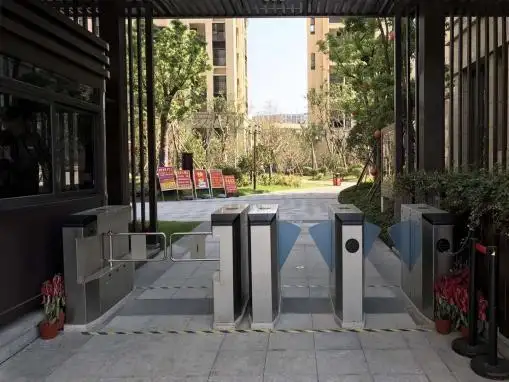
This is the highest-visibility zone. The gate here sets the tone for the building. Requirements: premium SUS304 finish, quiet brushless motor, fast reset, face recognition compatibility, and LED status indicators visible from a distance.
Recommended: Turboo's full automatic tripod turnstile (LB123) — brushless DC motor, blue tempered glass cover, RGB indicator, face recognition integration, and RS485 communication for real-time visitor management. This is the flagship commercial lobby model.
Corporate Floor or Executive Zone
Lower volume, higher security requirement. Anti-pass back, strict single-entry enforcement, and face recognition for no-card access. The semi-automatic automatic tripod turnstile EF1213 with memory mode and IC/ID card, QR, and face recognition support covers this precisely. It also supports extensible access control, attendance, and fee function integration from a single board.
Staff and Service Entrances
High daily cycle, moderate aesthetic requirement. Reliability and low maintenance cost are the priorities here. Turboo's tripod turnstile bridge K149 — δ=1.5mm SUS304 full-welding cabinet, anti-pass back, RS485, and pass rate of 35–50 per minute — handles this zone reliably for years at minimal service cost.
Parking and Basement Access Points
Outdoor exposure, vehicle proximity, and potential dust and moisture ingress. IP54+ protection and full-weld construction are mandatory here. Turboo's heavy duty tripod turnstile range is built specifically for these environments — outdoor rated, high-cycle mechanism, and NEMA-certified enclosure.
For a full scenario map and gate combination recommendations for commercial buildings, Turboo's commercial buildings turnstile solution page covers multi-zone configurations in detail.
Credential and Integration Options for Commercial Sites
A commercial tripod turnstile in 2025 is only as useful as the credential systems it supports. Commercial buildings typically run multiple credential types simultaneously — employee RFID, visitor QR, contractor PIN, and face recognition — often through a single integrated access management platform.
Turboo's control boards support:
- IC/ID multi-format RFID — HID, EM, Mifare, NFC
- QR code and barcode — visitor and delivery management
- Face recognition — touchless, no-card entry for pre-enrolled employees
- Temperature detection — post-pandemic building management requirements
- RS485 and dry contact — both open integration protocols, compatible with all major access management platforms
Furthermore, extensible firmware means a single control board handles access control, attendance logging, and visitor fee collection without secondary hardware. This is specifically valuable for multi-tenant buildings where different tenants may use different credential formats.
For RFID-specific credential system integration, Turboo's RFID tripod turnstiles page covers multi-format card reading, NFC mobile access, and software platform compatibility in depth.
Aesthetic Fit: Making a Commercial Tripod Turnstile Look Like It Belongs
This is one of the most overlooked procurement considerations in commercial buildings — and one of the most frequently raised in post-installation feedback.
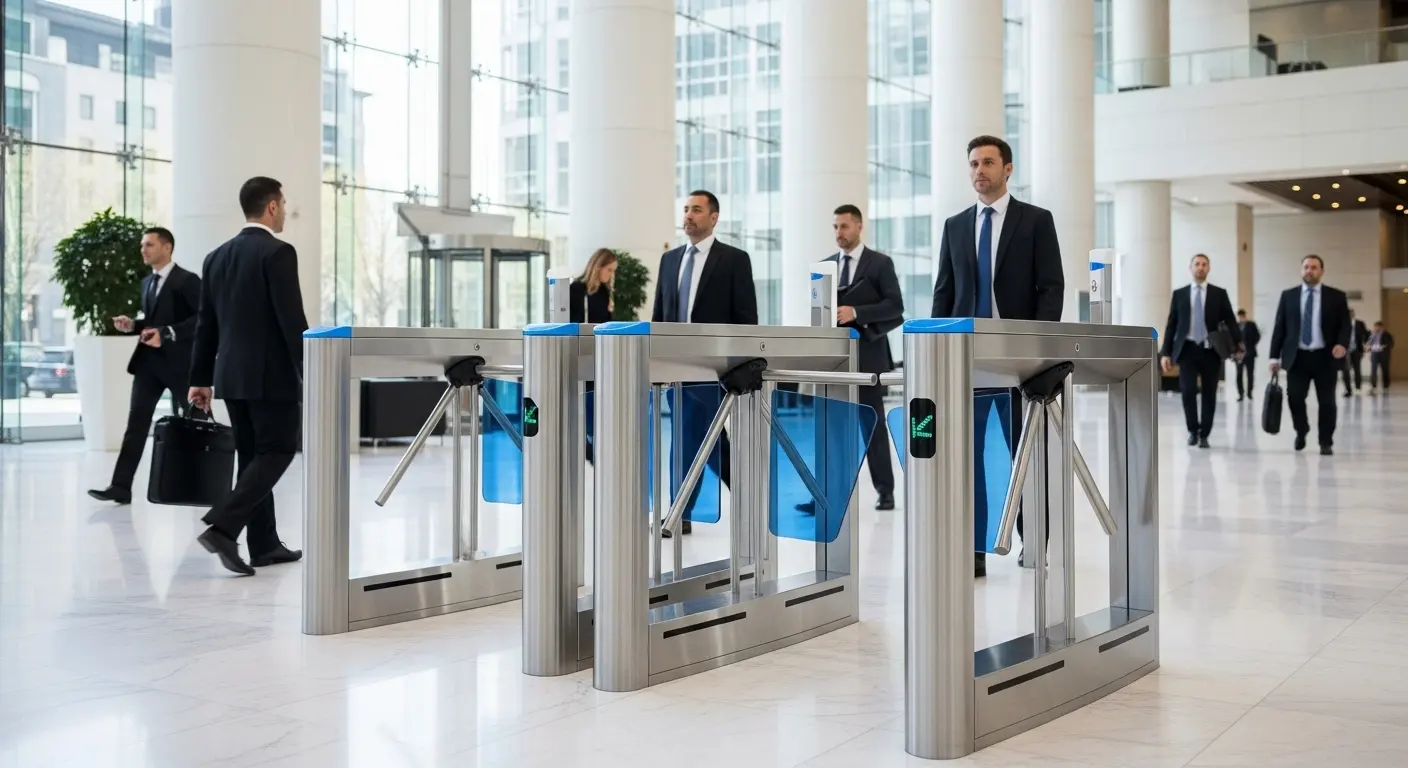
A standard-grade commercial tripod turnstile with brushed SUS304 panels and clean LED indicators looks entirely appropriate in most corporate lobbies. However, premium office towers and branded commercial complexes often require a higher visual standard.
Turboo's full automatic LB123 model addresses this directly — the blue tempered glass covers over the arm assembly distinguish it from standard industrial-style gates and signal a premium entry experience consistent with Class A office building standards.
For even higher aesthetic requirements — reception-level entries, luxury hotel lobbies, or financial services buildings — Turboo's flap barrier range provides a step up in visual refinement. The flap barrier specifications page covers material grades, opening speed, and integration options for premium lobby applications where a tripod gate may not match the design brief.
Maintenance Schedule for a Commercial Tripod Turnstile
A well-maintained commercial tripod turnstile runs without intervention for years. Here is the schedule that maximizes service life:
Monthly:
- Visual inspection of arm condition and LED indicators
- Wipe-down of cabinet surfaces with non-abrasive stainless steel cleaner
- Check control board indicator for error codes
Every 6 Months:
- Lubricate the mechanism core (main gear, transmission shaft, spring assembly) with the manufacturer-specified grease
- Inspect and re-torque floor anchor bolts
- Test fail-safe drop-arm function with a deliberate power interruption
Annually:
- Full control board inspection — check all terminal connections for corrosion or loosening
- Firmware version check — update if a new release is available
- Arm alignment check — re-centre if deviation from 120° spacing is detected
For a full installation and commissioning checklist that feeds into this maintenance routine, Turboo's turnstile installation guide covers pre-installation, commissioning, and first-service procedures in full detail.
Commercial buyers sourcing through a regional channel can access Turboo's verified Turboo turnstile dealer network for local purchasing, installation support, and ongoing service in key international markets.
FAQ: Commercial Tripod Turnstile
What is a commercial tripod turnstile?
A commercial tripod turnstile is a waist-height, three-arm access control gate engineered specifically for the daily traffic volumes, aesthetic standards, and integration requirements of commercial buildings — office towers, corporate campuses, retail complexes, and multi-tenant properties. Commercial-grade units feature SUS304 cabinet construction, brushless motor mechanisms rated for 3–5 million arm cycles, low-noise operation, and open communication protocols for building management system integration.
How do I choose between a semi-automatic and full automatic commercial tripod turnstile?
For main lobby entry points with peak rush hour traffic above 1,000 persons per hour per lane, a full automatic model is the better choice — it processes 35–50 persons per minute versus 25–35 for semi-automatic. For lower-volume staff entrances, service doors, and secondary access points, a semi-automatic model delivers the same security at lower cost and with simpler maintenance.
Can a commercial tripod turnstile integrate with visitor management software?
Yes. Turboo's commercial turnstile control boards support RS485 communication and dry contact input, allowing direct integration with all major visitor management platforms. QR code visitor passes, temporary PIN access, and face recognition for pre-registered guests all operate through the same control board without secondary hardware.
How many tripod turnstile lanes does a commercial building need?
Calculate peak hourly footfall divided by the gate's pass rate per hour. Always add one lane beyond the minimum calculation for redundancy. A 1,500-person-per-hour peak with full automatic gates (2,500 passes per hour per lane) requires a minimum of one lane — but a two-lane configuration is recommended for operational continuity.
What maintenance does a commercial tripod turnstile require?
Monthly visual checks and surface cleaning, six-monthly mechanism lubrication and anchor bolt re-torque, and an annual control board inspection with firmware review. With this schedule, a quality SUS304 commercial unit consistently achieves 10+ years of service without major component replacement.
How loud is a commercial tripod turnstile in an office lobby?
Turboo's brushless motor models operate at or below 45dB — below typical office ambient noise of 50–60dB. In a busy lobby environment, the gate is effectively inaudible against background sound levels.