


Biometric Tripod Turnstile: What Security Managers Need to Know Before Specifying One

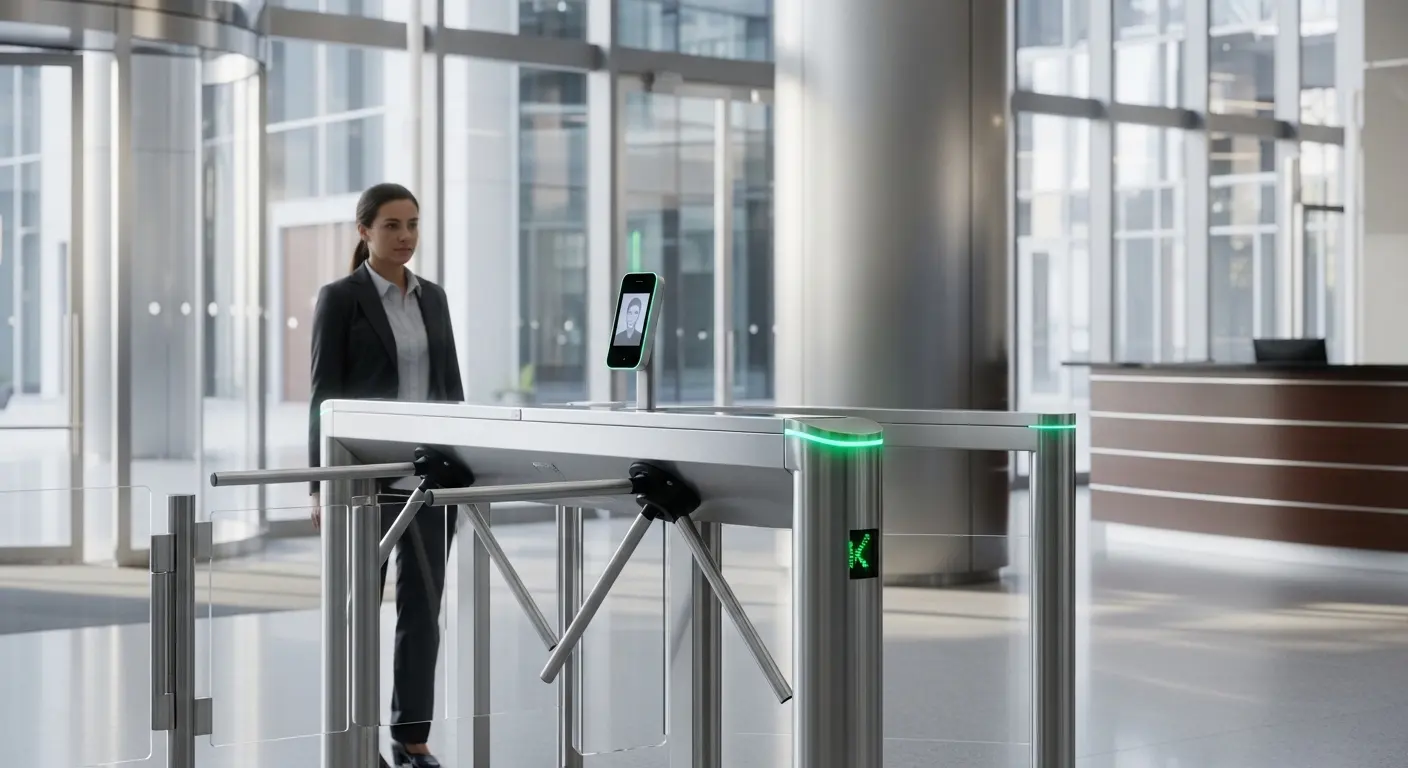
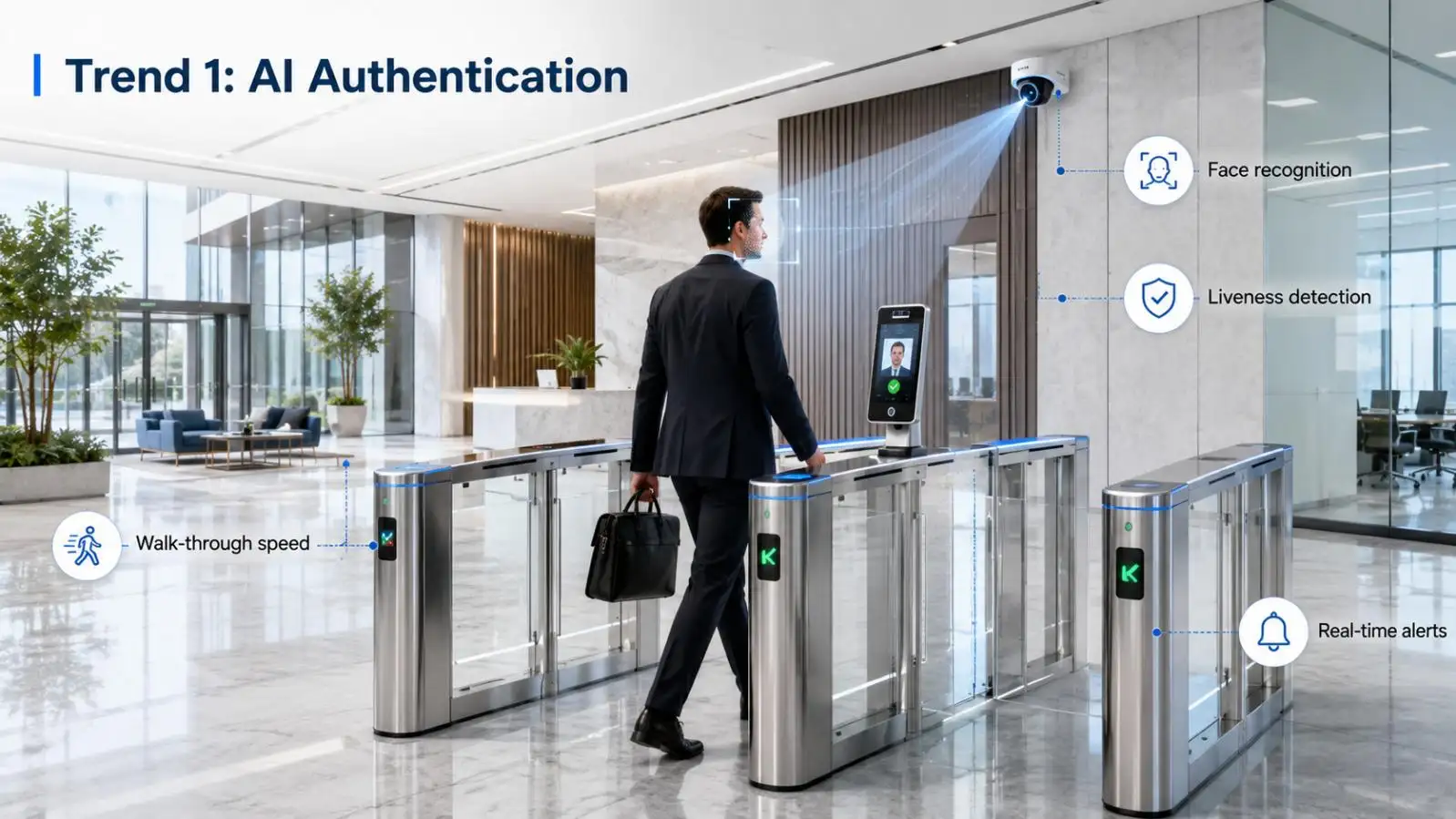
A biometric tripod turnstile solves the problem that RFID cards cannot: it ties access rights to a physical characteristic that cannot be transferred, cloned, or forgotten. Card sharing between colleagues, proxy check-ins, and tailgating after a tap are the three most common credential fraud patterns in workplaces — and all three are structurally impossible when the credential is a fingerprint or a face.
However, specifying a biometric tripod turnstile correctly requires answering four questions before purchasing: Which biometric type fits your facility? Does the reader include liveness detection? How does biometric data storage comply with privacy regulations? And how does the system integrate with your existing attendance or HR platform?
This guide answers all four — in the order a security manager needs them. For Turboo's full tripod turnstile range, explore our tripod turnstile product category first.
How a Biometric Tripod Turnstile Works
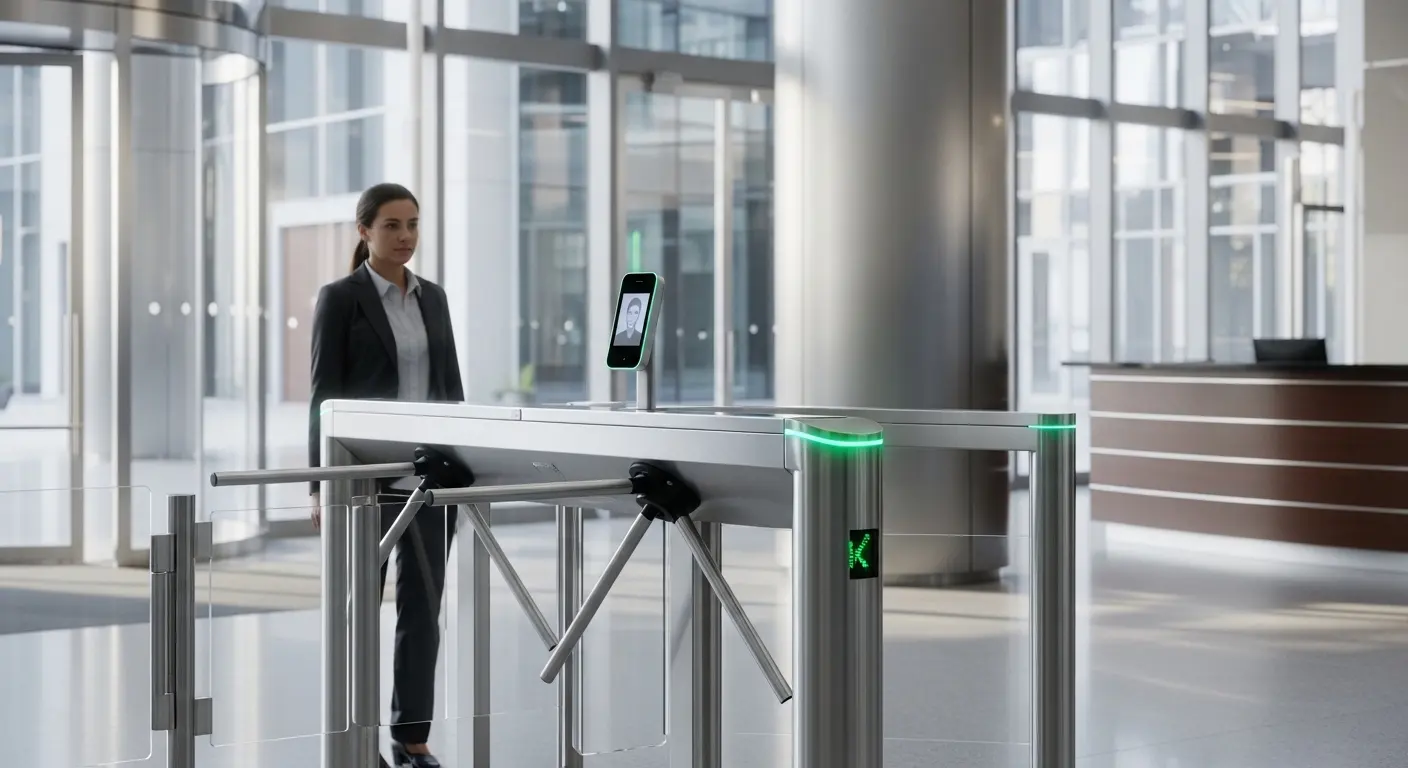
A biometric tripod turnstile authenticates identity by capturing a physical characteristic at the reader, matching it against a stored enrollment template, and rotating the arm in under 0.5 seconds if the match is confirmed.
Steps 1–4: Capture to Verification
The process from user arrival to gate open runs as follows:
- The user approaches the gate — the biometric reader activates automatically (camera, fingerprint sensor, or iris scanner depending on the configured modality).
- The reader captures the biometric sample — a face image, fingerprint scan, or iris pattern.
- The controller runs a 1:N match against stored enrollment templates in the access control database.
- A confirmed match sends an unlock signal — the arm rotates and one person passes through.
Steps 5–6: Response and Logging
- No match keeps the arm locked. An alert activates. An optional fallback credential — RFID card or PIN — can be prompted at the gate.
- The entry is logged with a timestamp, verified identity, and zone assignment. This data feeds attendance or HR platforms automatically.
The key security differentiator is structural: the credential lives in the person, not in an object. Therefore, no one can hand their access rights to a colleague — even intentionally.
In our experience deploying biometric tripod turnstiles at corporate offices, the most common question from security managers before purchase is not whether biometrics are more secure than cards. It is whether liveness detection is included as standard.
Biometric Types on a Tripod Turnstile: Fingerprint, Facial Recognition, Iris, and Palm Vein
The four main biometric types for tripod turnstile applications are fingerprint, facial recognition, iris scanning, and palm vein — each with different speed, accuracy, cost, and contactless characteristics.
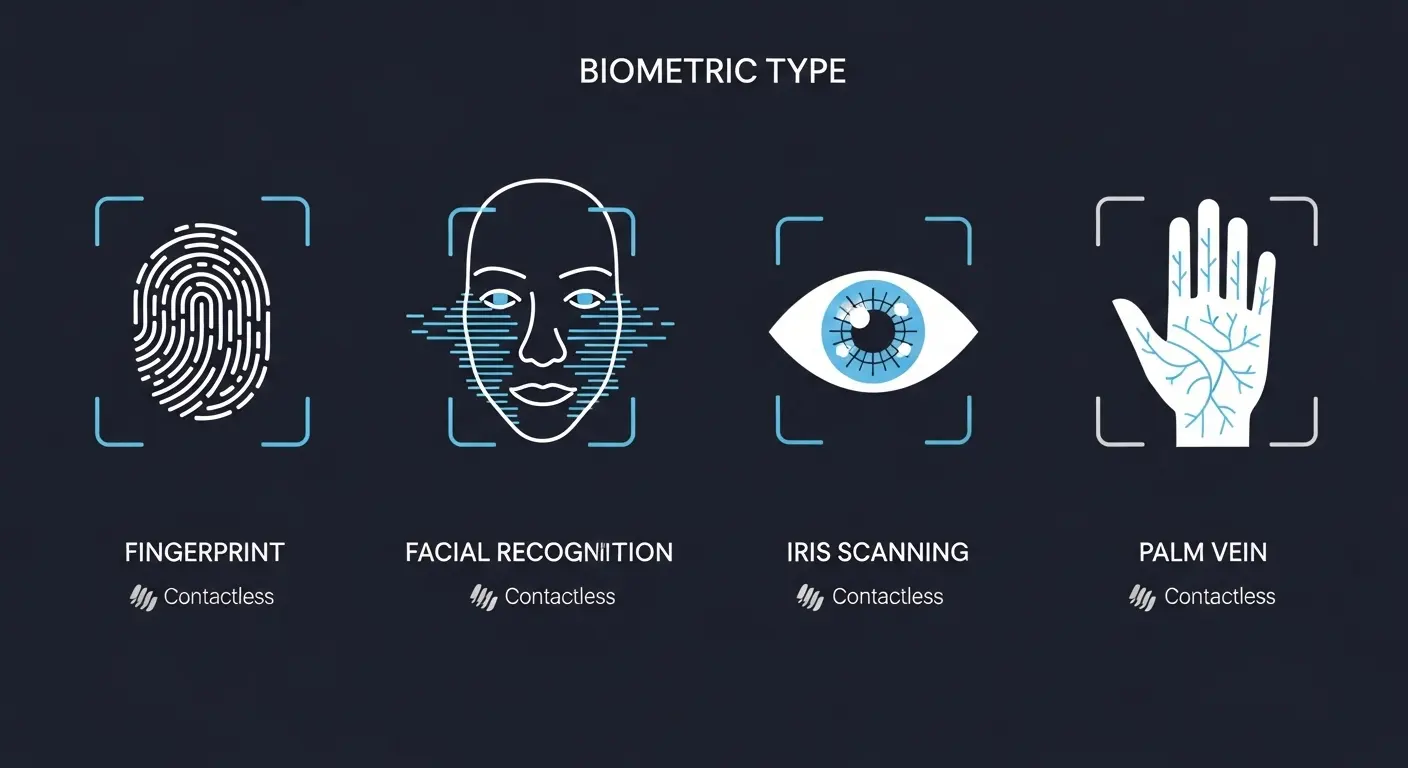
Biometric Type Comparison
| Biometric Type | Speed | Contactless | Accuracy | Cost | Best For |
|---|---|---|---|---|---|
| Fingerprint | < 0.5 sec | ❌ Touch required | 99.9%+ | Low | Offices, factories, gyms |
| Facial Recognition | < 0.3 sec | ✅ Fully contactless | 99%+ | Medium | Transit, campuses, stadiums |
| Iris Scanning | < 1 sec | ✅ Near-contactless | Highest | High | Government, data centers |
| Palm Vein | < 0.5 sec | ✅ Near-contactless | Very high | Medium-High | Hospitals, hygiene-critical sites |
When to Use Each Type
Fingerprint is the most widely deployed biometric on tripod turnstiles globally. It offers the lowest cost per gate and the fastest enrollment process. However, it is not suitable where gloves are worn routinely or where hygiene protocols prohibit contact with a shared surface.
Facial recognition is the dominant choice for high-volume public-facing deployments. It requires no physical contact and works in varied lighting conditions. Turboo's fingerprint access turnstiles cover fingerprint-specific configurations in detail — facial recognition models are available alongside these.
Iris scanning delivers the highest accuracy of any biometric modality. It suits government buildings, financial facilities, and data centers where a false accept rate near zero is a compliance requirement.
Palm vein is preferred in hospitals and food production environments. It is fully contactless, highly accurate, and certified for hygiene-critical settings where touching a shared surface is prohibited.
Additionally, a multi-modal configuration — where one gate supports facial recognition, RFID, and QR simultaneously — is the strongest choice for facilities that serve both long-term staff and variable visitors.
Is a Biometric Tripod Turnstile More Secure Than RFID?
Yes — a biometric tripod turnstile is more secure than RFID because the credential is a physical characteristic that cannot be transferred, copied, or forgotten. RFID cards can be cloned, shared, or lost.
Credential Security Comparison
| Security Factor | Biometric | RFID Card | QR Code |
|---|---|---|---|
| Can be shared | ❌ Never | ✅ Card can be passed | ✅ Screenshot shareable |
| Can be cloned | ❌ No | ✅ Card skimming | Partial (static QR) |
| Can be lost or forgotten | ❌ No | ✅ Yes | ✅ Phone needed |
| Proxy check-in possible | ❌ No | ✅ Yes | Partial |
| Requires hardware to carry | ❌ No | ✅ Yes | Phone required |
What Biometrics Actually Closes
Biometric authentication eliminates three specific RFID failure modes: card sharing between colleagues, cloned card attacks via proximity skimming, and proxy check-ins where one employee badges in on behalf of another.
However, biometrics does not eliminate tailgating. The three-arm mechanism still closes immediately after each valid cycle — but a second person can still attempt to follow through the same opening. Therefore, anti-tailgating infrared beam sensors remain essential alongside biometric readers on any high-security gate.
The Security Industry Association identifies biometric authentication as the highest-confidence credential tier in access control system design — above card, PIN, and mobile credentials combined.
Liveness Detection: Why Anti-Spoofing Is Non-Negotiable
Liveness detection — also called anti-spoofing — is the ability of a biometric reader to distinguish a real, live person from a photograph, video, 3D mask, or silicone replica. Without it, a printed photo can bypass a facial recognition system.
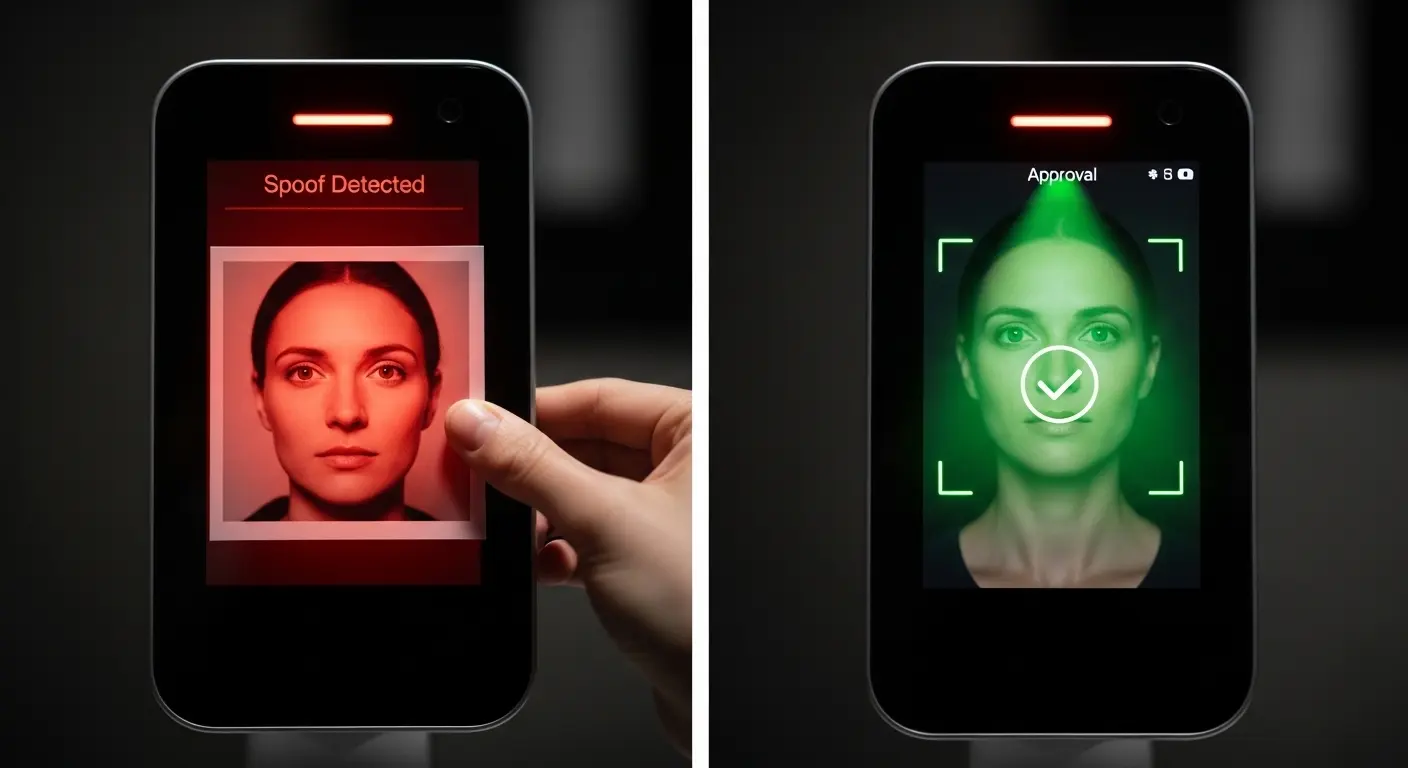
2D vs. 3D Liveness Detection
Two levels of liveness detection exist in commercial biometric readers:
2D liveness detection analyzes the biometric sample for signs of life — blinking, skin texture, micro-movement. It blocks most casual spoofing attempts but is vulnerable to high-quality printed photographs or video playback.
3D liveness detection uses depth sensors or infrared facial mapping to confirm physical volume. It cannot be fooled by any flat image. This is the minimum standard for any security-sensitive deployment.
For fingerprint readers, liveness detection checks for pulse, skin elasticity, and moisture — confirming that the fingerprint belongs to a living person present at the gate, not a silicone replica or lifted print.
What to Ask Before Purchasing
Always ask suppliers specifically: "Does this unit include 3D liveness detection or 2D detection only?" A 2D-only facial recognition system is not appropriate for any facility where physical security is the primary purpose of the installation.
In our experience, the liveness detection question resolves most procurement delays immediately. Once buyers confirm that 3D anti-spoofing is included as standard, the remaining objections shift to compliance and integration — both of which are addressable.
Biometric Data Privacy and Compliance: What Facility Managers Must Address
Biometric data is not the same as an RFID card number. It is classified as special category data under GDPR Article 9 — requiring explicit user consent, a legitimate processing basis, and a documented data minimization approach.
Two Storage Models and Their Compliance Implications
On-device template storage keeps the biometric template on the turnstile controller or on a smart card carried by the user. The data never leaves the device. This is the simplest GDPR compliance path. No central database stores personal biometric data. Therefore, breach risk and regulatory exposure are both minimized.
Centralized server storage stores templates in a database accessible across multiple gates. This requires a full Data Protection Impact Assessment (DPIA), encryption at rest and in transit, access controls, and a defined retention and deletion policy.
Best Practice for Most Deployments
For the majority of facilities, on-device template storage with no biometric image retained after enrollment is the recommended approach. Only a mathematical template is stored — this cannot be reverse-engineered to reconstruct a face or fingerprint.
Additionally, always inform users clearly that biometric data is collected. Gate signage and an enrollment consent process are both required under GDPR and most national biometric privacy frameworks. Check local laws separately — Illinois BIPA (USA) and China PIPL both impose additional requirements beyond GDPR.
Turboo's biometric turnstile models store enrollment templates on the local controller. Biometric images are not retained after template generation.
Which Biometric Tripod Turnstile Fits Your Environment?
The correct biometric type and hardware configuration depend on your facility. Here is how to match both to four common scenarios.
Corporate Office and Government Building
Facial recognition is the standard recommendation for offices and government buildings. It is fast, fully contactless, and requires no physical action from the user after initial enrollment. A multi-modal configuration — face + RFID + QR — covers employees, contractors, and visitors on one gate.
Anti-tailgating sensors are critical in corporate environments. Morning peak entry concentrates the highest tailgating risk. Integration connects the turnstile controller to HR attendance platforms via TCP/IP or open API — no manual export needed.
University and Corporate Campus
Multi-modal configuration is the standard for campuses. Students use facial recognition on their phone-linked credentials; contractors and short-term visitors use RFID or QR. Time-zone scheduling restricts lab and server room access to authorized hours automatically.
Multi-building deployments run on a single centralized access management platform. Emergency drop-arm behavior must be confirmed — arms must release automatically on fire panel signal. For high-volume campus gates, see Turboo's heavy duty tripod turnstile models, rated to a 10 million throughput cycle design life.
Industrial Facility, Factory, and Warehouse
Fingerprint is the standard for indoor industrial environments where gloves are not worn. Palm vein covers gloved environments and chemical handling areas. High-security zones — server rooms, chemical storage — benefit from biometric + RFID two-factor authentication.
Integration connects to factory time-and-attendance and shift management software via Wiegand or RS485. For outdoor perimeter gates on industrial sites, see Turboo's outdoor turnstile gate range for IP-rated configurations.
Hospital and Healthcare Facility
Palm vein is the preferred biometric for hospitals. It is fully contactless, hygiene-certified, and requires no surface contact at the reader. Restricted zone access — pharmacy, ICU, laboratory — benefits from palm vein or iris accuracy levels.
Staff shift tracking integrates directly with hospital workforce management platforms. IP-rated hardware is required for areas where regular disinfectant cleaning is standard practice. Confirm the IP rating of both the gate housing and the biometric reader module separately.
How Biometric Data Flows From Gate to Your Systems
The integration path for a biometric tripod turnstile uses the same protocols as RFID and QR — RS485, TCP/IP, or Wiegand — with one additional step: the enrollment workflow.
Enrollment Workflow
Each user's biometric characteristic is captured once during an enrollment session. A mathematical template is generated and stored on the controller or in the access control database. No image is retained after this step. In our experience integrating Turboo biometric tripod turnstiles with HR platforms, enrolling 100 employees takes approximately 2–3 hours with a single enrollment station.
Live Operation and Data Output
During normal operation, each gate scan matches the live biometric sample against the stored template. No image is transmitted or stored. The controller sends a timestamped entry record tied to the verified identity — feeding attendance, payroll, and compliance dashboards in real time.
Real-time sync is required for anti-passback enforcement across multiple gate lanes. Batch sync is acceptable for single-gate low-security deployments. The NIST Biometric Evaluation Program publishes standardized performance metrics for commercial biometric systems — useful when evaluating supplier accuracy claims during procurement.
For a specification consultation or project quotation, Turboo's tripod turnstile quotes page provides a direct path to the access control team.
Frequently Asked Questions
Q1: How does a biometric tripod turnstile work?
A biometric tripod turnstile works by capturing a physical characteristic — fingerprint, face, iris, or palm vein — at the gate reader, matching it against a stored enrollment template in under 0.5 seconds, and rotating the three-arm mechanism to admit one person if the match is confirmed. No card or PIN is required. The credential cannot be transferred to another person because it is a physical characteristic of the enrolled user. An invalid or unrecognized biometric keeps the arm locked and triggers an alert.
Q2: What is the difference between fingerprint and facial recognition on a tripod turnstile?
Fingerprint requires the user to place their finger on a sensor — it is the lowest-cost biometric option with 99.9%+ accuracy for commercial-grade readers. Facial recognition is fully contactless — the user simply approaches the gate and the camera identifies them automatically, making it the better choice for high-volume entry points where speed and minimal friction matter most. Fingerprint suits fixed employee populations in indoor environments; facial recognition suits transit hubs, campuses, and stadiums. Both can be installed on the same multi-modal tripod turnstile gate.
Q3: Is a biometric tripod turnstile more secure than RFID?
Yes — a biometric tripod turnstile is more secure than RFID because biometric credentials are tied to a physical characteristic that cannot be shared, cloned, or forgotten. RFID cards can be handed between colleagues for proxy check-in, cloned via proximity skimming devices, or simply lost. Biometrics eliminates all three failure modes structurally. However, biometrics does not eliminate tailgating — anti-tailgating infrared sensors remain essential on any high-security gate regardless of the credential type used.
Q4: What is liveness detection and why does it matter for biometric turnstiles?
Liveness detection is the ability of a biometric reader to confirm that the biometric sample comes from a real, live person — not a photograph, video, 3D mask, or silicone replica. Without liveness detection, a high-quality printed photo can bypass a facial recognition system. Commercial-grade biometric tripod turnstile readers should include 3D liveness detection as standard — 3D detection uses depth mapping to confirm facial volume and cannot be deceived by any flat image. Always ask the supplier whether their reader uses 2D or 3D liveness detection before purchasing.
Q5: How is biometric data stored — and is it GDPR compliant?
Biometric data is classified as special category data under GDPR Article 9, requiring explicit consent and data minimization. The most GDPR-compliant approach for tripod turnstile deployments is on-device template storage — the mathematical biometric template is stored on the turnstile controller or a user's smart card, no biometric image is retained, and data never enters a central database. Centralized database storage is permissible but requires a full Data Protection Impact Assessment (DPIA), encryption, and a documented retention and deletion policy. Additionally, check local national frameworks — BIPA in Illinois (USA) and PIPL in China impose requirements beyond GDPR.
Conclusion
Three decisions determine whether a biometric tripod turnstile deployment succeeds. First, match the biometric type to your facility and user population before ordering hardware — facial recognition for high-volume contactless environments, fingerprint for cost-sensitive fixed staff, palm vein for hygiene-critical or gloved environments. Second, confirm 3D liveness detection is included as standard — this is the single technical feature that separates a genuinely secure system from a vulnerable one. Third, resolve the data storage model before procurement begins — on-device template storage removes the GDPR compliance obstacle immediately and shortens the procurement approval process significantly.
A correctly specified biometric tripod turnstile eliminates credential fraud, automates attendance data capture, and removes the operational cost of card issuance and replacement permanently.
To specify the right biometric tripod turnstile for your facility, request a configuration consultation via Turboo's tripod turnstile quotes page — our access control team will match the biometric type and model to your exact environment.