


Smart Pedestrian Turnstile Gate for Offices: Mobile Credential Access for Frictionless Entry

Smart Pedestrian Turnstile Gate for Offices is no longer judged only by lane speed, cabinet finish, or basic badge reading. For many overseas buyers, the harder question is whether the entrance system can support mobile credential access without creating user friction, upgrade headaches, or integration risk with the wider access control platform. That challenge matters more now because office security is moving toward hybrid-cloud management, touchless entry, and identity-driven workflows.
The Real Pain Point: Legacy Credentials Slow Down Modern Offices
Many office buildings still operate with a mix of physical cards, temporary visitor passes, reception-issued badges, and separate tenant workflows. That may work at a basic level, but it often creates delays at the entrance and extra administration behind the scenes. Lost cards, slow issuance, revalidation work, and uneven visitor handling can all weaken the user experience.
This is exactly why mobile credential access is becoming more attractive. HID notes that mobile credentials stored on smartphones or smart watches support contactless access through NFC or Bluetooth Low Energy, while also making issuance, revocation, and modification easier to handle remotely. HID also highlights the security advantage of stronger encryption and the option to combine mobile access with PIN or biometrics for stronger authentication.
For office buyers, the implication is clear: a turnstile should not be treated as a stand-alone barrier. It should act as a credential-ready entry point that fits how employees, tenants, contractors, and visitors already move through a modern workplace.
Why Mobile Credential Access Matters More in 2026
The office environment has changed. Security teams now need to protect the lobby, reduce unauthorized entry, and keep movement smooth at peak hours. At the same time, building operators want better oversight, easier multi-site control, and fewer manual processes.
Genetec's 2026 industry outlook says organizations are favoring hybrid-cloud deployments so they can keep certain infrastructure on premises while gaining faster rollout, easier updates, and improved feature access. The same outlook also shows growing interest in applying access control data to operations, including occupancy, congestion, and broader business workflows.
LenelS2 similarly points to rising demand for touchless access, unified security platforms, and AI-powered automation that can detect abnormal access patterns and support faster incident response.
For office projects, that means a buyer is not only selecting a gate. They are selecting a front-end device that should support:
• Mobile credentials alongside existing cards during transition periods
• Visitor and tenant workflows with less reception dependency
• Integration with access control, video, and analytics platforms
• Smoother passage without compromising anti-tailgating logic
The Feature That Changes the Buying Decision
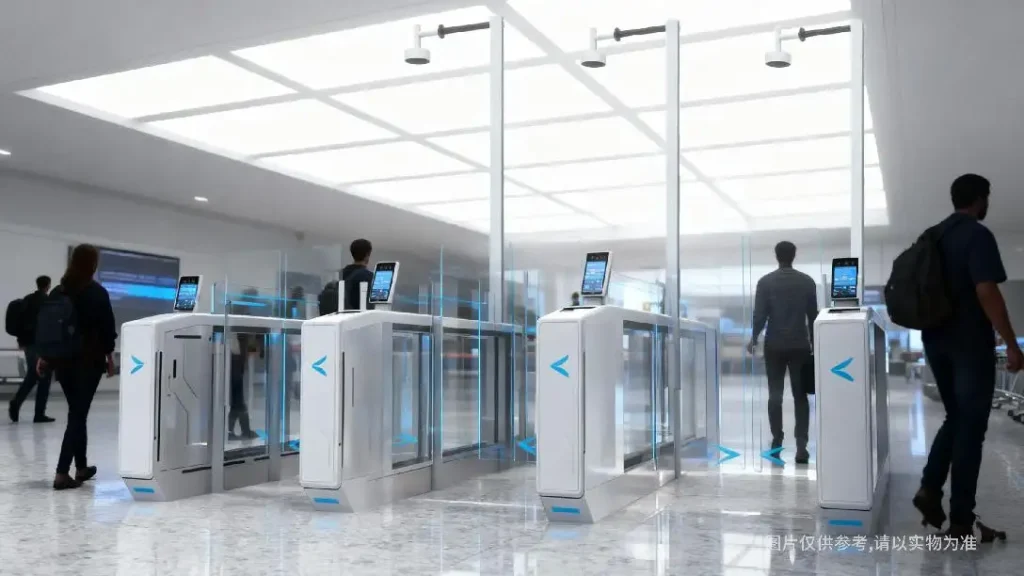
The most compelling feature in this category is not simply touchless opening. It is flexible credential compatibility built into a smart pedestrian turnstile gate for offices.
A mobile-first office rarely becomes mobile-only overnight. Most projects pass through a mixed stage where some users still depend on cards, while others use phone-based credentials or QR-based visitor access. A turnstile that supports this transition is far more valuable than one designed around a single authentication method.
This is where Turboo is well aligned with current market direction. Turboo is a specialist focused on intelligent pedestrian access control since 2006, with a dedicated R&D team, testing laboratory, quality control center, and broad support for applications such as visitor management, access control, and time and attendance. Turboo also focus on solutions for commercial buildings and smart entrance scenarios, which fits office deployment needs well.
For buyers, this specialization is relevant as office entry projects usually incorporate:
•Lane control: Good lane control allows for the regulation of pedestrian movements, discourages crossings, and maintains the order of entrances to offices during bus traffic.
•Credential reader integration: Integration of credential readers allows turnstile readers to process mobile credentials, access cards, QR codes, and other forms of authentication as part of a single access control system.
•Visitor logic: Visitor logic assists in the management of time-limited, schedAuled authorizations, and reception management in the case of visitors, contractors, and delivery personnel.
•Safety sensing: Safety sensing monitors pedestrian movement in real time to reduce accidental contact, improve user protection, and support safe gate operation.
•Long-term maintenance consistency: Long-term maintenance consistency helps maintain reliable performance, simpler servicing, and more controlled operating costs over time.
A manufacturer that stays focused on pedestrian access equipment is often better positioned to support those practical requirements.
How Turboo Fits Current Office Security Trends
Turboo's value in this topic is not about chasing trends for marketing language. It is about matching real project demands.
From an office procurement perspective, a strong smart pedestrian turnstile gate for offices should help solve four current problems.
•Faster Entry Without Losing Control
Mobile credential access removes the repeated friction of card presentation, badge replacement, and manual pass issuance. HID also points out that digital credentials simplify lifecycle management and reduce reliance on plastic cards and printer consumables.
•Better Support For Hybrid Security Architecture
As hybrid-cloud deployments become more common, buyers need entrance hardware that can work with evolving access ecosystems rather than locking them into a narrow pathway. Organizations want access control and video in one platform, whether cloud or on-prem, and want support for mobile credentials and biometrics where appropriate.
•Cleaner Office Experience For Employees And Visitors
The touchless systems and unified platforms improve convenience while reducing operational complexity. In office lobbies, that translates into smoother first impressions, easier visitor handling, and less queue formation during busy periods.
•Better Long-Term Upgrade Logic
The wrong turnstile can create a bottleneck when a client later wants to add visitor QR flows, phone credentials, or tighter analytics. The right one gives the project room to evolve.
What Overseas Buyers Should Evaluate
When sourcing a smart pedestrian turnstile gate for offices, overseas buyers should look beyond appearance and opening speed. A better evaluation framework is:
•Can the lane support a practical migration from physical badges to mobile credentials?
•Can it integrate cleanly into a unified office access strategy?
•Can it reduce reception burden while improving user flow?
•Can the manufacturer support customization, testing, and deployment consistency for commercial buildings?
These questions are increasingly important because access control is becoming a business operations tool, not just a lobby checkpoint.
A Smarter Standard for Office Entry
The best smart pedestrian turnstile gate for offices is no longer defined by barrier mechanics alone. It is defined by how well it supports mobile credential access for frictionless entry while remaining secure, adaptable, and easy to integrate into modern office infrastructure.
That is why this topic resonates with today's buyers. They are not only buying a gate. They are buying a smoother credential experience, a more future-ready entrance strategy, and a better bridge between physical security and workplace operations. By concentrating on smart pedestrian access control, commercial building use cases, and products built for easier system collaboration, Turboo remains in step with today's market trends.