


Anti-Tailgating Tripod Turnstile: How Detection Works and When It's Enough


An anti-tailgating tripod turnstile stops unauthorized followers at your facility's entry point through two independent mechanisms: a physical three-arm barrier that structurally enforces one-person-per-cycle passage, and an infrared sensor array that electronically detects a second person and triggers an immediate re-lock. Security managers need to understand both — because the physical mechanism alone deters casual tailgating, while the sensor system handles the close-following attempts that a passive arm cannot catch.
This article walks through the exact detection logic, three real tailgating scenarios, and the gate comparison question that most procurement teams ask last: is a tripod turnstile's anti-tailgating mechanism sufficient, or is a flap barrier or full-height gate required?
For Turboo's complete tripod turnstile product range, see our tripod turnstile category. For broader anti-tailgating gate strategy, see our anti-tailgating turnstile guide.
How an Anti-Tailgating Tripod Turnstile Detects a Second Person
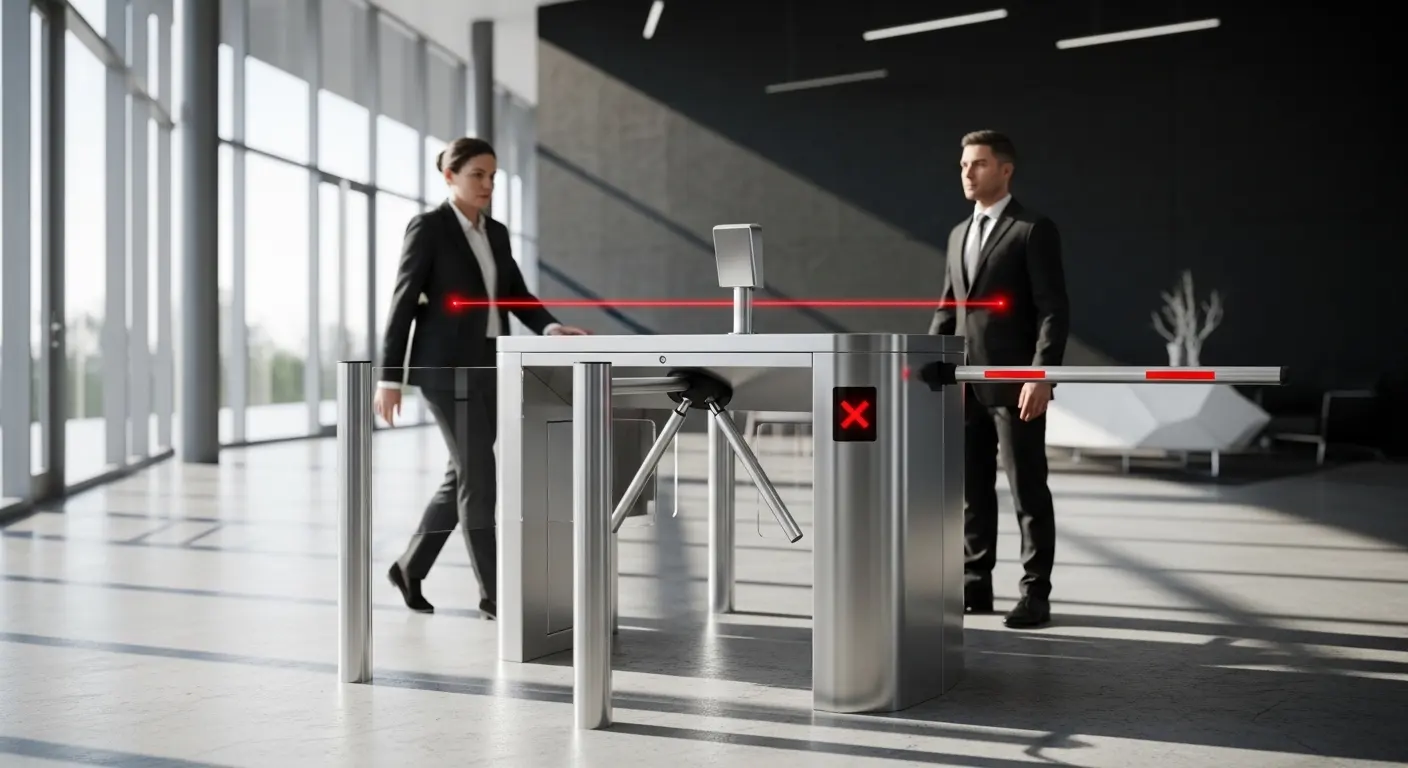
An anti-tailgating tripod turnstile detects a second person using a dual infrared sensor array across the passage lane at torso height. If both beams are interrupted simultaneously during a single credential cycle, the controller identifies a tailgating attempt and re-locks the arm immediately.
The Infrared Sensor Array: What It Detects and How
The sensor array positions multiple infrared beams across the passage cross-section at different heights. Minimum beam spacing of 20mm ensures detection of close-following behavior — even when the second person attempts to stay directly behind the first person's body.
The detection logic distinguishes between two movement signatures. A single person passing generates sequential beam interruption from the entry side to the exit side. Two people passing generate overlapping beam interruptions that do not match a single-person timing pattern. The controller identifies the difference and responds accordingly.
Importantly, arm reset and sensor detection operate as two independent systems. The arm may have unlocked for Person A. However, if the sensor detects Person B entering the same cycle window, the lock re-engages before the arm completes its full 120° rotation. Therefore, the credential authorization and the physical barrier work together — neither alone is sufficient.
Per Gteksensor's infrared light curtain technical specification, advanced tripod turnstile sensor arrays achieve a maximum detection distance of 8m and a minimum detection height of 160mm — covering the full passage cross-section without dead zones.
What Triggers the Lock, and What Does Not
These inputs trigger an immediate arm re-lock and alarm output:
- Confirmed tailgating: second torso-height beam interruption during an active open cycle
- Forced arm pressure: mechanical overload sensor detects unauthorized force — arm re-locks and alarm fires
These inputs do NOT trigger a false alarm on correctly calibrated systems:
- Large rolling luggage trailing behind a single user: sensor logic identifies the bottom-weighted, continuous interruption as luggage movement — not a second person
- Credential presented but person fails to pass: the gate re-locks automatically after a preset timeout window — no tailgating alarm, but unauthorized access is prevented
What Actually Happens When Someone Tailgates, Three Real Scenarios
The anti-tailgating tripod turnstile responds differently to each tailgating method. Understanding all three scenarios gives security managers the technical evidence needed to justify the hardware investment internally.
Scenario 1 - The Close Follower
Person A presents a valid card. The controller sends an unlock signal. The arm begins its 120° rotation. Person A enters the lane.
Person B follows immediately — less than one arm-length behind. The dual infrared sensors detect simultaneous torso-height interruption during Person A's active cycle window.
The controller identifies the overlapping beam pattern. It sends an arm re-lock signal. The arm halts mid-rotation. The audible alarm activates at the gate. The LED panel switches from green to red. If CCTV is connected, the camera trigger output fires simultaneously.
Person B cannot pass. Person A has already cleared the arm reset zone. The cycle closes.
Scenario 2 - The Luggage User (False Positive Risk)
Person A presents a valid card and enters carrying large rolling luggage behind them. The luggage causes a trailing sensor beam interruption after Person A's torso has already cleared the detection zone.
Advanced sensor logic identifies the interruption pattern as bottom-weighted and continuous with Person A's movement signature. The system classifies it as luggage — not a second person. The gate completes a normal cycle. No alarm fires.
However, older single-beam sensor configurations may flag this as a tailgating event. Sensor beam count and calibration settings directly determine the false positive rate. Always confirm the beam configuration before deployment in high-luggage environments such as transit or hotel reception areas.
Scenario 3 - Aggressive Forced Entry Attempt
Person B attempts to push through the arm before a valid credential is presented. The physical arm mechanism resists. The arm requires a controller unlock signal to rotate — it cannot be pushed through manually under normal operating load.
The mechanical overload sensor activates. The alarm output fires immediately. Additionally, in emergency scenarios — fire alarm activation, power failure — the arm drops automatically. This is a mandatory safety standard across all Turboo anti-tailgating tripod turnstile models. For higher forced-entry resistance in perimeter applications, see Turboo's anti-climbing full height turnstile.
Anti-Tailgating vs. Anti-Reverse: A Distinction Security Managers Miss
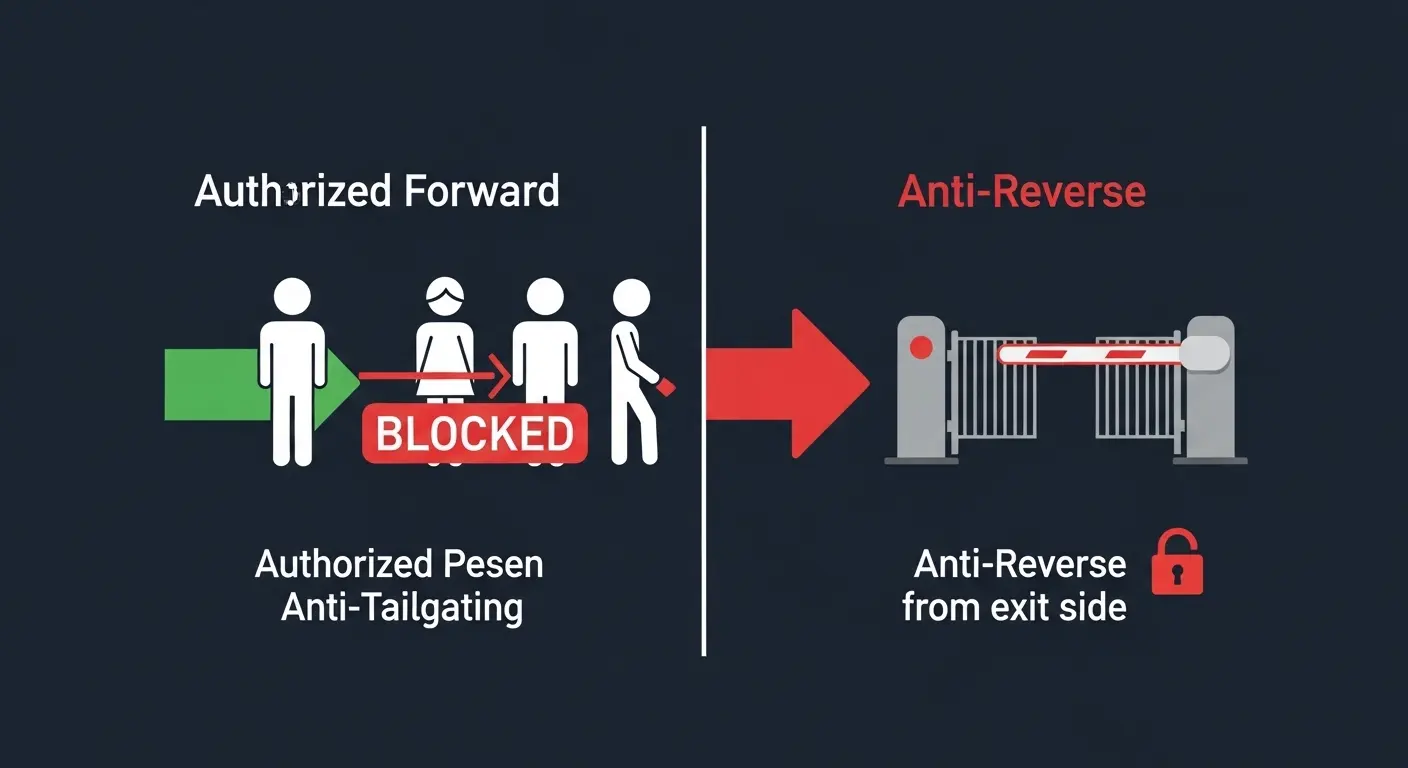
Anti-tailgating detects a second person following an authorized user through the gate in the correct direction. Anti-reverse detects any person attempting to enter the gate from the exit side — moving against the authorized flow. Both are distinct functions and both must be active for complete unauthorized entry prevention.
Detection Direction Comparison
| Detection Type | Direction Monitored | Trigger Condition | System Response |
|---|---|---|---|
| Anti-tailgating | Forward (entry direction) | Second person during single valid cycle | Arm re-lock + alarm |
| Anti-reverse | Backward (exit-to-entry direction) | Any movement against authorized flow | Arm lock + alarm |
Why Disabling Anti-Reverse Creates a Security Gap
A facility that enables anti-tailgating but leaves anti-reverse disabled has a structural vulnerability. Any person can enter through the exit-direction lane without a credential — and the system will not trigger an alarm.
Anti-reverse detection uses directional infrared beam sequencing. If beam interruption order runs exit-to-entry rather than entry-to-exit, the controller triggers an immediate lock. Both functions are enabled by default on Turboo anti-tailgating tripod turnstile models. However, always confirm both are active in the controller settings after installation — particularly after any firmware update or configuration reset.
For broader strategies on reducing unauthorized entry, see Turboo's guide on how to reduce tailgating with turnstiles.
"With Memory" Mode vs. "Without Memory" Mode, Which Is More Secure?
"Without memory" mode is more secure. It requires each person to present a valid credential before the gate unlocks for that individual — enforcing strict one-credential-one-entry. "With memory" mode allows multiple card swipes to queue before the gate opens for each in sequence. This means one valid card batch can open the gate for several people without strict one-for-one validation.
Mode Comparison
| Mode | How It Works | Security Level | Best For |
|---|---|---|---|
| Without Memory | One credential = one arm rotation, no queuing | High | Corporate offices, government buildings, secure zones |
| With Memory | Multiple credentials queue; gate opens for each in sequence | Medium | Busy shift-change periods where queue throughput matters |
Security Risk of "With Memory" Mode
The risk is not theoretical. If employees are permitted — or simply accustomed — to swiping for colleagues ahead of them in a queue, a batch of queued authorizations allows multiple unverified people to pass between card presentations. The sensor system still operates. However, the credential-to-person linkage becomes unreliable.
The recommended default is "without memory" mode for any zone where one-credential-one-entry enforcement is a security requirement. "With memory" mode is appropriate only during specific low-security periods — cafeteria entry, gym access — where throughput matters more than strict validation.
In our experience, leaving "with memory" mode active during high-security phases is the most common anti-tailgating configuration error in corporate office deployments. It is worth reviewing mode settings during every scheduled security audit.
Anti-Tailgating Tripod Turnstile vs. Flap Barrier vs. Full-Height: When Each Is Enough
A tripod turnstile's anti-tailgating mechanism is sufficient for most offices, campuses, gyms, and transit environments where the threat is opportunistic tailgating by unauthorized visitors. A flap barrier or full-height gate is required when the threat model includes determined forced entry, ADA primary-lane accessibility, or a high-security restricted zone where the barrier must be physically unbreachable.
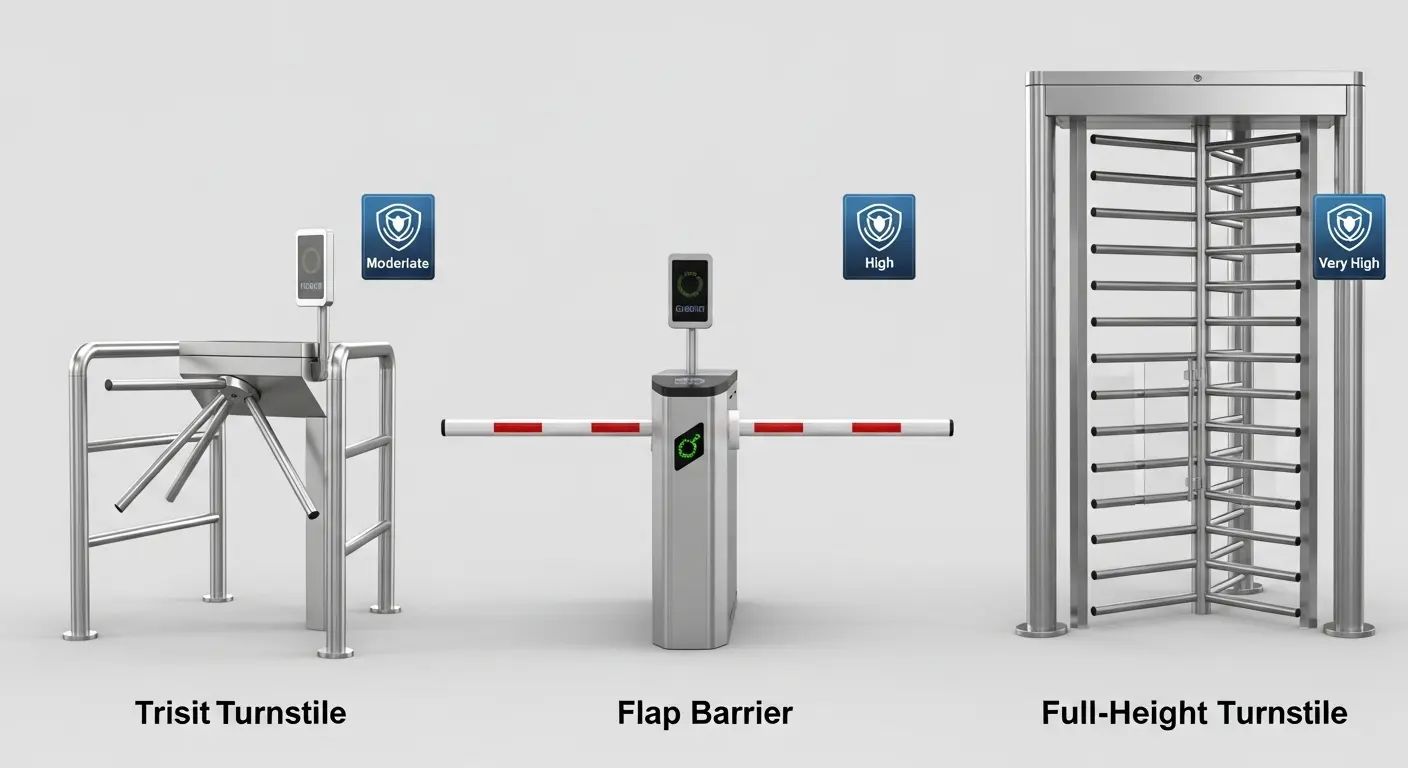
Gate Type Comparison
| Gate Type | Physical Barrier | Anti-Tailgating | Forced Entry Resistance | ADA Compatible | Best For |
|---|---|---|---|---|---|
| Tripod Turnstile | Mechanical arm (waist-high) | ✅ Dual IR sensors | Moderate | ❌ Separate ADA lane needed | Offices, factories, transit, gyms |
| Flap Barrier | Motorized flap panels | ✅ Multi-beam sensors | High | ✅ Wide-lane option | Corporate lobbies, airports, campuses |
| Full-Height Turnstile | Floor-to-ceiling rotor | ✅ Built-in by design | Very High | ❌ | Data centers, military, perimeters |
Matching Gate Type to Threat Level
Choose a tripod turnstile when the threat is social or opportunistic tailgating — colleagues following each other through, unauthorized visitors attempting casual entry, or facilities where physical forced entry is not a realistic scenario.
Upgrade to a flap barrier when lobby aesthetics matter for a corporate reception environment, when ADA compliance is required in the primary entry lane, or when sustained throughput above 30 persons per minute is required.
Upgrade to full-height when physical forced entry is a realistic threat — outdoor perimeter security, industrial sites, data center access, or any zone where a determined person could physically climb over or push through a waist-high mechanism.
For Turboo's high security tripod turnstile configurations and for full-height anti-climbing options, both product pages provide detailed specification comparison. The Security Industry Association publishes physical security barrier standards for each facility type — a useful reference when presenting gate selection to a compliance committee.
Alarm Integration: Connecting Detection to CCTV and Security Desk
The anti-tailgating tripod turnstile's alarm output is only as effective as the system it connects to. A gate that alarms in an unstaffed lobby without a connected monitoring system provides detection — but not response.
Available Alarm Output Types
Four output types are available on standard Turboo anti-tailgating tripod turnstile models:
- Audible alarm: speaker at the gate activates immediately on tailgating detection — effective alert radius of 5–10 meters
- Visual alarm: LED panel switches from green entry arrow to red cross; visible from a security desk sightline in most lobby configurations
- Dry contact relay output: the gate controller's relay connects to any external system that accepts a dry contact input — CCTV trigger, security desk display, BMS alarm panel
- RS485 / TCP/IP event log: every tailgating detection event logs automatically with timestamp and gate ID, feeding security audit dashboards in real time
CCTV Integration Workflow
The gate controller's relay output wires directly to the CCTV system's external trigger input. On tailgating detection, the relay closes. The CCTV camera on the entry lane immediately begins recording and timestamps the event.
The security desk receives a simultaneous alert on the monitoring screen — gate ID, event type, and timestamp — without requiring any staff to watch the feed continuously. Based on Turboo deployments across 100+ countries, facilities with CCTV integration reduce security staff response time to unauthorized entry attempts by 70–80% compared to audio-only alarm configurations.
For tailgating detection methodology and standards context, Avigilon's tailgating and piggybacking security research (Motorola Solutions) provides a widely cited reference on unauthorized entry patterns and detection system requirements.
Frequently Asked Questions
Q1: How does an anti-tailgating tripod turnstile detect a second person?
An anti-tailgating tripod turnstile detects a second person using a dual infrared sensor array positioned across the passage lane at torso height. If both beams are interrupted simultaneously during a single credential cycle — matching the overlap pattern of two people passing rather than one — the controller identifies a tailgating attempt. The arm re-locks immediately and an audible and visual alarm activates. Per Gteksensor's infrared light curtain technical specification, advanced arrays achieve minimum beam spacing of 20mm and maximum detection distance of 8m across the full passage cross-section.
Q2: What happens when someone tailgates through a tripod turnstile?
When the sensor array detects a second person during an active cycle, the arm re-lock signal fires before the arm completes its full 120° rotation. The gate halts mid-cycle. The audible alarm activates at the gate speaker. The LED visual indicator switches from green to red. If CCTV is connected via dry contact relay, the camera trigger fires simultaneously and the security desk receives a real-time alert. The second person cannot pass. The gate resets to locked status for the next credential presentation.
Q3: What is the difference between anti-tailgating and anti-reverse on a tripod turnstile?
Anti-tailgating detects a second person following an authorized user through the gate in the correct entry direction — forward movement from entry to exit side. Anti-reverse detects any person attempting to enter the gate from the exit side against the authorized flow direction. Both are distinct detection functions. A facility that enables anti-tailgating but leaves anti-reverse disabled has a structural entry vulnerability — any person can enter through the exit lane without triggering an alarm. Both functions should always be confirmed as active after installation and after any firmware update.
Q4: What is "with memory" mode vs. "without memory" mode — and which is more secure?
"Without memory" mode requires each person to present a valid credential before the gate unlocks for them individually — one credential equals one arm rotation with no queuing. "With memory" mode allows multiple card swipes to queue before the arm opens for each in sequence. "Without memory" mode is more secure because it enforces strict one-credential-one-entry and prevents one employee from batch-swiping for colleagues. "With memory" mode is appropriate only for low-security high-throughput periods where processing speed matters more than strict individual validation.
Q5: Can a wheelchair or large luggage trigger the anti-tailgating sensor on a tripod turnstile?
Large rolling luggage trailing behind a single user can trigger a false positive on older single-beam sensor configurations. Advanced multi-beam sensor arrays use pattern recognition to distinguish bottom-weighted, continuous movement — characteristic of luggage — from the torso-height overlapping interruption pattern of a second person. Wheelchairs require a separate accessible entry lane or a wide-format gate. Confirm the sensor beam count and calibration settings with the supplier before deploying in environments with high luggage volume or mobility aid users.
Conclusion
Three technical points determine whether an anti-tailgating tripod turnstile will hold up to scrutiny from a security manager or compliance officer. First, the dual infrared sensor array detects close followers at the beam level — not just after they have passed — and re-locks the arm mid-rotation before unauthorized entry is completed. Second, "without memory" mode is the correct default for any facility where one-credential-one-entry enforcement is a documented security requirement. Third, a tripod turnstile's anti-tailgating mechanism is sufficient for the vast majority of office, campus, and transit environments — the upgrade to flap barrier or full-height is only warranted when forced entry resistance or ADA primary-lane compliance is a specific requirement.
Contact Turboo's access control team with your facility type, expected throughput, and current credential system for a tailored anti-tailgating configuration recommendation before specifying hardware.