


Automatic Tripod Turnstile vs. Semi-Automatic: Full Specification and Buyer's Guide

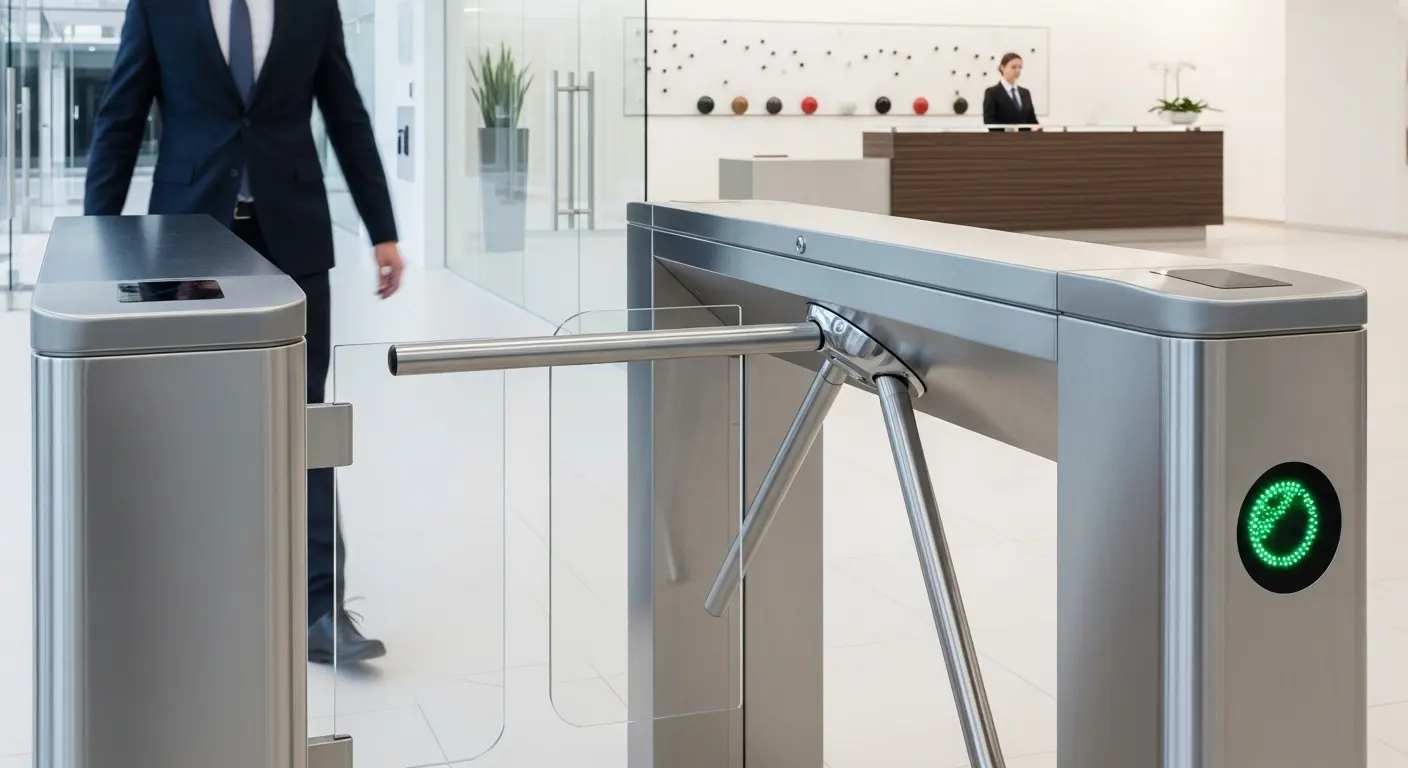
Choosing between an automatic tripod turnstile and a semi-automatic model is a specification decision — not just a budget one. Procurement managers and facility directors need to know exactly what "automatic" means in practice: the arm opens by brushless motor on valid credential, resets within a configurable timeout, and drops safely on power failure. All without any physical push from the user.
This guide covers the full specification comparison — automatic vs. semi-automatic vs. manual, brushless motor ROI, auto-reset timeout logic, safety functions, credential compatibility, outdoor requirements, and facility-type matching. Every section is built to answer the one question buyers ask most: is the automatic model worth the premium for my facility?
For Turboo's complete tripod turnstile product range, including all model tiers and configuration options, visit the product category page.
Automatic vs. Semi-Automatic vs. Manual Tripod Turnstile
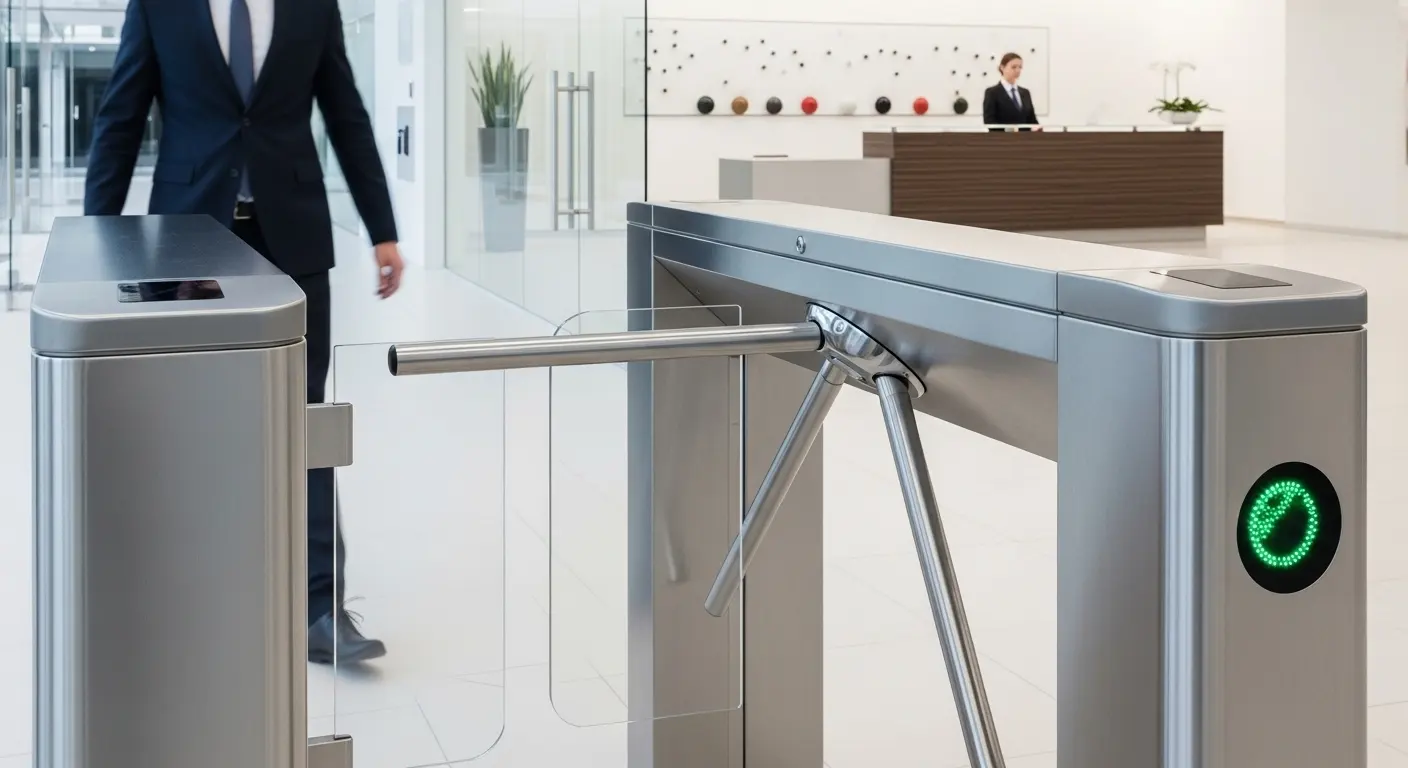
An automatic tripod turnstile opens the arm by motor power on valid credential — no physical force required. A semi-automatic tripod turnstile unlocks electronically, but the user must push the arm through. A manual tripod turnstile operates entirely by physical push with no electronic credential integration.
What Each Tier Actually Does
The automatic model uses a brushless DC motor to drive the full 120° arm rotation. The user approaches, presents their credential, and the arm moves. There is no contact required. The arm resets to locked position automatically within the configured timeout window.
The semi-automatic model releases an electronic lock on valid credential. However, the user still pushes the arm through by hand. The arm returns by spring or gravity. This model still supports RFID and card access — but it lacks the hands-free convenience and brushless motor longevity of the automatic tier.
The manual model has no electronics. It is a push-through mechanism only — suitable for free-flow, low-security zones where access logging and credential control are not required.
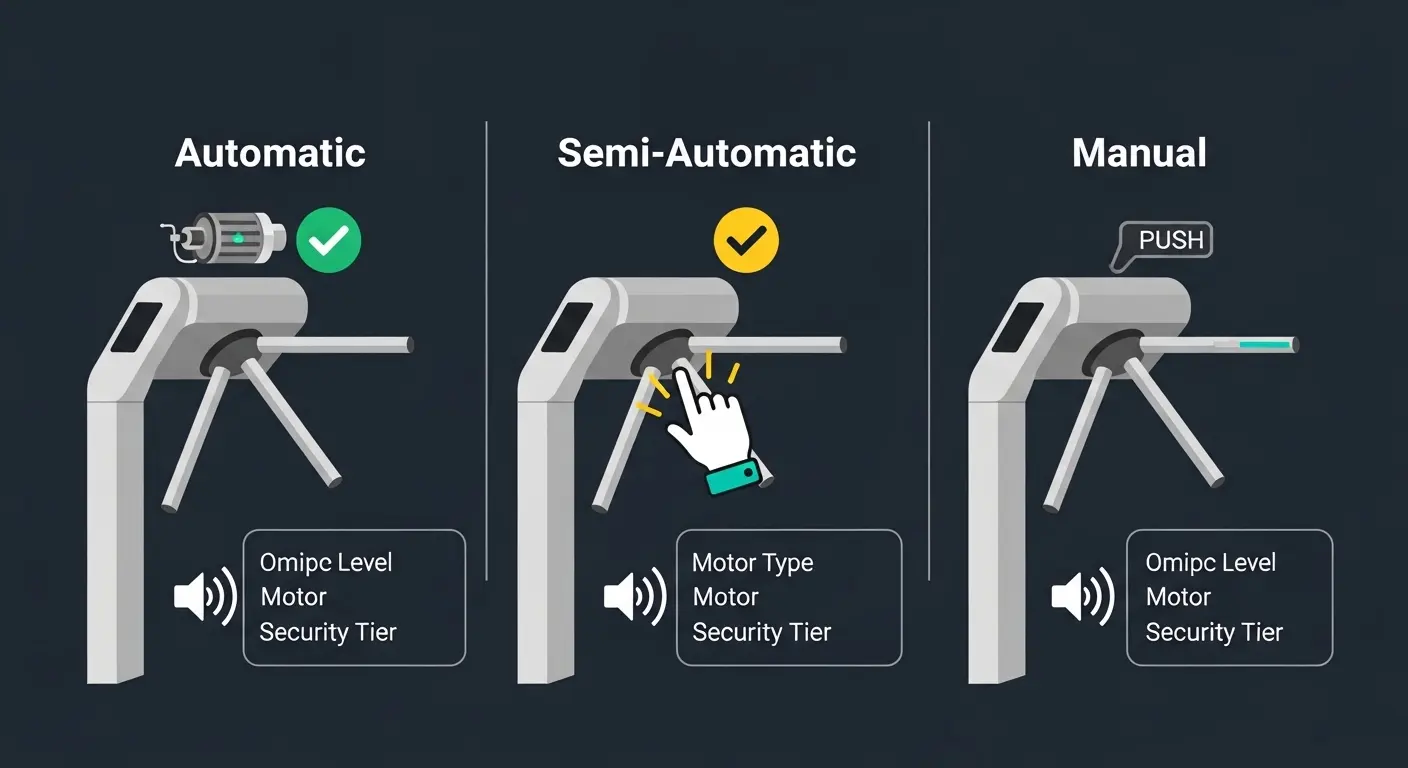
| Feature | Automatic | Semi-Automatic | Manual |
|---|---|---|---|
| Arm opens by motor | ✅ | ❌ User pushes | ❌ User pushes |
| Electronic credential | ✅ Full | ✅ Lock release only | ❌ None |
| Auto-reset timeout | ✅ Adjustable | Partial | ❌ None |
| Brushless motor | ✅ Standard | Optional | ❌ None |
| Arm-drop on power fail | ✅ Automatic | Manual release | N/A |
| Noise level | Very low | Low | Moderate |
| Best for | Offices, transit, corporate | Low-traffic, budget sites | Free-flow zones |
Brushless Motor: Why It Matters for Long-Term Value
A brushless DC motor has no friction carbon brushes to wear out. This results in near-silent operation, approximately 3× longer service life than a brush DC motor, and zero scheduled brush replacement cost over the gate's operational life.
Brushless vs. Brush DC Motor, Performance Differences
A brush DC motor uses carbon brushes in physical contact with the commutator. This contact generates friction noise. Additionally, the brushes wear down over 12–18 months of daily operation and require scheduled replacement. This adds maintenance cost and downtime at busy facilities.
A brushless motor uses magnetic commutation with no physical contact. It operates smoothly with deceleration buffering. Furthermore, it carries no wear consumables and is rated for an operating range of -20°C to +70°C — suitable for 24/7 high-traffic operation without maintenance interruption.
In our experience manufacturing automatic tripod turnstiles for deployments across 104 countries, facilities that switch from brush to brushless motors report a significant reduction in annual maintenance call-outs within the first 18 months. The brushless motor premium pays back in reduced servicing cost — especially at sites processing more than 500 entries per day.
Noise Level: Why It Matters in Professional Environments
Brushless motor operation is near-silent. This matters in open-plan office lobbies, hospital reception areas, and library entrances. Persistent mechanical noise from a brush motor creates a poor user experience and frequently generates complaints from reception staff.
In our experience, buyers who initially specify a semi-automatic model for cost savings often upgrade to a brushless automatic within 12 months. The reason is consistently the same: noise complaints from lobby-facing staff. The Turboo EF1213 automatic tripod turnstile uses a brushless control system with DC 24V, 150W power supply — delivering smooth, quiet operation at 35–50 persons per minute throughput.
For facilities requiring the highest security configuration alongside automatic operation, see Turboo's high security tripod turnstile models.
Auto-Reset Function: How Timeout Logic Protects Your Entry Point
The auto-reset function cancels an authorized passage if the user does not pass within the configured timeout window. The arm re-locks automatically — without requiring a new credential presentation — preventing an open authorization signal from being exploited by an unauthorized follower.
How Timeout Logic Works
The controller sends an unlock signal on valid credential. The arm rotates open. If no passage is detected within the timeout period, the arm re-locks automatically. The user must present their credential again to re-open the gate.
This function directly supports anti-tailgating security. A timeout window left too long creates an opportunity for a second person to enter on a single authorization. Therefore, timeout calibration is a security decision — not just a convenience setting.
| Timeout Setting | Best For | Security Implication |
|---|---|---|
| 5 seconds | High-security fast-flow environments | Tightest anti-passback; may frustrate slow walkers |
| 10 seconds | Standard office / transit | Best balance of throughput and security |
| 20 seconds | Wheelchair / mobility aid users | Accommodates slower movement; lower enforcement |
When we configured auto-reset for a corporate office lobby deployment, the 10-second window provided the best balance. It maintained throughput speed and prevented opportunistic re-use of an open authorization window. For broader tailgating prevention strategy, see Turboo's guide on anti-tailgating turnstile configurations.
Safety Functions: Arm-Drop on Power Failure and Fire Alarm
On power failure, an automatic tripod turnstile drops all three arms to the horizontal position automatically — clearing the passage for safe evacuation without requiring any manual staff intervention at the gate.
What Happens on Power Failure
The arm-drop response activates within the controller's emergency response cycle — typically under one second of power interruption detection. This is a mandatory safety standard for all Turboo automatic tripod turnstile models. Every unit is tested for emergency drop response before leaving the factory.
When power is restored, the arms raise automatically to the locked position. No manual re-mounting of arms is required on brushless automatic models. Therefore, post-outage recovery is seamless and requires no staff presence at the gate.
Fire Alarm Integration
A dry contact input on the gate controller connects directly to the building's fire alarm panel. On fire alarm signal, the arm drops immediately and the passage opens for full evacuation flow — identical to the power failure response.
Additionally, remote software control allows the security desk to trigger an arm-drop manually for any emergency scenario. These three emergency response modes — power failure drop, fire alarm drop, and remote software drop — are all standard on Turboo automatic tripod turnstile models. For perimeter applications requiring higher forced-entry resistance, see Turboo's anti-climbing full height turnstile range.
Credential Compatibility: What an Automatic Tripod Turnstile Supports
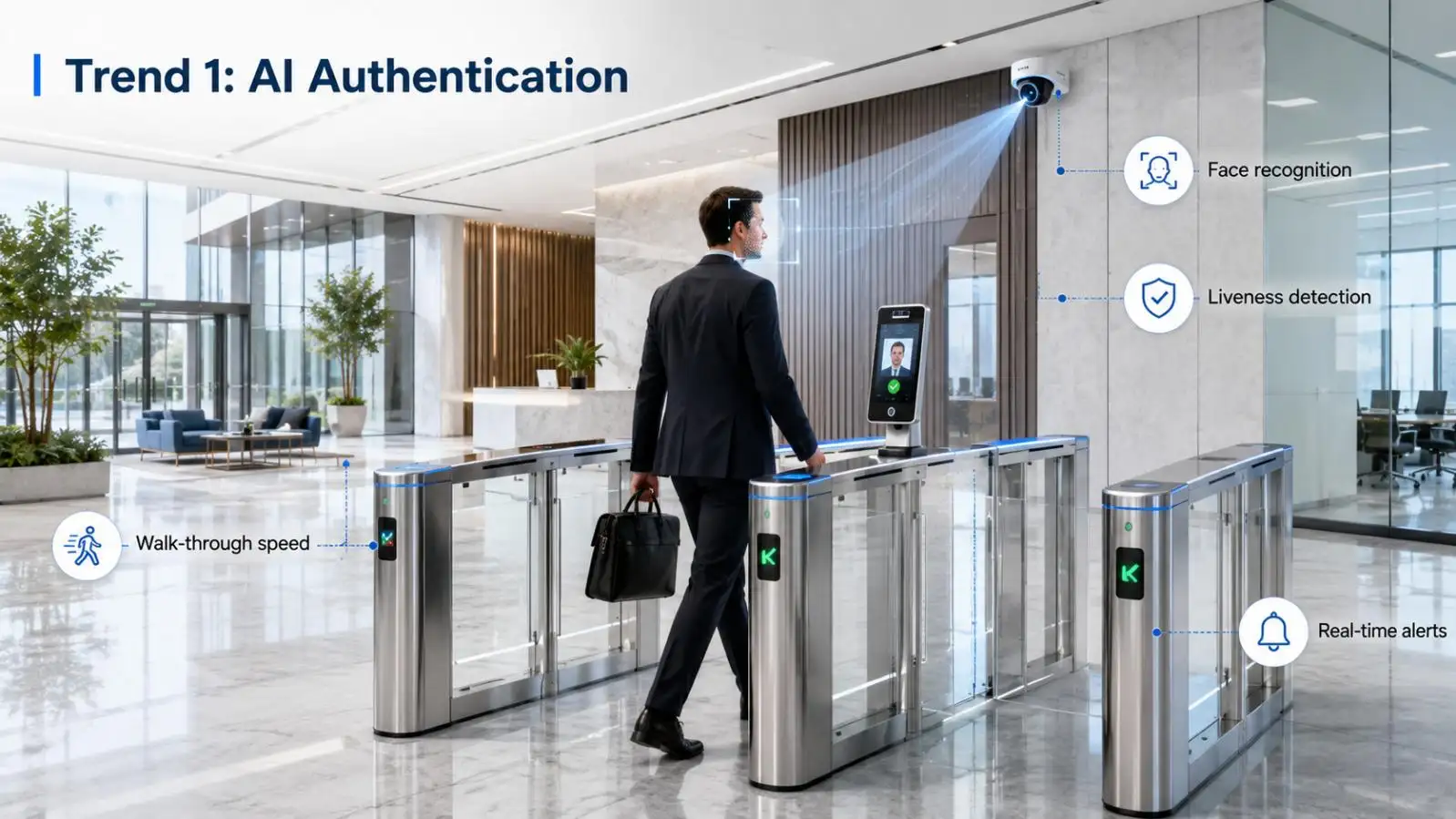
An automatic tripod turnstile supports IC/ID card, face recognition, QR code, and fingerprint credentials — either as standard-mounted options or via a unified external electrical interface that accepts any compatible reader module without modifying the gate housing.
Supported Credential Types
| Credential Type | Standard or Optional | Reader Interface |
|---|---|---|
| IC/ID Card (RFID) | Standard | Built-in or external mount |
| Face Recognition | Optional reader module | External mount |
| QR Code | Optional reader module | External mount |
| Fingerprint | Optional reader module | External mount |
| Temperature Detection | Optional module | External mount |
The unified external electrical interface uses dry contact and RS485 protocols. These are the same protocols used by standard access control platforms — including Lenel, Honeywell, and generic Wiegand controllers. Therefore, integration with an existing system requires no additional middleware.
Multi-Credential on a Single Gate
One automatic tripod turnstile unit supports multiple credential types simultaneously. Face recognition for enrolled staff, QR code for visitors, and IC card for contractors can all operate on the same gate. This flexibility makes the automatic model significantly more capable than a semi-automatic model in multi-user-type facilities. According to the Security Industry Association's access control hardware standards, multi-credential support on a single entry point is considered best practice for facilities with mixed user populations.
Outdoor Automatic Tripod Turnstile: Specification Requirements
An automatic tripod turnstile can be deployed outdoors provided the housing meets minimum IP4X protection, the operating temperature range covers the site's climate, and the arm and housing material is stainless steel rated for weather exposure.
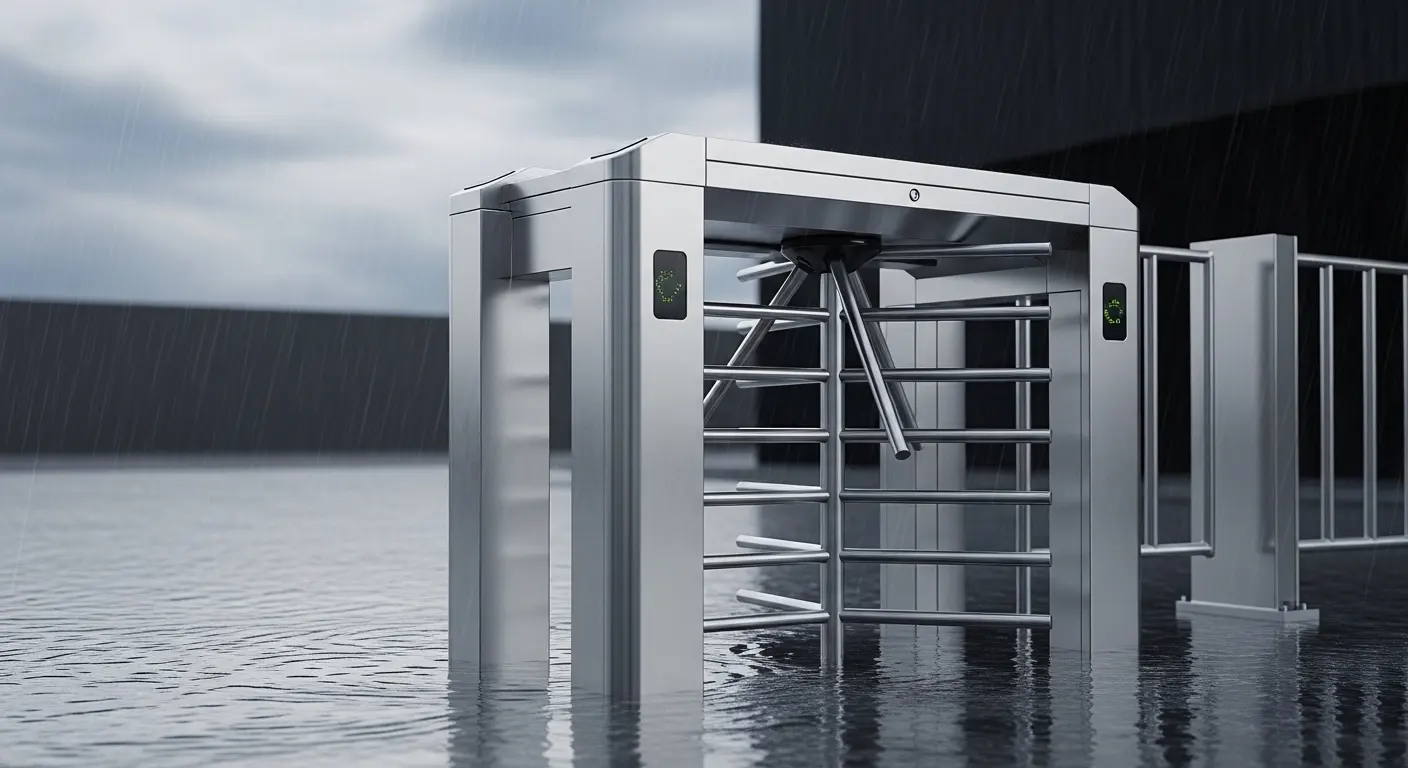
Indoor vs. Outdoor Specification Comparison
| Specification | Indoor Standard | Outdoor Requirement |
|---|---|---|
| IP Rating | IP4X minimum | IP54 or higher recommended |
| Operating Temp | -20°C to +70°C | -20°C to +70°C (same spec) |
| Housing Material | Cold-rolled steel / SUS201 | SUS304 stainless minimum |
| Arm Material | SUS201 | SUS304 stainless minimum |
| Biometric Reader | Standard mount | Weatherproof module required |
Humidity and Coastal Deployment Notes
The standard humidity tolerance for Turboo automatic tripod turnstile models is ≤90% non-condensing. However, coastal and tropical deployments regularly exceed this threshold. Confirm the site's worst-case humidity environment before specifying for coastal facilities.
SUS304 stainless steel housing is the minimum outdoor material standard. Furthermore, any biometric or QR reader module mounted externally requires an IP-rated weatherproof housing — the standard internal module is not weather-sealed. Specify the outdoor reader option separately when ordering for exposed installations. For demanding industrial outdoor environments, Turboo's heavy duty tripod turnstile models offer reinforced housing with enhanced weather protection ratings.
Is an Automatic Tripod Turnstile Worth the Premium? Use-Case Matching
An automatic tripod turnstile is worth the premium over semi-automatic when the facility has high daily throughput, operates in a professional environment where noise matters, requires multi-credential flexibility, or prioritizes lower long-term maintenance cost over lower upfront cost.
Facility-Type Matching Guide
| Facility Type | Automatic Recommended? | Reason |
|---|---|---|
| Corporate office lobby | ✅ Yes | Noise level, throughput, visitor credential flexibility |
| University campus | ✅ Yes | High volume, multi-credential (student card + QR) |
| Factory / industrial site | Situational | Semi-auto sufficient for low-traffic internal zones |
| Gym / leisure center | ✅ Yes | High daily cycles, noise in member-facing space |
| Transit hub | ✅ Yes | 35–50 persons/min throughput; 24/7 operation required |
| Warehouse internal gate | ❌ Semi-auto sufficient | Lower traffic; cost sensitivity; gloves make pushing acceptable |
The ROI Case for Brushless Automatic
The brushless motor's 3× service life advantage becomes economically significant at facilities processing more than 500 entries per day. At that volume, the lower maintenance cost offsets the automatic model's price premium within 2–3 years of operation. Additionally, zero brush replacement cycles means no planned maintenance downtime — a concrete operational benefit for 24/7 sites.
The global tripod turnstile market is growing from $703M in 2021 to a projected $950M by 2025, according to Cognitive Market Research — with automatic brushless models representing the fastest-growing specification tier as facilities prioritize maintenance reduction and credential flexibility. For facilities where standard automatic specification is insufficient for the security requirement, see Turboo's high security tripod turnstile configurations.
Frequently Asked Questions
Q1: What is the difference between an automatic and semi-automatic tripod turnstile?
An automatic tripod turnstile uses a brushless DC motor to open the arm completely on valid credential — the user does not touch the gate at all. A semi-automatic model releases an electronic lock on valid credential, but the user must push the arm through manually. The automatic model also includes auto-reset timeout, bi-directional motor operation, and automatic arm-drop on power failure as standard. The semi-automatic model is lower cost but lacks hands-free operation and full brushless motor longevity.
Q2: How does the auto-reset function work on an automatic tripod turnstile?
The auto-reset function re-locks the arm automatically if the authorized user does not pass within the configured timeout window — typically set at 5, 10, or 20 seconds depending on the facility's throughput and security requirements. When the timeout expires, the arm returns to the locked position and the authorization signal is cancelled. The next user must present a fresh credential to open the gate again. This prevents an open authorization from being exploited by a second person following behind the authorized user.
Q3: Why is a brushless motor better than a brush DC motor in a tripod turnstile?
A brushless motor uses magnetic commutation with no physical contact between components — so there are no carbon brushes to wear down and no scheduled brush replacement maintenance. This results in approximately 3× longer service life, near-silent operation, and lower total cost of ownership compared to a brush DC motor over a 5–10 year operational period. Brush DC motors require carbon brush replacement every 12–18 months under daily high-traffic use — adding maintenance cost and periodic gate downtime.
Q4: What happens to an automatic tripod turnstile when the power fails?
On power failure, the three arms drop automatically to the horizontal position — clearing the passage lane completely for safe pedestrian evacuation without any manual staff intervention. This response activates within one second of power interruption detection and is a tested safety standard on all Turboo automatic tripod turnstile models. When power is restored, the arms raise automatically to the locked position without requiring staff to manually reset or re-mount the arms.
Q5: Can an automatic tripod turnstile be used outdoors?
Yes — an automatic tripod turnstile can be deployed outdoors when the housing is specified in SUS304 stainless steel, the IP rating meets IP54 or higher for the installation environment, and any externally mounted credential reader (face recognition, QR code, fingerprint) uses a weatherproof module. The standard operating temperature range of -20°C to +70°C covers most outdoor climate zones. However, coastal or tropical installations with humidity regularly exceeding 90% non-condensing require additional environmental assessment before specifying standard models.
Conclusion
Three specification decisions determine whether an automatic tripod turnstile is the correct choice for a facility. First, throughput and daily cycle volume: at 35–50 persons per minute and over 500 entries per day, the brushless motor's maintenance-free service life makes automatic the better long-term investment. Second, environment: open-plan lobbies, corporate receptions, and gym floors require near-silent operation — brushless automatic is the only defensible choice. Third, credential flexibility: if the facility needs face recognition, QR, and IC card on a single gate unit, only an automatic model's unified external interface delivers that capability without hardware changes.
Contact Turboo's access control team with your facility type, daily throughput estimate, and preferred credential type for an automatic tripod turnstile specification sheet and quotation.