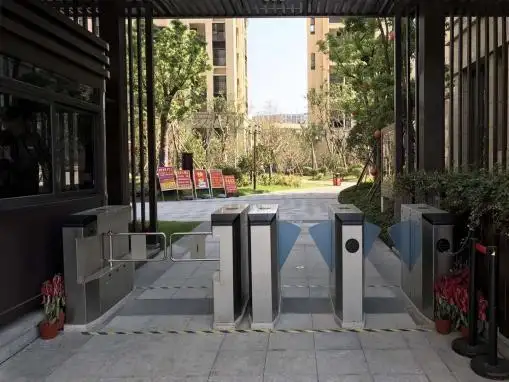



Security Turnstile Gate Insights: Six Key Market Trends for 2026–2032

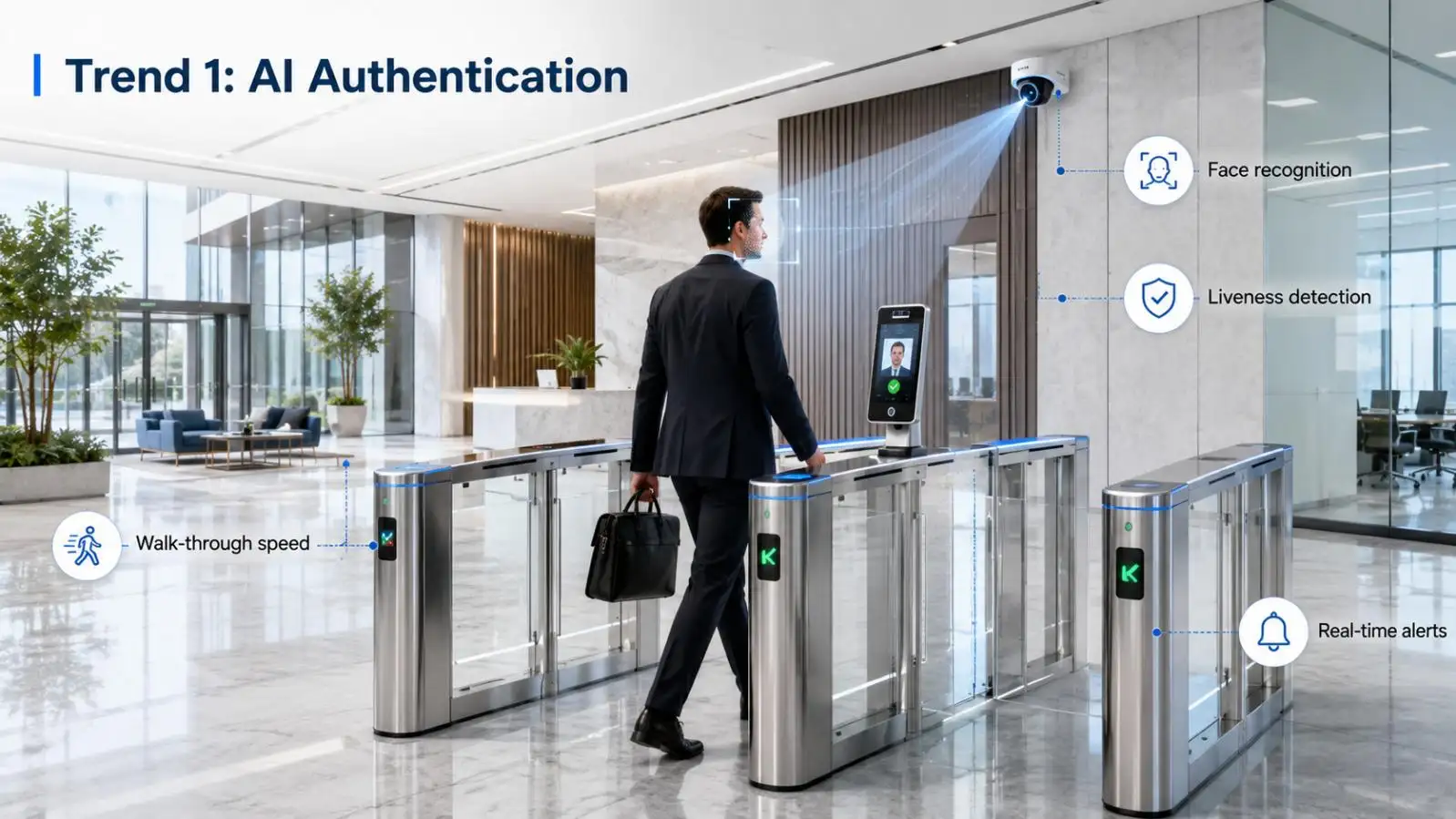
A security turnstile gate is an example of the ways in which technology advances products in an industry. Originally designed to simplify the control of pedestrian movement, turnstile gates are currently sophisticated systems that big data and access control technology integrate. In the lead up to 2032, several disruptions will continue to impact the security turnstile gate systems and the facilities of smart cities. In this article, and based on real-world product innovations and the latest market forecasts, six disruptions shaping the future of security turnstile gates have been identified.
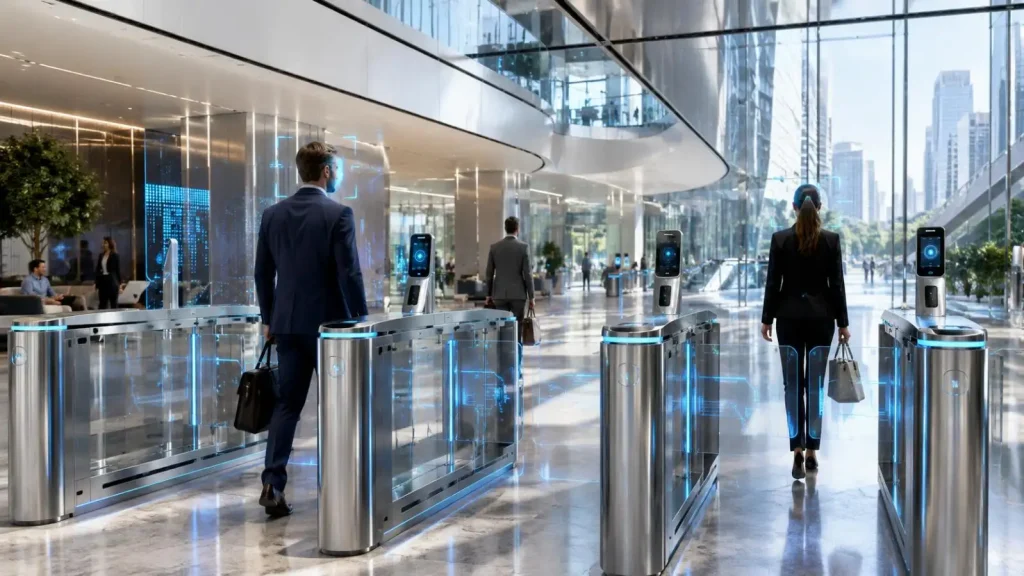
Market Overview: Unlocking New Opportunities
To appreciate the impact of the disruptions, it is important to understand the potential of the market. The security turnstile gates are part of an expanding ecosystem and include the following market segments:
•Global Security Turnstiles and Gates Market: forecast at $1,403 million by 2032, with a CAGR of 4.0%.
•Turnstile Market: Valued at $305.11 million in 2025 with a forecast of $421.60 million by 2032, a CAGR of 4.72%.
•Automatic Turnstile Market: Valued at $1.94 billion in 2025, with a forecast of $2.88 billion by 2032, a CAGR of 5.79%.
•Gate & Barrier System Equipment Market: Expected to reach $1.38 billion by 2032 with a CAGR of 8.25%.
•Pedestrian Access Control System Market: Expected to reach $3.86 billion by 2032, a CAGR of 9.8%.
As part of a comprehensive security solution, security turnstile gates enable organizations to meet their goals for speed, safety, and security, as well as regulatory compliance and aesthetics.
Revolution in Motion: New Age of Security Turnstile Gates
Today's security turnstile gates provide much more than entry control. Intelligent security turnstile gates can do the following:
•Real-time identity verification through AI-based facial recognition
•Tailgating detection through infrared sensors
•Cloud-based access control system integration
•On-premise biometric computation
•Facility and crowd control management analytics
Given these capabilities, security turnstile gates have become platforms of operational analytics, identity verification, and systems interoperability.
Trend 1: The Rise of Dependable, Convenient, AI-Based Authentication Systems
AI is the most significant innovation in security turnstile gates. Current AI facial recognition systems provide identity authentication at near walking speeds and employ machine learning to improve systems accuracy through automatic enrollment and liveness detection. Already, over 40% of biometric and transportation infrastructure systems include AI-based and/or biometric systems.
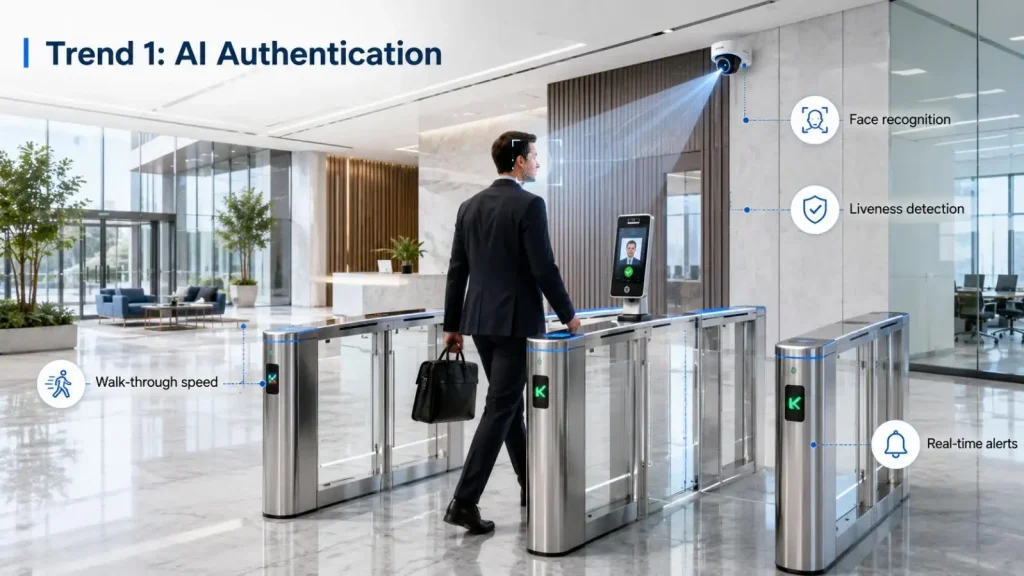
�� Implications for the Security Turnstile Gate Market: AI has the capability of shifting security turnstile gates of the future from reactive access control to systems designed to provide real-time security threat intelligence. Increasingly, security turnstile gates are being designed with AI and ML to analyze pedestrian flow and detect security threats through the identification of anomalous patterns. For purchasing teams, this may entail consideration of the AI sophistication and the embedded machine learning of the security turnstile gate systems, in addition to the gate's hardware specifications.
Trend 2: IoT and Cloud Integration: Turnstiles as Data Nodes
Positioned as stand alone devices, security turnstile gates are now being integrated as connected nodes in the larger digital framework. With IoT, turnstile gates offer the ability to control operations at a distance, analyze and measure traffic and users in real-time, and provide remote diagnostics for the system.
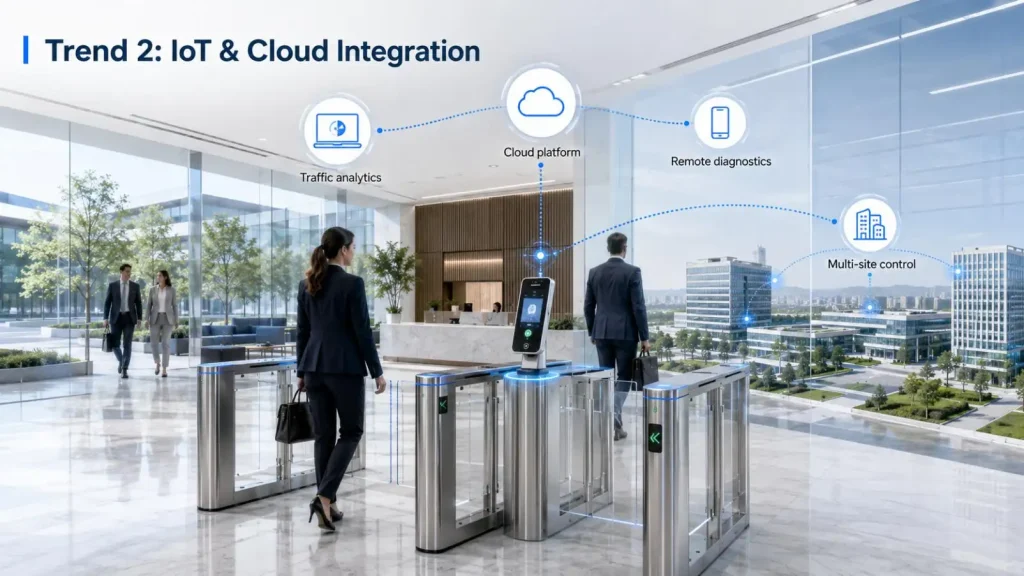
�� Impact on the Security Turnstile Gate Market: A Cloud solution results in lower operational costs for maintenance and the flexibility for greater scalability across multiple locations. It also enables easier system enhancements, data integrity, and interoperability with other intelligent building offerings, thus securing a more integral position for the security turnstile gate within the facility management systems ecosystem as opposed to a disconnected security element.
Trend 3: Multi-Factor Authentication for High Security Locations
The era of using a security RFID card is becoming obsolete. Contemporary security turnstile gate systems provide a variety of integrated methods for access control. Multi-Factor Authentication (MFA) requires a user to provide two or more verification factors to gain access.
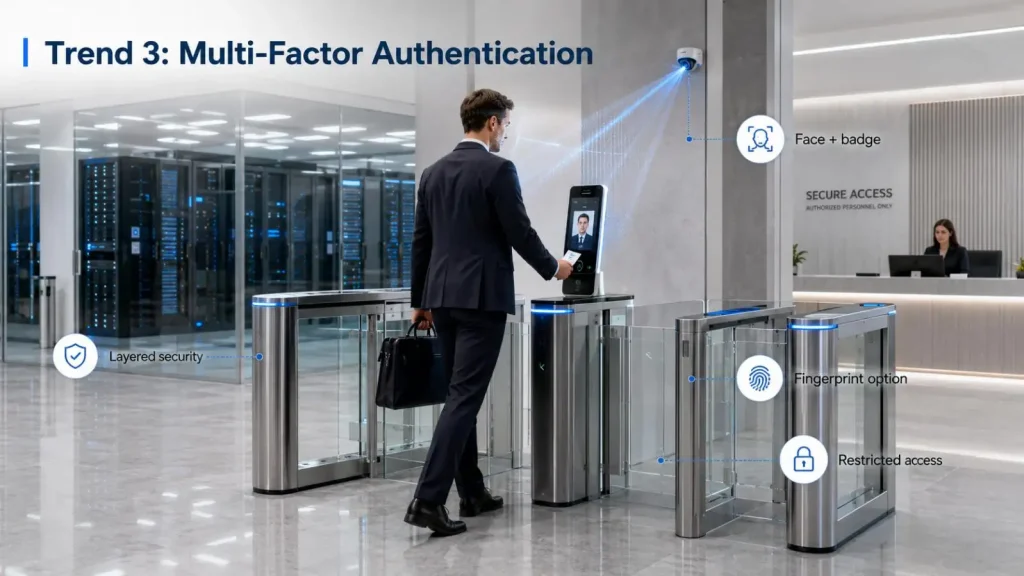
�� Impact on Security Turnstile Gate Market: MFA provides a greater level of control when managing authentication, thus providing a more modular and configurable security level to the turnstile gate solution. In light of restricted access concerns, turnstile gates may apply Multi-Factor Authentication (MFA) instead of Single Factor Authentication (FA).
Trend 4: Anti-Tailgating Technology Advancements Improve Detection
The leading type of security breach at a pedestrian access point remains tailgating. A security turnstile gate integrated with sophisticated anti-tailgating technology no longer simply opens and closes. Rather, it now detects and responds to security breach attempts.
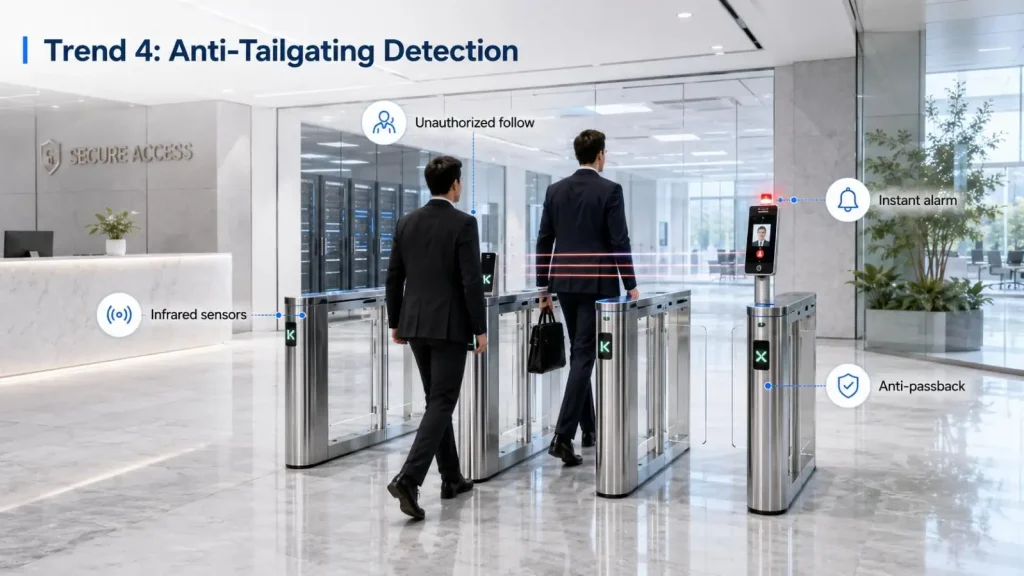
�� Impact on the Security Turnstile Gate Market: The anti-passback feature has also evolved to a degree where the same credential cannot be used in quick succession. This is critical in the case of data centers, financial institutions, and government facilities where the risk of one person gaining unauthorized access can be catastrophic. Due to these changes, a security turnstile gate with advanced tailgating detection has now become a compliance requirement in many regulated industries rather than a market differentiator.
Trend 5: Smart Cities and Transportation Systems Fuel a Mass Adoption
An unprecedented demand for the security turnstile gate systems has been created as a result of the worldwide focus on smart city systems. Major airports and transit hubs are now implementing contactless systems with facial recognition, as a means to optimize the flow of passengers. Demand for advanced access control systems has also been driven by the commercial high-rise construction and smart city systems in New York and Los Angeles, as well as in many cities across the Middle East.
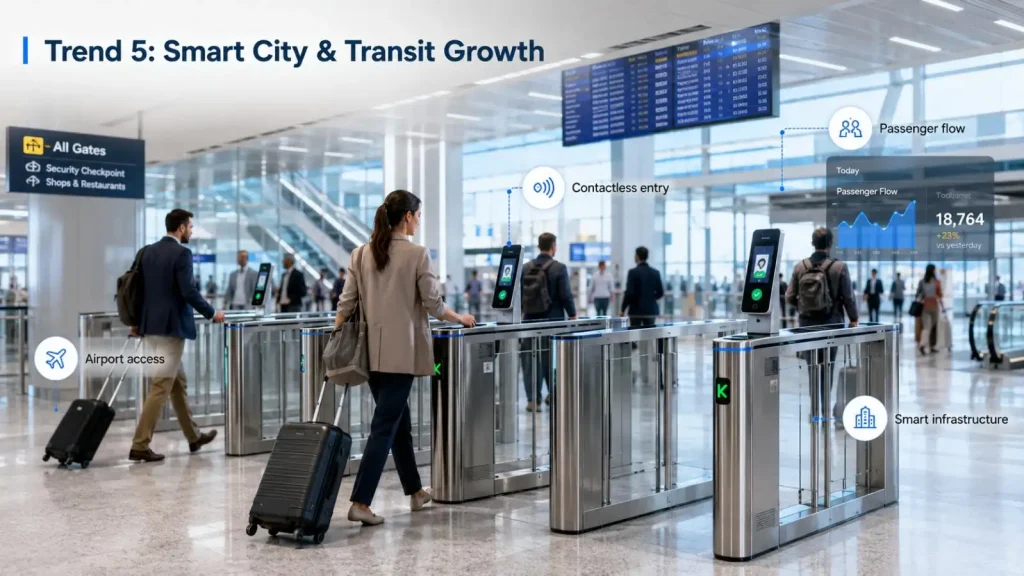
�� Impacts on the Security Turnstile Gate Market: The airport segment will see most growth within turnstiles, as airport turnstiles guide the flow of people to and from secure areas such as security screening, boarding gates, and customs. Around the world, airport security turnstile gates have become a vital part of many governments' modernization of infrastructure investments, and the greatest regional growth will happen in the APAC region due to massive urbanization and infrastructure development in both China and India.
Trend 6: Aesthetics and Sustainability Influence Design with Compliance as a Mandate
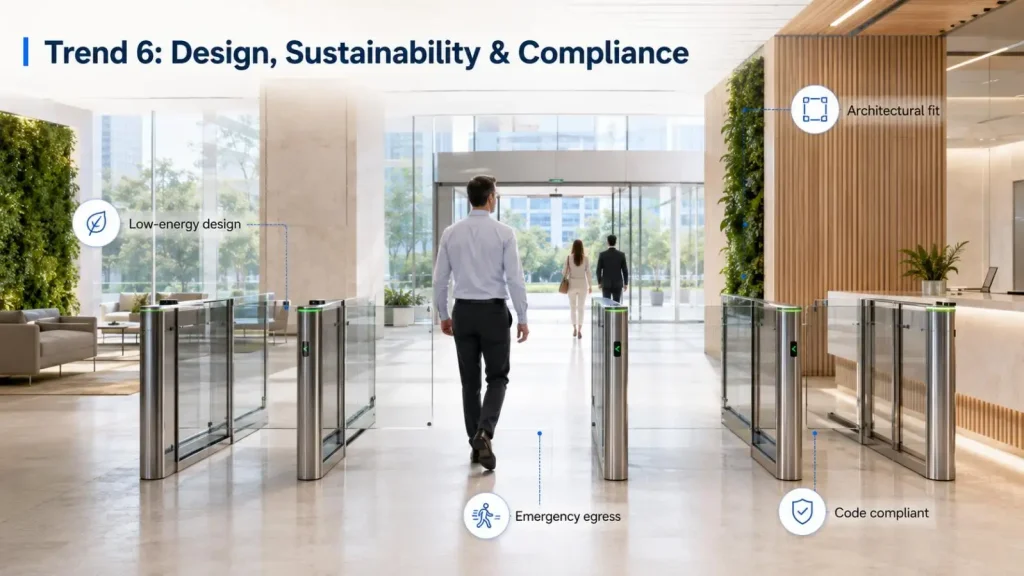
The Functional view of security turnstiles is rapidly shifting to how they define spaces, and are therefore architectural elements. There is an increasing demand for turnstile systems to be fully integrated with contemporary building design. This also includes custom design solutions in terms of material, finish, and lighting design. Coupled with this shift are sustainability concerns that require security turnstiles be designed with lower embodied energy and sustainable materials, and integrated adaptive systems that fulfill international sustainability of design and construction mandates.
�� Compliance as a Core Feature: The design of security turnstiles must also address the complexities of the various control and regulatory systems. For example: the NFPA 101 and IBC regulate that the space occupied by a turnstile, which is a means of egress, must be of sufficient size to assure unobstructed passage of at least 36 inches at and below 34 inches in height, and cannot be less than 32 inches between 34 and 80 inches. Proper design and integration of systems such as tripod turnstiles, full height turnstiles, revolving doors, and security portals, may offer a variety of design solutions that satisfy the requirements for safe egress during an emergency. These systems may include automatically opened doors or free-rotation features.
�� Impacts on the Security Turnstile Gate Market
Now that the NFPA has approved amendments on the integration of weapon detection systems in egress paths which preserve life safety, the security turnstile gate is being viewed more like exit doors in the regulatory context. This means that for security turnstile gate users, the issue of compliance cannot be addressed after the fact. Rather, it needs to be built in during the initial deployment of the security turnstile gates.
In Conclusion
The security turnstile gate has advanced beyond being a mechanical barrier, and is now an AI and data driven platform. With the continued evolution of smart cities, the role of security turnstile gates will be data collection, fraud prevention, and seamless integration with the smart city infrastructure. The focus needs to be on the long term adaptability and compliance of the solution, greater than the initial cost.
Trust Turboo Automation Co., Ltd. Established in 2006 and specializing in intelligent turnstiles (tripod, swing, speed, full-height), designed for use in Airports, Offices, etc. Turboo has more than 50 R&D employees, is a reliable partner to over 100 countries and provides full customization. See Turboo for your next project.
FAQs
Q1. In what way does AI enhance a security turnstile gate?
AI allows the fast turnstiles to recognize faces, detect tailgaters, and send alerts for anomalies, which increases the speed and safety of the turnstile beyond what mechanical systems can provide.
Q2. Is it possible to integrate security turnstile gates with other systems?
Yes, a majority of modern turnstiles are compliant with IoT and integrate with already established access systems, be it RFID, biometric, or even Building Management Systems.
Q3. What is meant by anti-tailgating technology in turnstiles?
This technology is meant to recognize individuals that are passing through turnstiles without verifying credentials by use of infrared or even AI technology. This would cause the turnstile to lock or activate other alarm functions.
Q4. Do security turnstile gates adhere with fire codes?
Yes. Models that are NFPA compliant are designed to handle a situation of an emergency by allowing full rotation of the turnstile arms or replacement with completely removable arms.
Q5. What are the commonly used security turnstile gates?
Commonly used security turnstile gates are tripod turnstile gates, swing turnstile gates, speed turnstile gates, and full height turnstile gates. These models meet various customer security and user passage needs.