


Warehouse Tripod Turnstile: Managing Staff, Contractors, and Drivers at One Gate

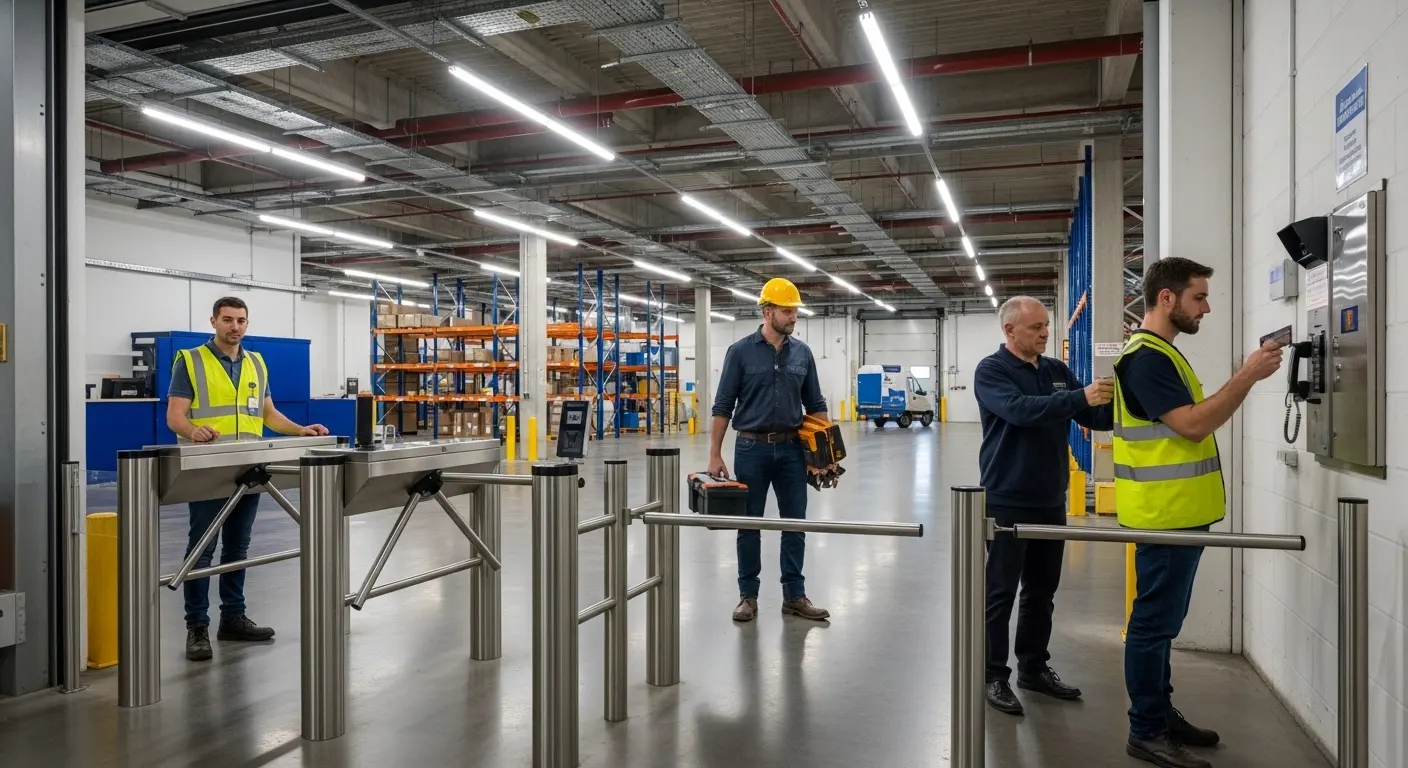
TL;DR: A warehouse tripod turnstile controls pedestrian access at distribution centres and logistics facilities, supporting multiple user types — permanent staff, agency workers, contractors, and delivery drivers — each with different credential logic. Key specifications are IP54 for dock-area gates, high MCBF for 24/7 operations, and role-based access management. Tripod turnstiles suit standard warehouse entrances; full-height is only needed for highest-security inventory zones.
Specifying a warehouse tripod turnstile is more complex than a standard factory or office gate — because a single warehouse entrance must serve four entirely different types of users, each with different access rights, credential types, and zone permissions.
This guide covers what makes warehouses operationally distinct, how to plan for multi-user credential management, where to install tripod turnstiles across your site, and how to match the right model to your warehouse tier.
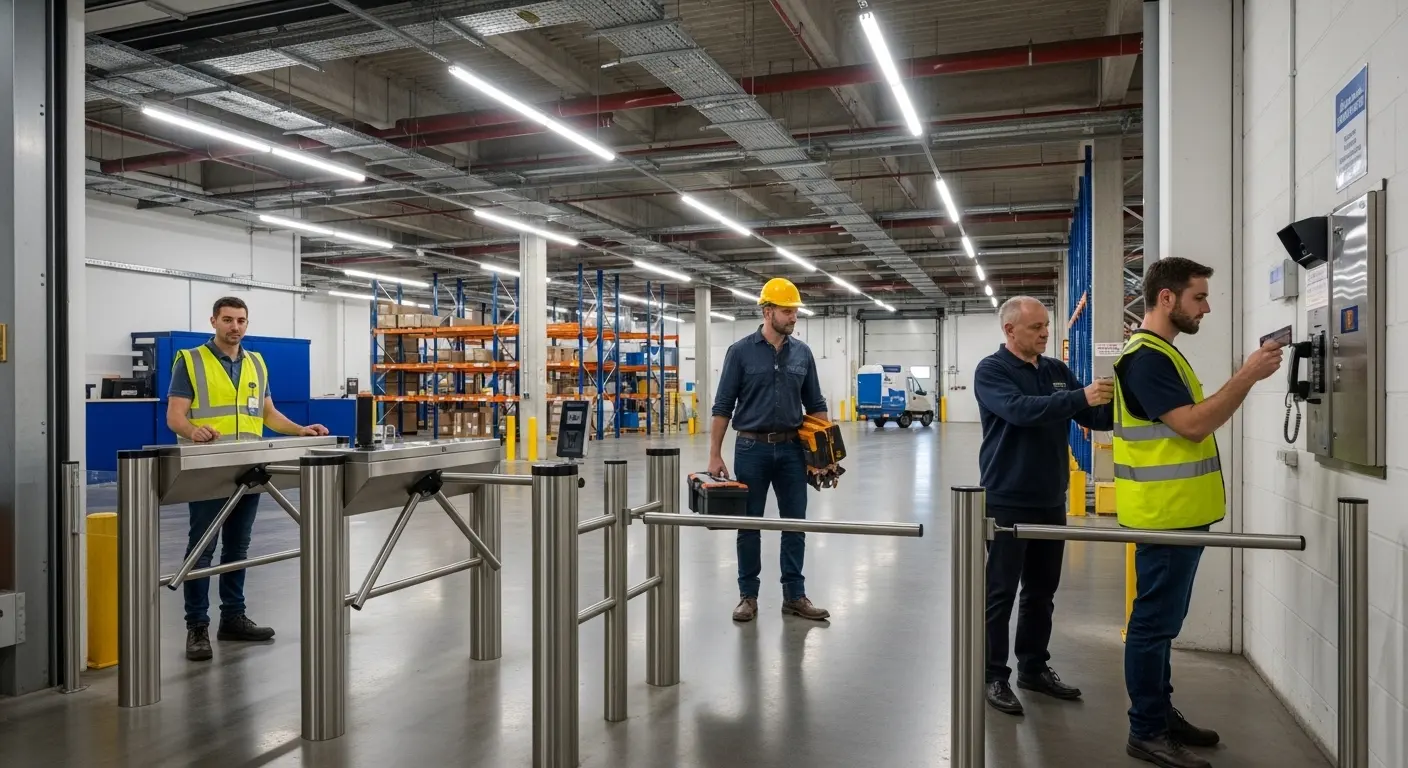
What Makes a Warehouse a Distinct Tripod Turnstile Deployment
Most tripod turnstile guides treat all industrial applications the same. A warehouse is not the same as a factory or office.
Three challenges separate warehouse deployments from every other context:
- Multi-user complexity: Permanent employees, agency workers, contractors, and delivery drivers all use the same entrance — with fundamentally different access needs. Shared or poorly managed credentials are the most common warehouse security failure.
- 24/7 operational demand: Large distribution centres run three shifts. With retail shrinkage projected to approach $100 billion in 2025, internal theft at inventory access points is a genuine operational risk that a turnstile directly counters.
- Environmental variation: Dock gates face dust, vehicle exhaust, humidity, and temperature extremes. A standard indoor-grade unit will fail at a loading bay within months.
For a broader view of industrial gate applications, the factory and industrial access control guide covers related high-security deployment contexts.
What Should a Warehouse Tripod Turnstile Include?
Warehouse buyers often compare models that look similar on spec sheets but fail in practice. These six criteria separate a warehouse-grade specification from a generic purchase.
Credential and Access Management Criteria
Role-based credential management: Each user type needs a distinct access profile. Permanent staff use persistent RFID or biometric credentials. Agency workers need time-limited access that expires automatically at shift end — preventing the badge retention problem that plagues many warehouses. Contractors receive zone-restricted profiles active only for their project duration. Drivers get intercom or pre-issued QR codes, keeping them entirely out of staff zones. The gate controller must support all four profiles simultaneously.
Anti-tailgating with full audit log: The physical three-arm mechanism enforces one-person-per-cycle. Every entry event logs with a time-stamp and credential identity — essential for inventory zone compliance and incident investigation.
Drop-arm fail-safe: Most warehouse safety regulations require automatic gate release during a fire alarm or power failure. Turnstiles with attendance tracking also record entry and exit times, supporting fire muster headcount requirements in facilities with large worker populations.
Physical and Environmental Criteria
IP Rating: IP54 is the minimum for dock-area gates, covered yard entry points, or any gate exposed to dust, humidity, or vehicle exhaust. Fully outdoor perimeter gates at coastal or exposed logistics parks require IP65 — which handles direct water jets and total dust exclusion. Standard indoor units without IP certification are not appropriate for loading bay environments.
MCBF for 24/7 operations: A three-shift warehouse logs roughly three times the daily cycles of a standard 8-hour operation. Select a model rated for at least 5 million cycles before major mechanism service. Under-specified MCBF means early mechanism failure and an unplanned gate replacement — rarely at a convenient time.
Brushless DC motor: Near-silent, fast cycle time under 0.5 seconds, and significantly lower wear over high cycle counts. Semi-automatic models create mechanical noise and slower throughput. For a high-volume warehouse entrance, brushless is the correct specification.
For RFID configuration options suited to multi-user warehouse environments, see RFID tripod turnstile configurations for warehouse access management.
How Do You Manage Staff, Contractors, and Drivers at the Same Warehouse Gate?
Staff use persistent RFID or biometric credentials. Agency workers receive time-limited access that expires automatically. Contractors get zone-restricted profiles for their project duration. Drivers use pre-issued QR codes or intercom authorization — keeping them entirely separate from staff areas and inventory zones.
In practice, each user type follows a distinct workflow.
Permanent employees use RFID cards or biometrics for fast daily access. High frequency, low friction. The gate processes their entry in under a second.
Agency and temporary workers are the highest-risk user group for credential management. Weekly badge issuance with automatic expiry at shift end prevents the access gaps that occur when temporary staff don't return cards. Most modern controllers handle this natively.
Contractors need zone-specific profiles that are active only during their assigned project window. A contractor installing HVAC on the mezzanine floor should not have access to the bonded goods area on the ground floor — even if both are inside the same building.
Delivery drivers and hauliers should never enter staff-only zones. Pre-registered QR codes issued through a visitor platform allow time-stamped, single-use entry to the dock reception area only. Role-based access control allows different levels of access based on individual roles and responsibilities, which is exactly what multi-user warehouse environments require.
For multi-credential controller options, the tripod turnstile access control range covers the full credential stack.
Where in a Warehouse Should You Install Tripod Turnstiles?
Tripod turnstiles suit five warehouse locations: the main staff entrance, the contractor and agency entry point, internal inventory zone checkpoints, high-value goods area gates, and dock-side staff access points. Full-height turnstiles are only necessary where physical bypass prevention is a hard requirement.
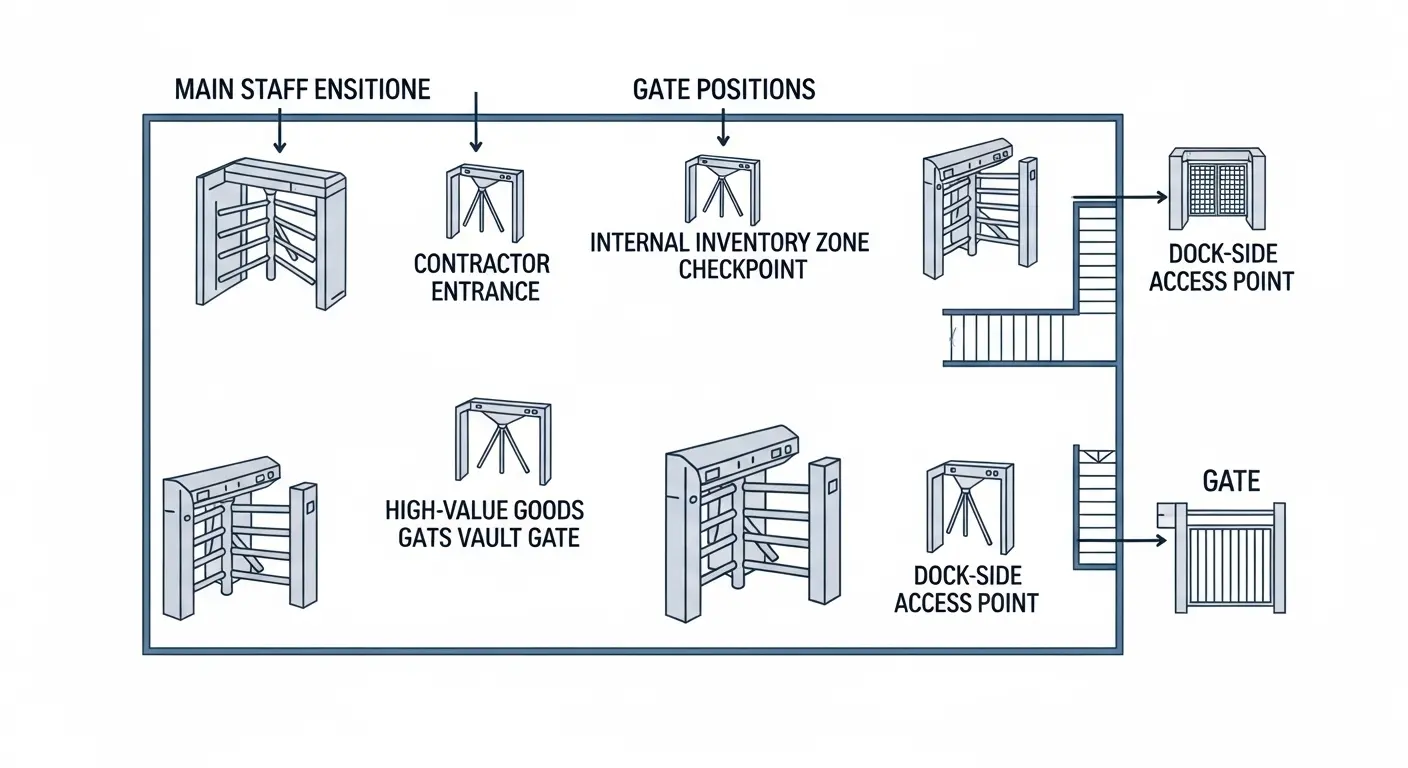
The zone-by-zone deployment table below gives a practical starting point for most warehouse layouts.
| Warehouse Zone | Recommended Gate | Key Reason |
|---|---|---|
| Main staff entrance | Tripod (brushless, IP54) | High daily volume; T&A integration; shift-change throughput |
| Contractor / agency entrance | Tripod (multi-profile controller) | Time-limited credential management; separate zone access |
| Internal inventory checkpoint | Tripod (indoor-grade) | Shrinkage control; audit trail; anti-tailgating |
| High-value / pharmaceutical vault | Full-height | Physical bypass prevention required |
| Dock-side staff gate | Tripod (IP54 or IP65) | Outdoor/semi-outdoor exposure; dust, humidity, forklift exhaust |
For dock gates and high-cycle main entrances, the heavy-duty tripod turnstile range is built for exactly these environments.
Matching the Right Warehouse Tripod Turnstile to Your Site
The right model depends on your operational intensity, gate environment, and the credential complexity your site requires. Here is a practical three-tier framework.
Tier 1 — Standard Warehouse Staff Entrance (Indoor/Covered)
Single or multi-lane entrance for 50–300 workers per shift. Standard environment, no direct weather exposure. Dust and humidity may be present near loading areas.
An automatic brushless model with SUS304 housing, IP54 rating, RFID plus QR visitor option, and RS485/TCP/IP T&A output covers this tier. Turboo's full automatic tripod turnstile is a common choice here — fast cycle time, multi-credential support, and a compact footprint for corridor-style entrances.
Tier 2 — Distribution Centre (24/7 Multi-Shift, Dock Exposure)
High-volume 24/7 operation with three shift changes daily. Dock gates exposed to semi-outdoor conditions. Multiple user types requiring role-based profiles.
This tier needs a heavy-duty brushless model with IP54 minimum (IP65 for fully outdoor positions), the highest-available MCBF, SUS304 or SUS316 housing, and a multi-profile controller. Turboo's industrial range carries CE and ISO9001 certification, confirming independent compliance verification — a common procurement requirement for this tier.
Tier 3 — 3PL / Multi-Tenant Logistics Park
Multiple client zones, contractor management per client contract, and tenant-specific access rules requiring remote credential management.
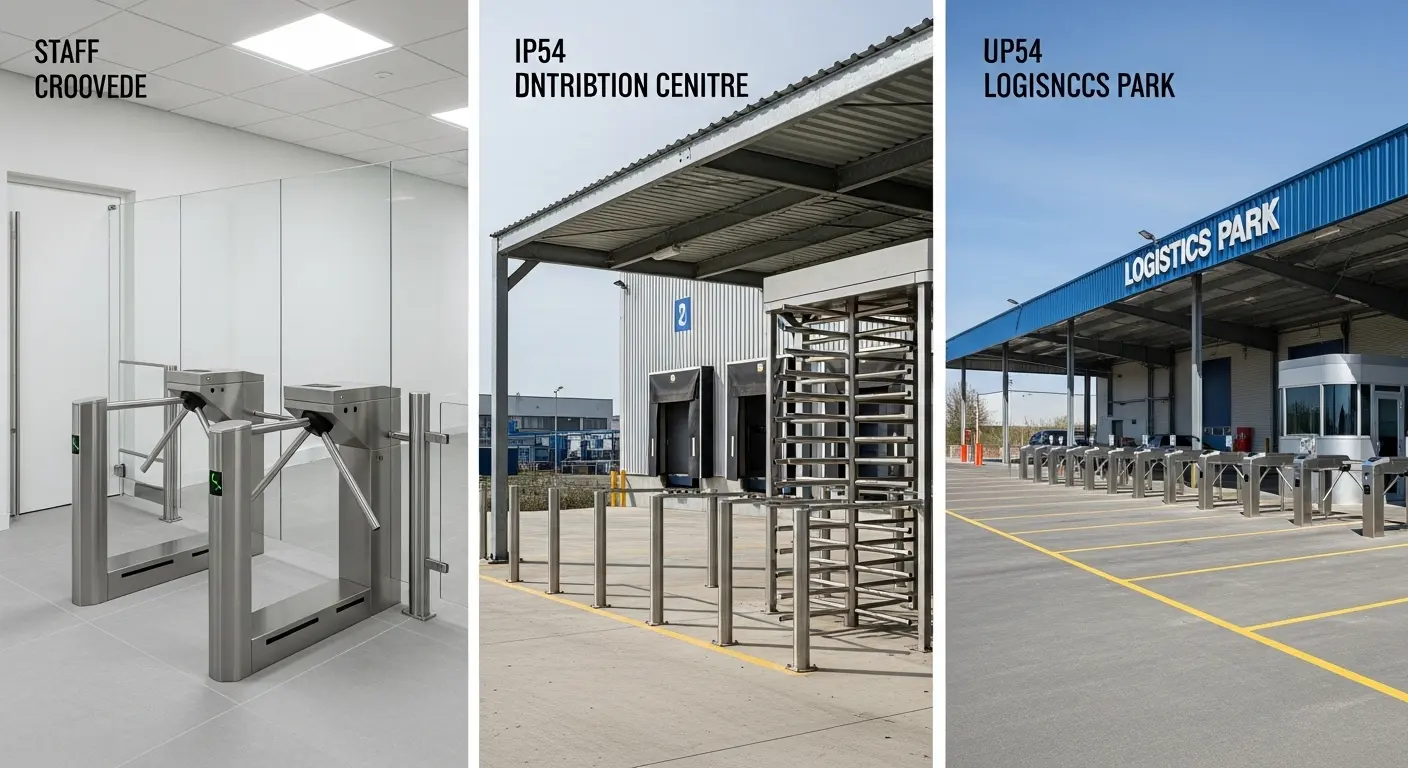
This tier adds cloud-based access control to the Tier 2 specification. Remote credential issuance and revocation across multiple sites without on-site IT visits is a 2026 operational standard for serious 3PL operators.
How Does a Warehouse Tripod Turnstile Connect to Attendance and Inventory Systems?
A warehouse tripod turnstile connects to time-and-attendance and HR software via RS485, TCP/IP, or Wiegand. Each credential event generates a time-stamped log that feeds directly into payroll platforms. Cloud-based systems allow remote credential management across multiple warehouse sites. WMS and ERP integration is also available for unified workforce and inventory access data.
In practice, integration follows four steps:
- Select your credential types — RFID, biometric, QR, or a combination
- Mount reader hardware on or alongside the turnstile chassis
- Connect via RS485, TCP/IP, or Wiegand to your access control panel
- Link the panel to your T&A, HR, payroll, or WMS platform
Turnstiles eliminate the need to staff every entrance manually, and track exactly when workers arrive and leave — reducing payroll disputes and improving shift compliance. The security benefit is equally measurable: RFID-integrated access combined with inventory tracking reduces shrinkage by up to 60%, according to 2025 data — a significant return for high-value goods environments.
What Does a Warehouse Tripod Turnstile Cost?
Unit prices range from $300 for basic semi-automatic indoor models to $1,500+ for heavy-duty outdoor units with IP65 rating and multi-profile access controllers. Total installed cost, including cabling, credentials, and T&A integration, typically adds 30–50% to unit price.
| Model Type | Typical Unit Price (USD) |
|---|---|
| Semi-Automatic (Indoor) | $300–$500 |
| Fully Automatic (IP54, Brushless) | $500–$800+ |
| Automatic + Multi-Profile Controller | $700–$1,200+ |
| Heavy-Duty (IP65, 24/7 Outdoor) | $900–$1,500+ |
For a two-lane main entrance plus two internal zone checkpoints, budget four units plus the 30–50% overhead. On the return side, eliminating manned checkpoints reduces ongoing labor costs — and demonstrating improved access control can reduce facility insurance premiums over time.
Brushless motor models carry a lower maintenance cost per cycle than semi-automatic mechanical units, which matters significantly at a gate processing 1,000+ cycles per day across three shifts.
Expert Tip: Before finalizing a specification, map your warehouse's user types against each gate location first — not the other way around. A common mistake is buying one model for all five gate positions and discovering it lacks the multi-profile controller needed at the contractor entrance. Turboo's industrial team can review your site layout and user access matrix to confirm the right controller and credential stack for each zone before you order.
Frequently Asked Questions
Is a tripod turnstile suitable for a warehouse entrance?
Yes. Tripod turnstiles are a standard choice for warehouse and distribution centre entrances globally. They handle large shift volumes, integrate with time-and-attendance systems, support multiple user types with role-based credentials, and meet IP54 requirements for dock-area gates. Full-height is only necessary for highest-security inventory zones.
How does a warehouse tripod turnstile manage contractors and agency workers?
Agency workers receive time-limited credentials that expire automatically at shift end, preventing badge retention issues. Contractors get zone-restricted profiles active only for their project duration. Role-based access control allows different access levels for each user type, keeping each group within their permitted areas.
What IP rating does a warehouse dock area turnstile need?
IP54 is the minimum for semi-outdoor, dusty, or humidity-exposed dock gates. Fully outdoor perimeter gates at exposed or coastal logistics sites require IP65. Standard indoor-grade units without IP certification are not appropriate for loading bay environments and will degrade quickly.
Can a warehouse tripod turnstile run 24 hours a day?
Yes, when specified with the appropriate MCBF. A three-shift warehouse logs roughly three times the daily cycles of a standard operation. Select models rated for at least 5 million cycles before major mechanism service. Brushless motor models are recommended for 24/7 deployments due to significantly lower wear over high cycle counts.
How does a warehouse tripod turnstile reduce inventory shrinkage?
By logging every entry and exit at inventory zone checkpoints, it creates an audit trail showing exactly who accessed a restricted area and when. RFID-integrated access combined with inventory tracking can reduce shrinkage by up to 60%, according to 2025 data, making it a measurable security investment for high-value goods environments.
What is the difference between a tripod and full-height turnstile for a warehouse?
Tripod turnstiles are waist-height, process 30–35 persons per minute, and suit standard warehouse worker entrances and internal zone checkpoints. Full-height turnstiles prevent climbing or bypassing entirely and are only necessary for the highest-security zones — pharmaceutical vaults, cash handling rooms, or server rooms. Most warehouse gates use tripod turnstiles.
How much does a warehouse tripod turnstile cost per lane?
Unit prices typically range from $300 for basic semi-automatic indoor models to $1,500+ for heavy-duty outdoor units with IP65 and multi-profile controllers. Total project cost, including cabling, credentials, and T&A software integration, typically adds 30–50% above unit price. Multi-site 3PL deployments should also factor in cloud access software licensing.
Ready to Specify Your Warehouse Gate?
Every warehouse has different gate environments, shift structures, user types, and integration requirements. Turboo's industrial access control team can review your site layout and recommend the right model, IP rating, and credential configuration.
Browse the full tripod turnstile range or contact the team directly for a warehouse-specific specification and quote.