


Stadium Tripod Turnstile: Throughput Planning, Outdoor Spec, and Ticketing Integration Guide

TL;DR: A stadium tripod turnstile manages event ticketing, member access, and crowd flow at sports venues and arenas. Key specs are IP65 for outdoor positions, brushless motor for high event-day cycle loads, and QR/NFC ticket scanner integration. Tripod suits member concourses, VIP entrances, and secondary gates; full-height is the correct choice for main public perimeter gates requiring physical bypass prevention.
A 50,000-seat stadium with 80% of fans arriving in the final 30 minutes before kick-off represents more than 1,300 entry validations per minute. A single under-specified gate or wrong gate type at a stadium perimeter creates dangerous pre-gate congestion before the event even begins.
This guide covers where a stadium tripod turnstile belongs, how to calculate the right number of lanes, what outdoor weatherproofing spec to require, how QR and NFC ticketing integration works, and how to match the right model to your venue size.
Where Does a Tripod Turnstile Fit in a Stadium Layout?
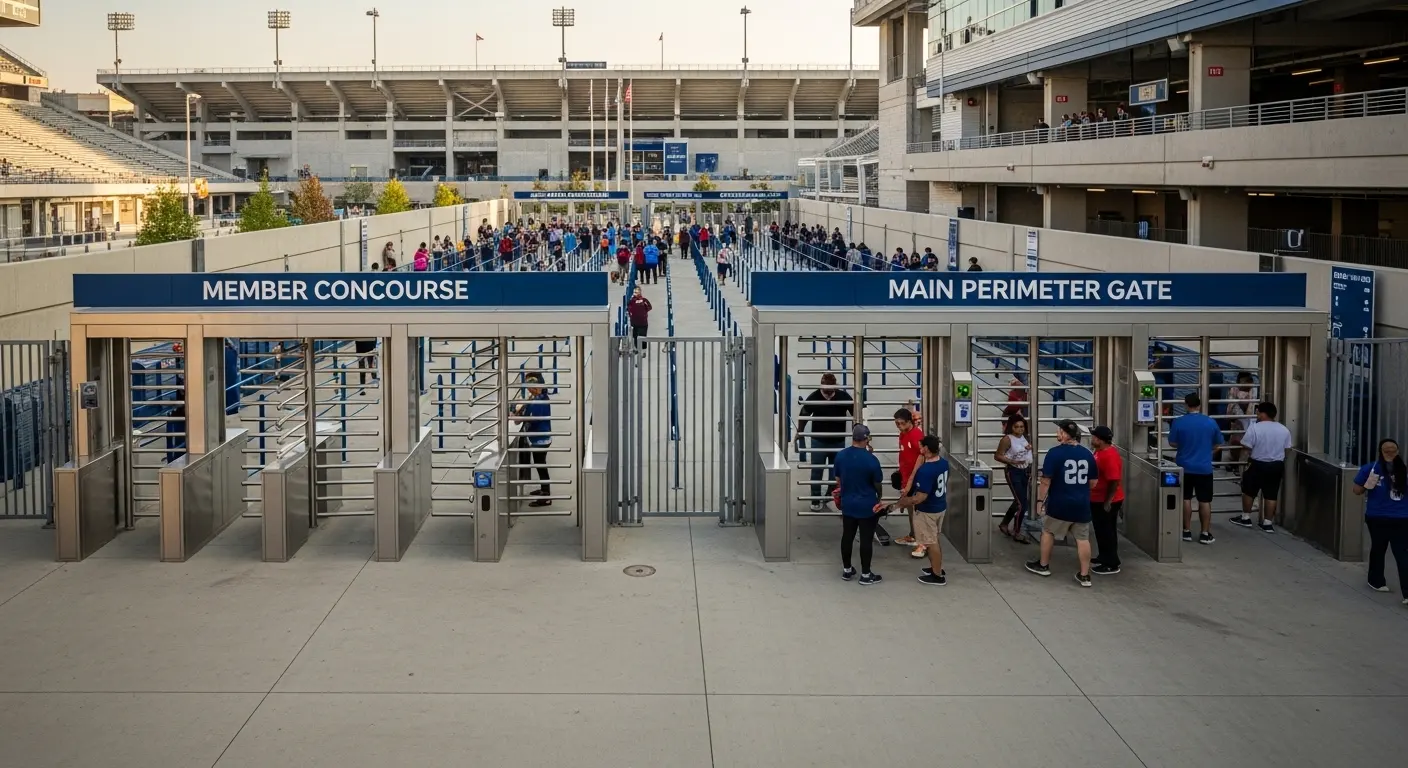
Tripod turnstiles are best for member and season ticket concourses, VIP entrances, secondary entry points, and internal zone checkpoints. Full-height gates remain the standard for main public perimeter positions. Most large stadiums deploy both types — tripod where throughput and credential verification are the priority, full-height where physical bypass prevention is a hard requirement.
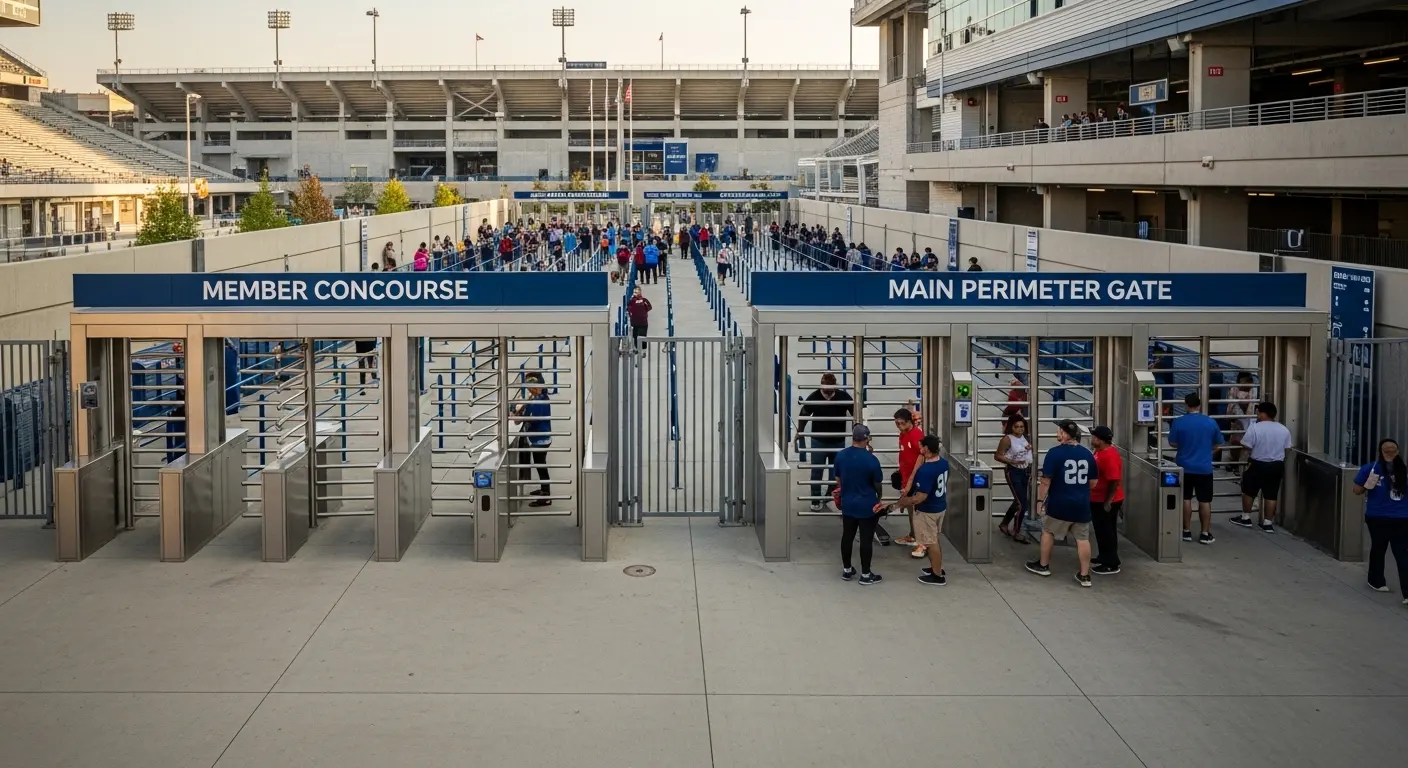
The core distinction is simple. A tripod verifies credentials and prevents tailgating. A full-height gate physically prevents climbing, jumping, or forcing through. For top-division football and major concert venues where ticket fraud is commercially significant, that physical barrier matters at the outer perimeter.
According to Security Solutions GB, full-height is the standard for main entrances and restricted areas; half-height or tripod is the practical choice for secondary entrances and VIP sections where fast access is the priority.
| Stadium Zone | Recommended Gate | Primary Reason |
|---|---|---|
| Main public perimeter gate | Full-height | Physical bypass prevention |
| Member / season ticket concourse | Tripod (IP65, heavy-duty) | Fast RFID/mobile throughput |
| VIP / premium entrance | Tripod or flap barrier | Credential verification; premium flow |
| Internal zone checkpoint | Tripod (IP54 indoor) | Zone access separation |
| Secondary / service entrance | Tripod (IP54/IP65) | Staff and contractor access |
| Exit gate | Tripod (exit-mode, drop-arm) | Egress management; fail-safe required |
For a full overview of stadium-specific gate options by zone, see Turboo's stadium turnstile gate range for sports venues and arenas.
How Many Tripod Turnstile Lanes Does a Stadium Need?
Divide your expected 30-minute peak entry load by 30 — the standard throughput for a full-automatic tripod lane in passages per minute. For a 50,000-seat venue with 80% of fans arriving in the final 30 minutes before kick-off, that is 40,000 entries requiring at least 45 simultaneously active lanes.
Gunnebo confirms that tripod turnstiles deliver around 30–40 passages per minute. Using the conservative 30 ppm figure gives a safe lane count floor, not a ceiling.
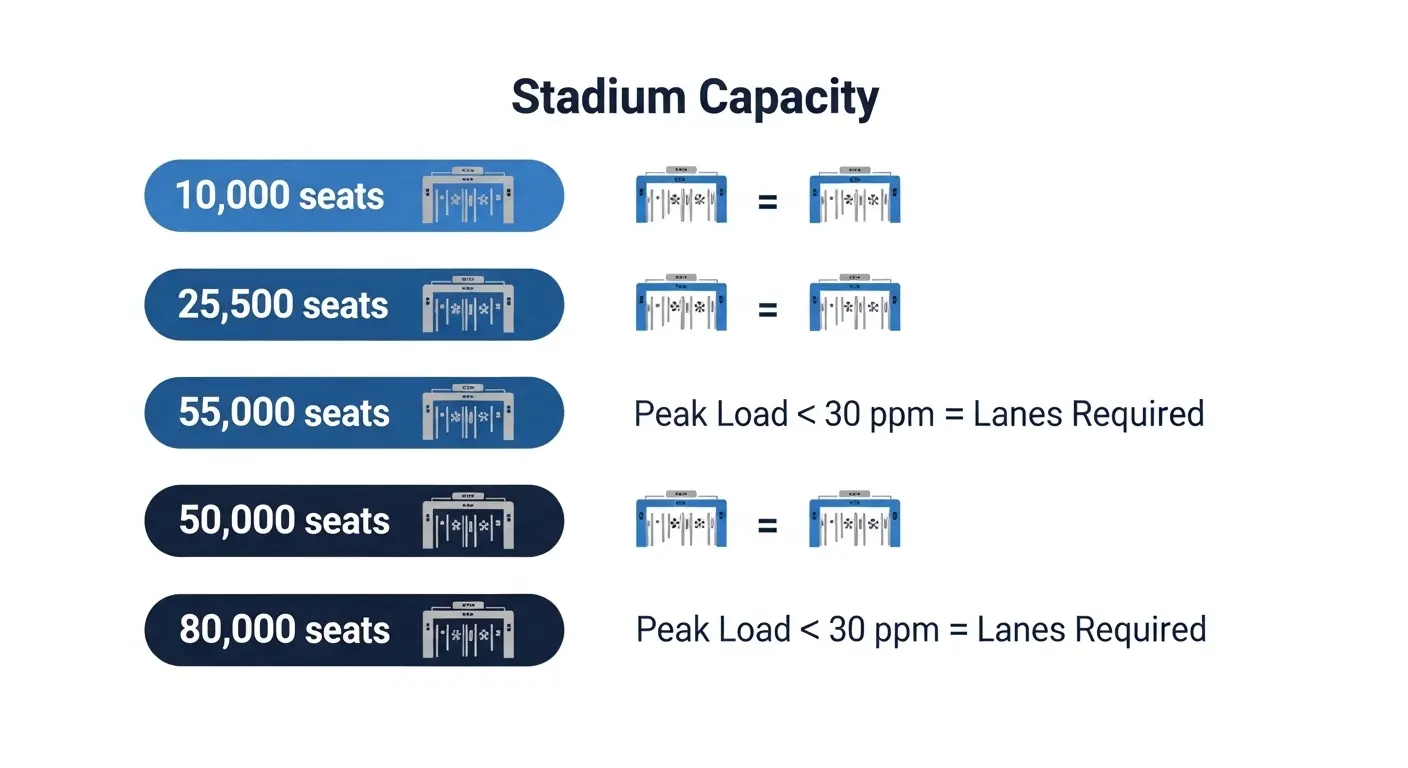
Sample Lane Count by Venue Size
| Venue Capacity | Peak 30-min Load (80%) | Minimum Lanes (30 ppm) |
|---|---|---|
| 10,000 | 8,000 | 9 |
| 25,000 | 20,000 | 23 |
| 50,000 | 40,000 | 45 |
| 80,000 | 64,000 | 72 |
Semi-Automatic vs. Full-Automatic for Event Day
A common specification mistake is choosing semi-automatic models to save cost. Semi-automatic tripod lanes deliver around 20 ppm — roughly 50% less throughput than a full-automatic model. At a 25,000-seat venue, that difference alone means needing 12 more lanes to match the same entry rate. Over the lifetime of the installation, the lane cost difference is far smaller than the crowd management risk.
For event-day positions, full-automatic tripod models are the correct specification. Semi-automatic models are appropriate only for low-traffic secondary entrances and staff access points.
What IP Rating Does an Outdoor Stadium Turnstile Need?
IP65 is the minimum specification for a fully exposed outdoor stadium perimeter position. It provides complete dust exclusion and protection against water jets from any direction. IP54 — sufficient for a school or office outdoor gate — is not adequate for an exposed stadium environment. SUS304 stainless steel is the minimum housing material; SUS316 is recommended for coastal or high-humidity tropical venues.
Stadium perimeter gates face conditions most access control installations never see: heavy rain, wind-driven dirt from pitch surfaces, pressure washing after events, and humidity cycling across seasons. IP65 sealing ensures the electronics and motor remain fully protected under all of these.
| Environment | Minimum IP | Notes |
|---|---|---|
| Covered concourse (semi-outdoor) | IP54 | Shielded from direct rain |
| Fully outdoor perimeter gate | IP65 | Direct rain, wind, dust, pressure wash |
| Coastal / tropical / high-humidity | IP66–IP67 | Salt air; possible standing water risk |
For the housing material, SUS304 stainless steel handles standard outdoor stadium environments. Coastal stadiums and tropical-climate venues should specify SUS316 — its higher molybdenum content provides significantly better resistance to salt air corrosion over a multi-year installation.
Turboo's outdoor-rated tripod turnstile range covers IP65-certified models with SUS304/316 housing and CE/ISO9001 certification — both of which are typically required in major venue procurement tender documents.
How Does a Stadium Tripod Turnstile Integrate with a Ticketing System?
A QR or barcode scanner module mounted on the turnstile reads the fan's ticket and transmits the code to the ticketing validation server. The server confirms the ticket is valid and unused, then returns a pass or fail signal to the gate controller — typically within 300 milliseconds. The gate opens or stays locked based on that response.
Mairsturnstile documents this validation cycle at under 300ms per scan — fast enough that a properly configured lane does not create perceptible delay for fans presenting their tickets.
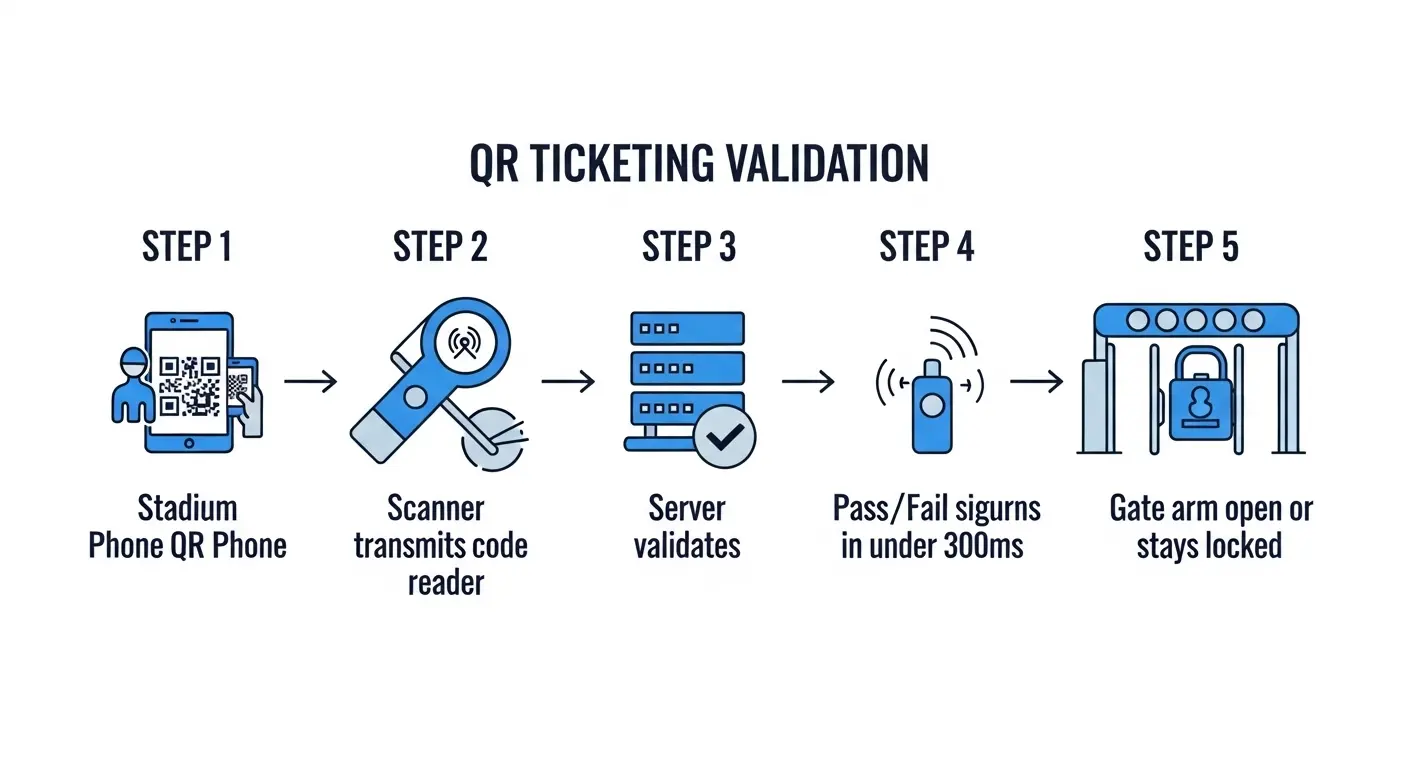
The complete workflow at each gate position runs as follows:
- Fan presents QR code on phone screen, printed ticket, or NFC mobile wallet
- The scanner reads the code and sends it to the ticketing server via the controller's TCP/IP or RS485 connection
- The server validates: is the ticket genuine, is it for the correct gate zone, has it already been scanned?
- A pass or fail signal returns to the gate controller in under 300ms
- The turnstile arm releases (pass) or remains locked (fail); the event is logged for revenue reconciliation
Single-use validation must be enforced across all lanes simultaneously in real time. Offline-only validation — where the gate checks a local cache rather than the live server — is not adequate for a multi-lane stadium installation.
Dual-Mode Operation: Event Day vs. Non-Event Day
The same tripod controller must handle two different operational modes. On an event day, it processes QR or NFC ticket codes for thousands of fans. On a non-event day, it manages RFID card access for staff, contractors, and maintenance personnel. No hardware change should be required between modes — the controller configuration switches the credential type and access rules.
Wembley Stadium's 2025 upgrade to digital QR and NFC readers at all turnstile positions confirms NFC digital wallet ticketing as the current direction for major venues. The turnstile hardware must support both 13.56MHz RFID and BLE/NFC reader protocols simultaneously to cover staff cards and fan mobile tickets from the same lane.
For RFID and multi-credential capable stadium tripod models, see the RFID tripod turnstile range with QR and mobile ticket integration.
Tripod vs. Full-Height for a Stadium: Which Gate for Which Zone?
The decision between tripod and full-height at a stadium is not a preference — it is a zone-specific specification question. Full-height turnstiles physically block passage at 2.0–2.3 meters, preventing any fan from jumping, climbing, or forcing through. Tripod gates verify credentials and deter tailgating, but they do not provide the same physical barrier.
| Criteria | Tripod | Full-Height |
|---|---|---|
| Physical bypass prevention | No | Yes |
| Throughput | 30–35 ppm | 15–20 ppm |
| Cost | Lower | Higher |
| Best zones | Member concourse, VIP, secondary, internal | Main public perimeter |
| IP65 outdoor spec available | Yes | Yes |
For venues where ticket fraud is a lower commercial risk — smaller arenas, community sports facilities, and indoor event venues — tripod at all entry positions may be acceptable. For top-division football stadiums or major concert venues, the financial and reputational cost of unauthorized entry justifies full-height at the outer perimeter.
In practice, most large stadiums operate both gate types across the same perimeter. Turniq notes that while tripod is more cost-effective, it does not provide the same deterrence as full-height for high-risk perimeter positions.
Matching the Right Stadium Tripod Turnstile to Your Venue
The correct model depends on venue capacity, gate environment, and ticketing system integration requirements. Here is a practical three-tier framework.
Tier 1 — Small Venue or Community Stadium (under 10,000 capacity)
Semi-outdoor or indoor positions; IP54 minimum, IP65 for exposed external gates; RFID card plus QR event mode; standard brushless full-automatic model. A standard full-automatic tripod turnstile handles this tier — multi-credential support, compact footprint, and a throughput rate sufficient for events up to 8,000–10,000 capacity.
Tier 2 — Mid-Size Stadium or Arena (10,000–50,000 capacity)
Fully outdoor perimeter gate positions; IP65-rated housing standard; QR/NFC ticketing plus RFID staff access on the same controller; dual-mode operation required; brushless motor at the highest available MCBF for sustained event-day cycle loads. CE and ISO9001 certification is often required at this tier in procurement specifications. Turboo's tripod turnstile for stadium entrance deployments covers this configuration with the outdoor durability and integration capability mid-size venues need.
Tier 3 — Major Stadium or Multi-Venue Operator (50,000+ capacity)
Enterprise-scale deployment with 50–200+ simultaneous tripod lanes at member and secondary zones; ticketing server SDK/API integration; mobile NFC and digital wallet support; real-time crowd analytics output from gate throughput data; facial recognition fast lanes optional for premium members. ISO9001 and CE are typically mandatory in tender specifications at this scale.
Expert Tip: A common mistake at mid-size venues is installing the correct model count but specifying a shared server connection across too many lanes. If the ticketing validation server cannot process simultaneous requests from all active lanes within 300ms, you will see gate hesitation and queue buildup despite having the right hardware. Verify server response time under concurrent load — not just single-lane validation — before signing off on the integration.
Frequently Asked Questions
What type of turnstile is best for a football stadium or sports arena entrance?
Most major stadiums use full-height gates at main public perimeter positions — they physically prevent bypass and deter ticket fraud. Tripod turnstiles are the standard for member concourses, VIP areas, secondary gates, and internal checkpoints, where throughput speed and credential verification are the primary requirements.
How does a stadium tripod turnstile connect to a QR code ticketing system?
A QR scanner module on the turnstile reads the ticket code and sends it to the ticketing server for real-time validation. The server returns a pass or fail signal in under 300ms. SDK or API integration connects the turnstile controller to third-party ticketing platforms without requiring hardware changes.
How many turnstile lanes does a stadium need for a sold-out event?
At 30 passages per minute per full-automatic lane, divide your expected 30-minute peak entry load by 30 to find your minimum lane count. A 50,000-seat venue with 80% arriving in the final 30 minutes requires at least 45 lanes running simultaneously.
What IP rating does an outdoor stadium tripod turnstile need?
IP65 is the minimum for fully exposed outdoor perimeter positions — complete dust exclusion and protection from water jets in any direction. IP54 is not sufficient for stadium environments. Coastal or tropical-climate venues should specify IP66 or IP67 for additional salt air and standing water resistance.
Can a stadium tripod turnstile accept NFC mobile tickets?
Yes. An NFC reader module reads digital tickets directly from Apple Wallet, Google Wallet, or venue apps. Wembley Stadium upgraded all its turnstile positions to support QR and NFC digital readers in 2025, confirming NFC mobile ticketing as the current standard for major venues.
What is the difference between a tripod and full-height turnstile for a stadium?
Full-height turnstiles stand 2.0–2.3 meters and physically block any attempt to climb or jump through. Tripod turnstiles are faster — 30–35 ppm versus 15–20 ppm — and cost less, but they do not provide the same physical barrier. Zone type should determine which one you specify.
Do stadium turnstiles need a drop-arm fail-safe for emergency egress?
Yes. Drop-arm fail-safe — automatic arm retraction on power loss or fire alarm signal — is a mandatory safety feature for any tripod turnstile installed at a public venue entry or exit position. Confirm this function is present in the controller specification and that it complies with your local fire safety and emergency evacuation regulations before procurement.
Ready to Specify Your Stadium Gate Configuration?
Stadium access control deployments vary significantly by venue size, gate environment, and ticketing platform. Turboo's access control specialists can review your venue layout and recommend the right tripod model, IP rating, lane count, and ticketing integration approach for each position.
Explore the full stadium tripod turnstile range or contact us for a venue-specific specification and project quote.