


School Tripod Turnstile: Safeguarding, Throughput, and Campus Deployment Guide


TL;DR: A school tripod turnstile is the most widely used access control gate in schools globally, balancing safeguarding enforcement, morning peak throughput, and budget. Key specifications are IP54 for outdoor main gates, role-based credentials by student age, anti-tailgating mechanism, and T&A integration. Tripod suits standard school entrances; full-height is only needed for the most restricted campus zones.
Specifying a school tripod turnstile carries a responsibility that no other access control deployment does: protecting children from unauthorized adult entry.
That requirement shapes every decision — from gate location and credential type to throughput planning for 800 students arriving in 15 minutes. This guide covers the safeguarding rationale, morning arrival lane planning, age-appropriate credentials, campus deployment by location, and a model matching framework by school type.
Why Do Schools Choose a Tripod Turnstile Over Other Gate Types?
Tripod turnstiles are the most popular access control solution for schools because they balance three priorities: safeguarding enforcement, fast morning peak throughput, and cost-effectiveness for school budgets. Swing gates suit high-traffic university lobbies; full-height turnstiles are reserved for the most restricted campus zones only.
Four reasons schools consistently choose tripod over alternatives:
- Safeguarding: The three-arm mechanism enforces one-person-per-credential entry, physically preventing unauthorized adults from following students through.
- Throughput: Full-automatic brushless models process 30–35 students per minute per lane — fast enough for peak school arrivals without dangerous crowding.
- Budget: Tripod turnstiles are considerably more cost-effective than full-height alternatives while still providing strong access enforcement for schools with limited procurement budgets.
- Durability: SUS304 stainless steel construction and drop-arm recoverability handle the daily wear of student use, including the kind of testing that secondary school students occasionally put gates through.
| Gate Type | Cost | Throughput | Best School Use |
|---|---|---|---|
| Tripod | Low–Medium | 30–35 ppm | Main entrance, library, sports hall |
| Swing/Flap | Medium | 40+ ppm | University lobby, admin reception |
| Full-Height | High | 15–20 ppm | Server room, pharmacy, restricted lab |
For a broader overview of school entrance management, the school entrance turnstile guide covers morning rush planning and staff workload reduction in more detail.
How Does a School Tripod Turnstile Support Safeguarding?
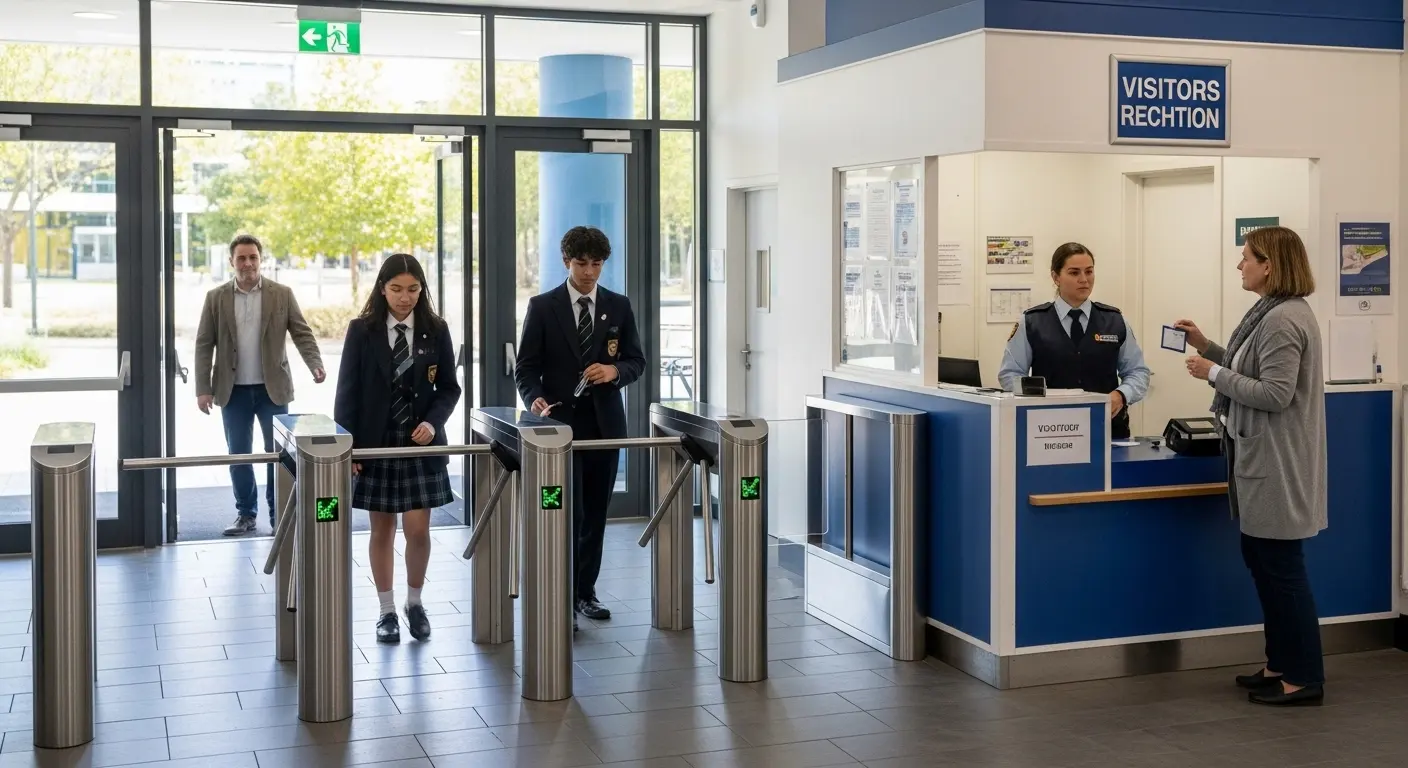
A school tripod turnstile supports safeguarding by enforcing one-person-per-credential entry, preventing unauthorized adults from tailgating students through the gate. Every entry is logged with a time-stamp and credential identity, creating an audit trail. Visitor access is managed separately, using time-limited passes issued only after registration.
Three safeguarding functions work together in practice.
Anti-tailgating enforcement is the physical core. The three-arm barrier resets after each single credential pass. No valid credential, no entry. This is the most direct mechanical safeguarding control a school gate can provide.
Visitor separation keeps parents, contractors, and delivery personnel on a completely different credential profile from students and staff. A visitor QR code grants time-limited access to a reception area only — never to student zones. Schools with controlled, logged visitor access reduce the risk of unauthorized individuals reaching student areas, which remains a primary concern in school security planning.
Audit trail for incident investigation records every entry and exit event. If a safeguarding concern arises, the gate log shows exactly who entered, when, and through which gate.
Parent pickup zones need separate planning. Parents collecting younger students need supervised, time-limited access to a designated collection area — not a gap in the main perimeter. A visitor QR pass with time-limited zone restriction is the standard solution.
For integration options that support visitor management workflows, see tripod turnstile access control configurations.
How Many Tripod Turnstile Lanes Does a School Need?
Divide peak student headcount by 30 (persons per minute per lane for a full-automatic model), then divide by your acceptable arrival window in minutes. A school with 800 students and a 15-minute arrival window needs at least two full-automatic lanes. Semi-automatic models at 20 ppm cause dangerous crowding at schools above 400 students.
The calculation in practice:
- Count the students in your largest single arrival wave
- Define your acceptable window (typically 10–20 minutes)
- Multiply: lanes × 30 ppm × window minutes = total capacity
- Add one lane if the result is within 15% of your peak headcount
Example: 1,000 students, 15-minute window. Two lanes at 30 ppm = 900 passes. Tight. Three lanes = 1,350. Comfortable with margin.
Tripod and flap barrier gates process approximately 30–35 students per minute — sufficient for most school peaks when lane count is correctly planned. The problem is almost always under-specified lane count, not the gate mechanism itself.
Semi-Automatic vs. Full-Automatic for Schools
Semi-automatic models run at roughly 20 ppm. For a school of 400 students with a 20-minute window, two semi-automatic lanes give 800 passes — workable. For anything larger or with a shorter window, full-automatic brushless models are the correct specification. The cost difference per unit is relatively small; the operational difference at peak arrival is significant.
What Credentials Work Best for a School Tripod Turnstile?
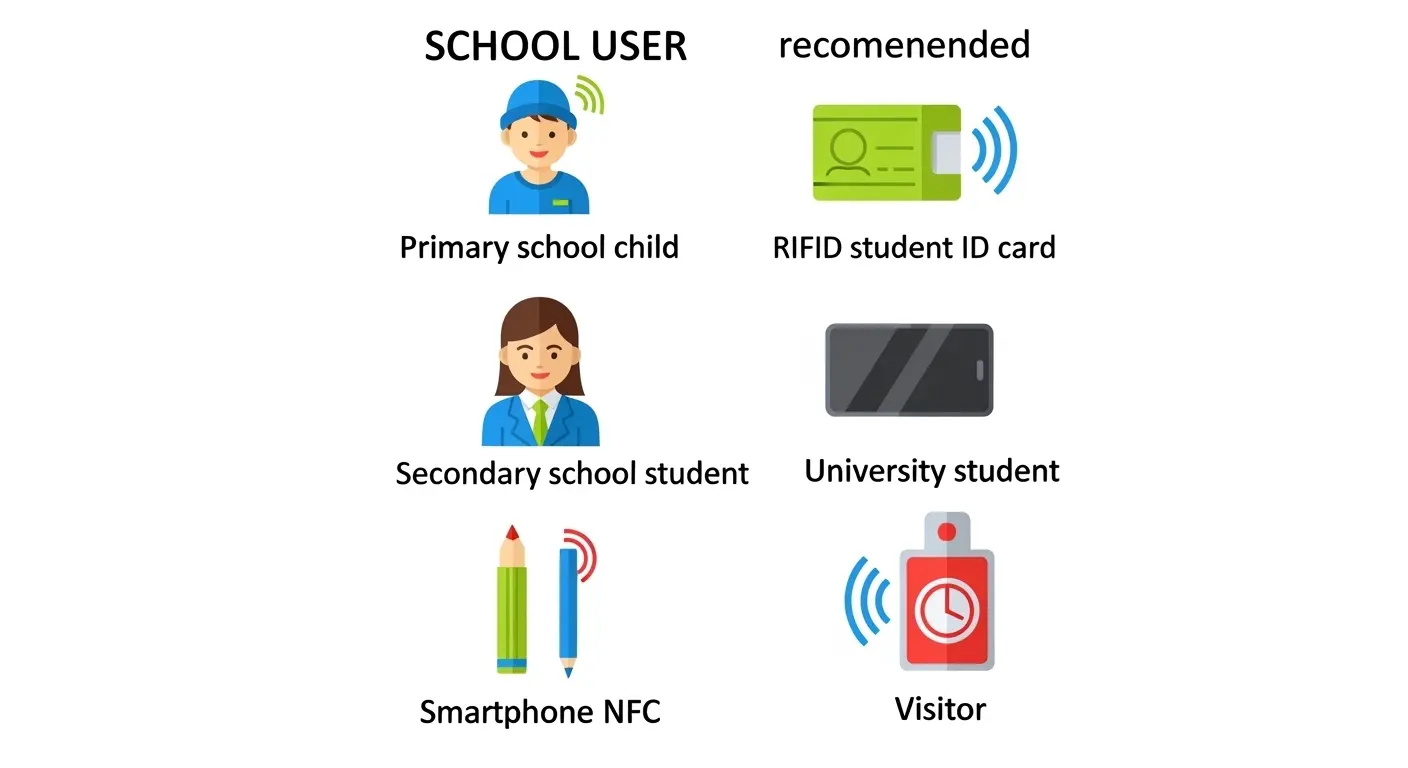
RFID student ID cards are the standard for primary and secondary schools — fast, centrally managed, and easy to revoke. Facial recognition is growing in adoption for secondary schools and universities. Mobile NFC credentials are increasingly expected at university level. Visitor and contractor credentials must always be a separate, time-limited profile with no access to student zones.
Nearly 70% of educational campuses use card or biometric access control, and that figure has risen steadily since 2022. The right credential type, however, varies by student age.
| School Type | Recommended Credential | Why |
|---|---|---|
| Primary (under 12) | RFID card or wristband | Simple, fast, centrally managed; supports parent-linked arrival alerts |
| Secondary (12–18) | RFID card + optional QR visitor pass | Standard; fast to revoke; visitor management integration |
| College/University | Mobile NFC + RFID card | Mobile-first expectations among students in 2025–2026 |
| Visitors and contractors | Time-limited QR or intercom | Separate from student profiles; logged and time-stamped |
One practical note on fingerprint readers: they are generally not appropriate for primary school students. Hygiene concerns, variable read accuracy with small hands, and the time pressure of morning arrivals all work against biometric finger scanning at that age group. RFID remains the most reliable credential for under-12s.
For RFID-compatible models with multi-profile controller support, see RFID tripod turnstile options for student ID integration.
Where in a School Campus Should You Install Tripod Turnstiles?
Schools are rarely single-gate deployments. Each location has different environmental, throughput, and credential requirements. The table below gives a practical starting framework for most school campus layouts.
| Campus Location | Environment | IP Rating | Credential | Priority |
|---|---|---|---|---|
| Main entrance gate | Outdoor/semi-outdoor | IP54 min (IP65 if fully exposed) | RFID + visitor QR | Critical |
| School library | Indoor | Standard | RFID student ID | Recommended |
| Sports hall | Indoor or semi-outdoor | IP54 if semi-outdoor | RFID | Recommended |
| Boarding dormitory | Semi-outdoor | IP54 min | RFID + curfew alert | Essential for boarding |
| Canteen | Indoor | Standard | RFID (budget-dependent) | Optional |
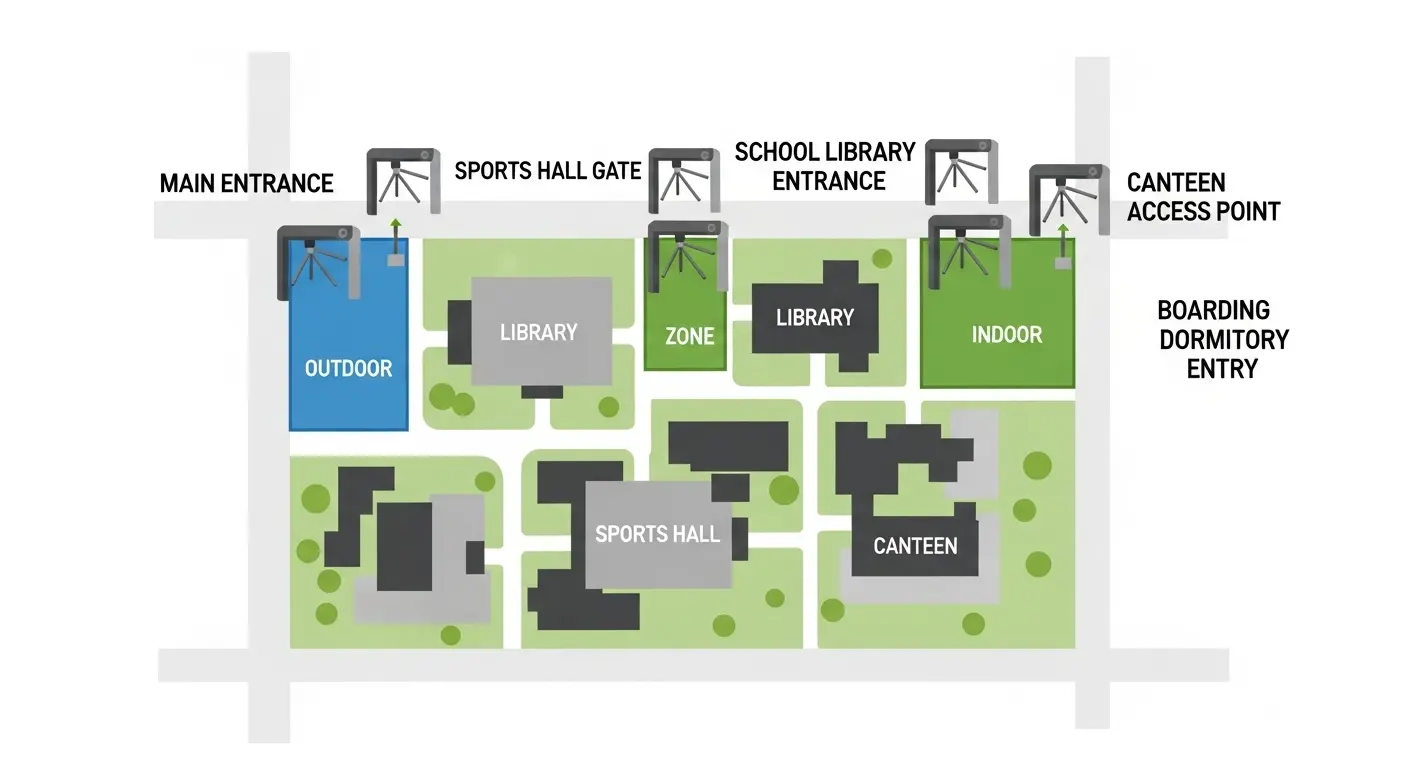
The main entrance gate carries the heaviest specification requirements: outdoor-rated housing, highest MCBF for daily student volume, visitor management integration, and full safeguarding audit logging. Every other location can typically use a lighter indoor-grade specification.
Boarding school dormitories are a special case. They run 24/7, need curfew return-time logging, and trigger alerts for overdue arrivals — functions that integrate with the same T&A platform as the main entrance gate.
For planning the physical installation of campus gate positions, the turnstile installation guide covers cabling, foundation, and connection requirements for school sites.
Matching the Right School Tripod Turnstile to Your Campus
The correct model depends on your school's size, gate environment, and credential requirements. Here is a practical three-tier framework.
Tier 1 — Primary School or Small Secondary (up to 300 students)
Single-lane main entrance; covered or semi-outdoor gate; IP54 minimum; RFID card; standard brushless automatic model; T&A output for attendance; parent notification integration possible. Turboo's full automatic tripod turnstile covers this tier — fast cycle time, multi-credential support, and a compact footprint for corridor-style school entrances.
Tier 2 — Secondary School or College (300–1,500 students)
Two-lane main entrance minimum; outdoor IP54 rated; visitor management QR plus RFID; brushless motor; anti-tailgating; attendance data linked to school MIS. This tier needs a higher MCBF than Tier 1 given the volume of daily cycles across three to five years of operation.
Tier 3 — University Campus (multi-building, multi-location)
Multiple gate locations across campus; cloud-based access management for remote credential issuance; mobile NFC plus biometric at high-security locations; IP65 for fully outdoor positions; dormitory curfew integration. CE and ISO9001 certification is a standard university procurement requirement — Turboo's industrial range carries both, supporting international campus procurement processes.
Browse the full tripod turnstile range for complete specifications across all school deployment tiers.
Expert Tip: The most common specification mistake in school deployments is buying the same model for every gate location. The main entrance needs outdoor IP54 rating, high MCBF, and visitor management integration. The library gate needs none of those — a standard indoor-grade unit is appropriate and significantly cheaper. Map each gate's environment and user type before selecting a model, not after. Turboo's school access control team can help you build a gate-by-gate specification for your campus layout before you finalize the procurement.
Frequently Asked Questions
Is a tripod turnstile suitable for a school entrance?
Yes. Tripod turnstiles are the most widely used access control gate in schools globally, balancing safeguarding enforcement, morning peak throughput, and cost. They prevent tailgating, log every entry with a time-stamp, and integrate with student ID and visitor management systems. Full-height is only necessary for the most restricted campus zones.
How does a school tripod turnstile prevent unauthorized visitors?
The three-arm mechanism enforces one-person-per-credential entry, blocking anyone without a valid credential from passing. Visitor management integration issues time-limited QR passes after registration and identity check. Every entry is logged with time-stamp and credential identity, supporting the school's safeguarding audit requirements.
How many tripod turnstile lanes does a school of 1,000 students need?
At 30 persons per minute per lane, two full-automatic lanes clear 900 passes in a 15-minute window. Three lanes give comfortable margin for 1,000-student schools. Semi-automatic models running at 20 ppm are not recommended for schools above 400 students due to peak-arrival bottlenecks.
What IP rating does an outdoor school gate turnstile need?
IP54 is the minimum for outdoor or semi-outdoor school main gates exposed to dust and humidity. IP65 is recommended for fully exposed, coastal, or heavily weathered environments. Standard indoor units without IP certification degrade quickly in outdoor school gate conditions and are not appropriate for external installations.
What credentials work best for primary school students?
RFID cards or wristbands are the most reliable for under-12s — fast, centrally managed, and easy to replace if lost. Fingerprint readers are generally not appropriate at this age due to read reliability and hygiene concerns. Parent-linked arrival alerts can be integrated with the same RFID credential for real-time attendance notification.
Can a school tripod turnstile connect to the school's attendance system?
Yes. Most school tripod turnstiles connect to student MIS platforms via RS485, TCP/IP, or Wiegand. Each credential swipe generates a time-stamped attendance record that feeds directly into the school register. Access control software adoption in schools rose from 42% in 2022 to 51% in 2024, and MIS integration is now a standard expectation in most procurement specifications.
How much does a school tripod turnstile cost?
Unit prices range from approximately $300 for basic indoor semi-automatic models to $1,000+ for outdoor IP54-rated full-automatic units with visitor management integration. For schools with limited budgets, tripod turnstiles are considerably more cost-effective than full-height alternatives while still providing strong safeguarding enforcement at the main gate.
Ready to Specify Your School Gate?
Every campus has different gate environments, student enrollment levels, and safeguarding requirements. Turboo's access control specialists can review your campus layout and recommend the right tripod turnstile model, IP rating, and credential configuration for each location.
Contact the team or browse the full tripod turnstile range to start your school gate specification.