


Campus Tripod Turnstile: Zone-by-Zone Deployment Guide for Universities and Colleges

TL;DR: A campus tripod turnstile manages access across university dormitories, dining halls, libraries, recreation centers, and research buildings — each requiring different specifications. Key requirements are SIS integration for automated credential management, IP54 for outdoor positions, ADA-accessible lanes at every installation, and mobile credential support. Tripod is the cost-effective choice for most campus zones; speed gates suit high-visibility main lobbies.
A university campus presents a challenge that no factory or office deployment does: it must be genuinely open and genuinely secure at the same time.
A campus tripod turnstile manages that balance — but only when it is specified correctly for each zone, integrated with student data systems, and paired with ADA-accessible lanes as required by law. This guide covers gate type selection by campus zone, SIS integration requirements, credential planning for 2026 student expectations, ADA and Clery Act compliance, and a model matching framework by campus tier.
Why Does a Campus Need a Different Tripod Turnstile Strategy?
A university is not a single deployment. It is a network of locations — each with different security requirements, user types, and traffic patterns. Dormitories need 24/7 resident-only access. Dining halls need fast meal-plan throughput. Research labs need high-security credential verification. No single gate configuration serves all of them.
Scale is the first reason campus deployments are categorically different. A large university may have 50,000+ active cardholders, with 10–20% of that population changing every year as students graduate and new cohorts enroll.
The second reason is cultural. Universities are open academic communities. Security that feels like a perimeter lockdown creates real friction with faculty, student bodies, and institutional values. Every gate placement decision carries that tension.
The third reason is multi-zone complexity. A dining hall gate has almost nothing in common with a research lab gate — different IP requirements, different credential types, different throughput needs, and different access rules. Planning starts with the map, not the model.
For Turboo's full connected-campus access framework, see the smart campus access control solution for multi-building deployments.
Tripod vs. Speed Gate vs. Full-Height: Which Gate for Which Campus Zone?
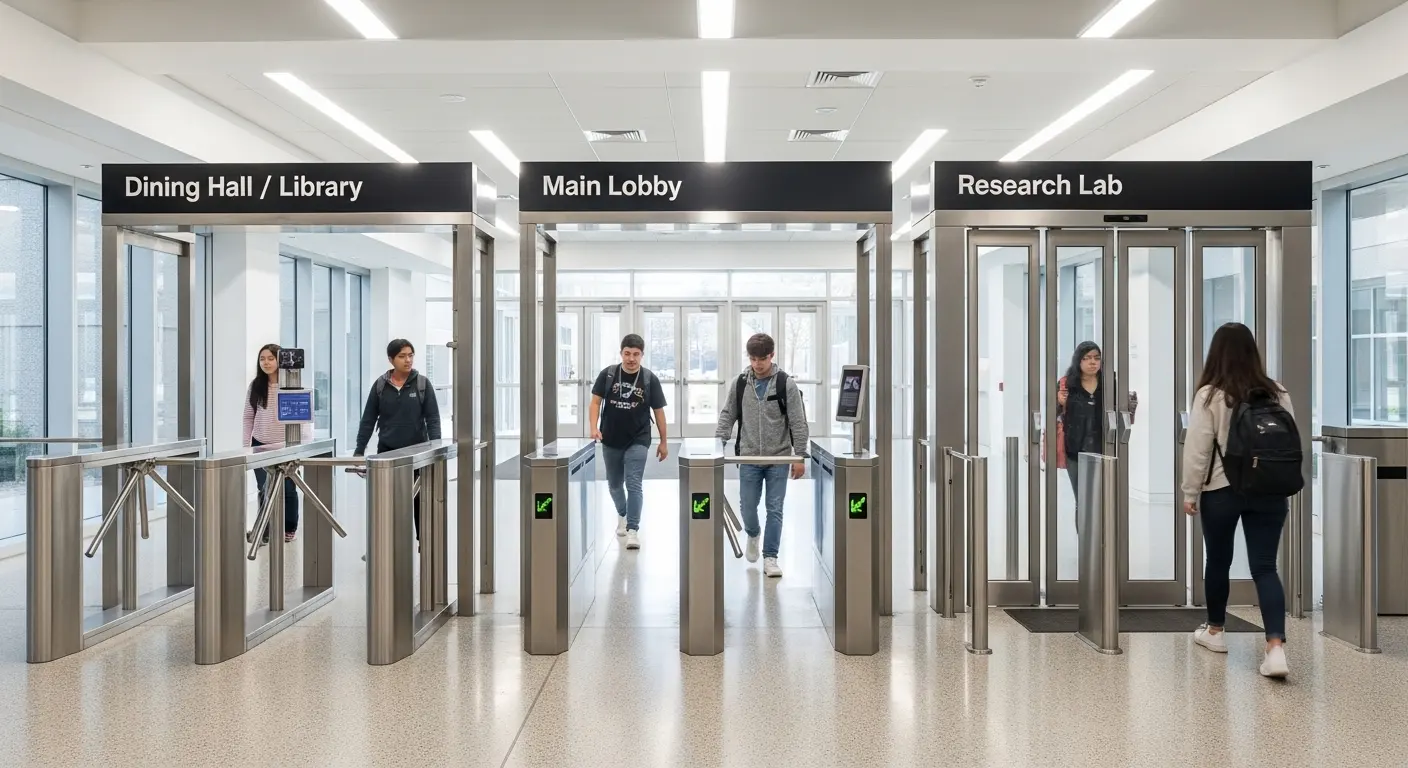
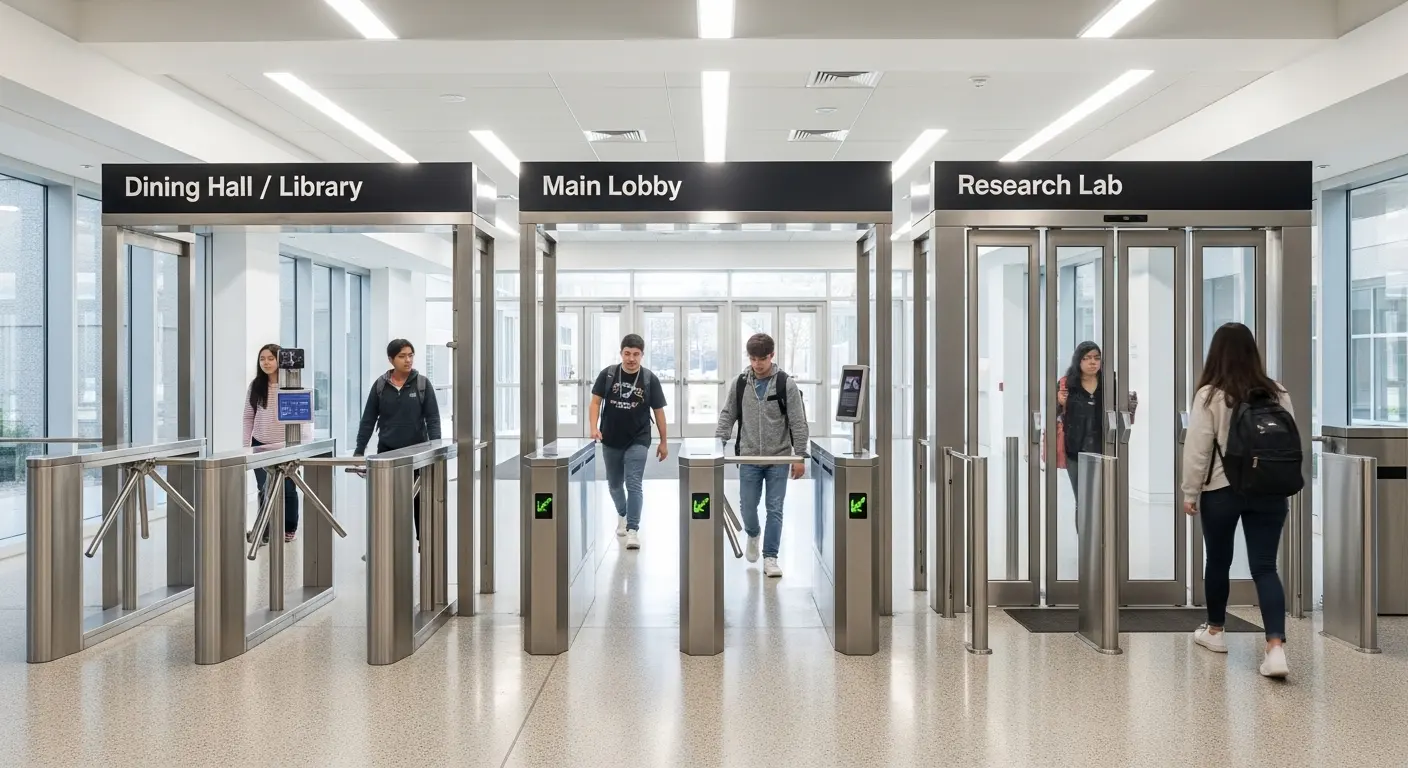
Tripod turnstiles are the most cost-effective solution for standard campus zones — dining halls, libraries, recreation centers, and dormitory secondary entrances. Speed gates suit modern, high-visibility main lobbies where aesthetics matter. Full-height is generally avoided for campus building entrances due to its visual impact, and is reserved only for the highest-security restricted zones.
The practical split for most campuses:
| Gate Type | Best Campus Zones | Cost | Cultural Fit |
|---|---|---|---|
| Tripod | Dining hall, library, recreation center, dormitory entrance, internal checkpoints | Low–Medium | Acceptable in functional spaces |
| Speed Gate / Flap Barrier | Main building lobby, student union, administrative entrance | Medium–High | High — preferred for visible public areas |
| Full-Height | Research lab perimeter, data center, pharmacy | High | Poor — restricted zones only |
The key insight here is that most campuses need both tripod and speed gates — the decision is about which type belongs at which location, not one type across the whole campus.
Browse the full campus tripod turnstile range with throughput and IP specifications to compare models across these zones.
Where Should You Install a Campus Tripod Turnstile?
Campus tripod turnstiles work best at dormitory secondary entrances, dining halls, libraries, recreation centers, and research building side entrances. Main visible lobbies typically suit flap barriers for aesthetic reasons. Each location needs its own specification — IP rating, throughput, and credential type vary significantly between zones.
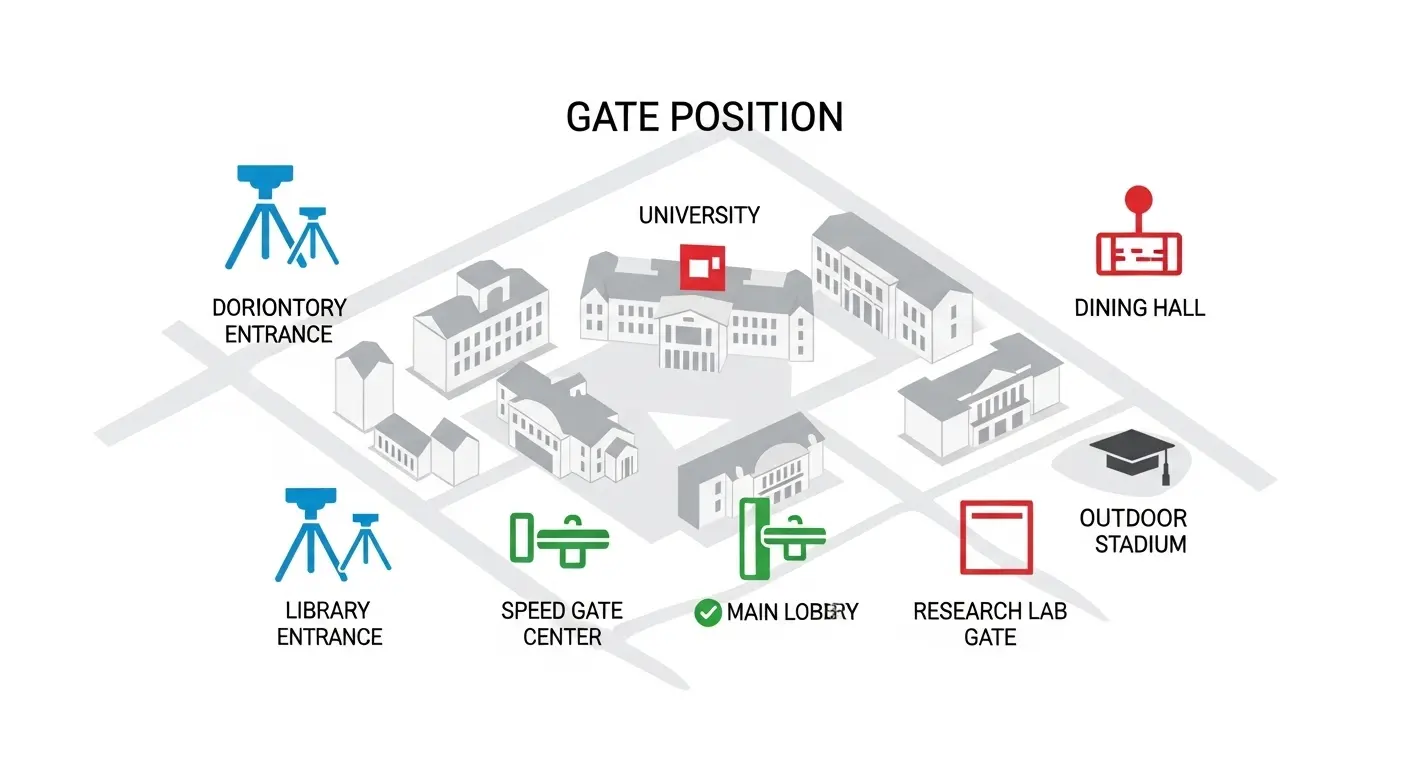
The table below is a practical deployment framework for most university campuses.
| Campus Zone | Environment | IP Rating | Primary Credential | ADA Lane | Priority |
|---|---|---|---|---|---|
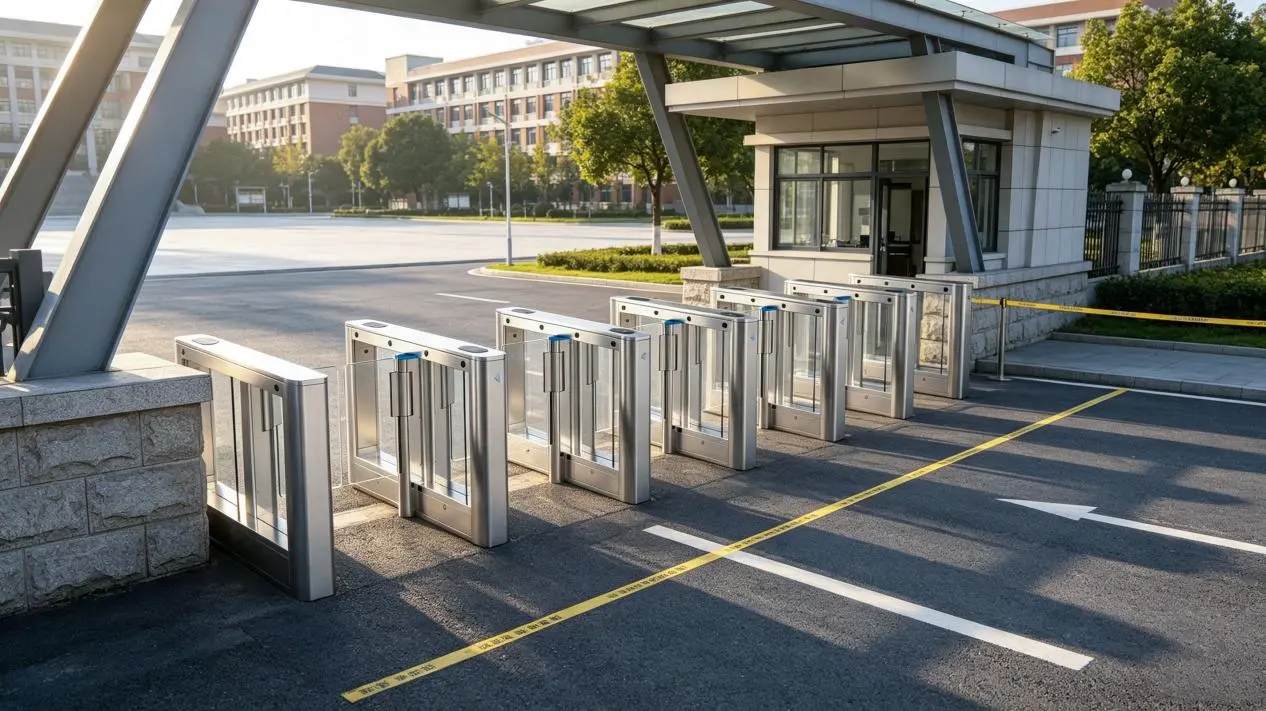
| Dormitory entrance | Semi-outdoor | IP54 min | RFID/mobile + guest QR | Required | Critical |
| Library entrance | Indoor | Standard | RFID student ID | Required | Recommended |
| Dining hall | Indoor | Standard | RFID meal plan card | Required | Recommended |
| Recreation center | Indoor/semi | IP54 if semi-outdoor | RFID / mobile | Required | Recommended |
| Research lab | Indoor | Standard | RFID + biometric 2FA | Required | High-security |
| Stadium / event venue | Outdoor | IP65 | QR ticket / RFID event mode | Required | Event-dependent |
Dormitory Entrances Deserve Special Attention
Dormitories run 24/7. They carry the highest personal safety requirement on campus — particularly for late-night return. The gate must support resident credentials, pre-registered guest access via QR, and curfew-alert logging for institutions that require it.
The MCBF specification matters more here than anywhere else. A dormitory gate cycling around the clock across a full academic year requires a model rated for 8–10 million cycles minimum. Fastlane's university library deployment demonstrates how bi-directional lane configuration handles peak-period flow — a relevant reference for any high-traffic campus location.
For campus gate positioning and cabling requirements, the tripod turnstile installation guide covers foundation, wiring, and connection specifics for each environment type.
How Does a Campus Tripod Turnstile Integrate with Student Systems?
The tripod turnstile controller connects to the Student Information System (SIS) and HR platform via RS485, TCP/IP, or Wiegand. SIS integration enables automatic credential provisioning when students enroll and automatic revocation when they graduate or withdraw — eliminating manual card management across thousands of users.
Manual provisioning is a non-starter at university scale. Without SIS integration, every enrollment, withdrawal, graduation, and staff change requires a manual credential update. For a university with 20,000 students and 3,000+ staff, that is operationally impossible.
In practice, campus integration follows four steps:
- Credential database sync: The turnstile controller pulls enrollment and access-rights data from the SIS on a scheduled basis
- Controller connection: RS485, TCP/IP, or API integration connects the gate hardware to the campus access management platform
- Permission rules by zone and role: Undergraduate students get dining and library access; PhD researchers get research building access; residents get dormitory access
- Automatic event logging: Every entry and exit generates a time-stamped record, feeding attendance, safety, and compliance systems
The same connection supports emergency lockdown protocols. Campus lockdown commands sent from the central security system reach every gate controller simultaneously — locking or releasing all gates across the entire campus.
Access control software adoption in higher education rose from 42% in 2022 to 51% in 2024, and SIS-connected gate management is now a standard specification in university access control RFPs.
What Credentials Work Best for a Campus Tripod Turnstile?
13.56MHz smart cards (MIFARE DESFire) are the current campus ID standard — secure, multi-application, and compatible with dining, library, and access control in one card. Mobile credentials via BLE or NFC are growing fast. Legacy 125kHz proximity cards should be replaced as a security risk — they are easily cloned and no longer appropriate for campus deployments.
Incoming students increasingly expect mobile-only access options, and in 2026 institutions still issuing physical-card-only credentials face friction with new cohorts. The tripod reader must support both 13.56MHz RFID and BLE/NFC simultaneously during the transition period.
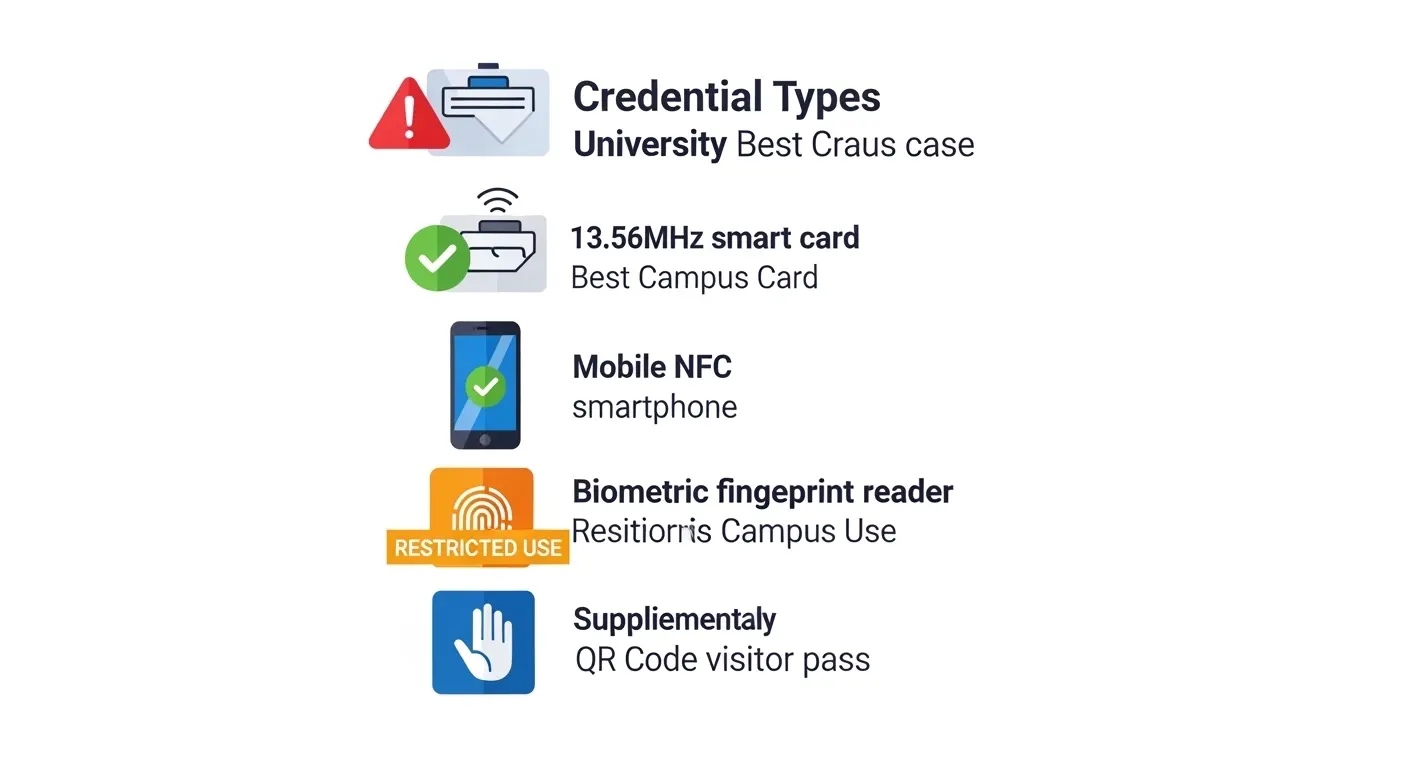
| Credential Type | Status | Best Campus Use | Risk Level |
|---|---|---|---|
| 125kHz proximity card | Legacy — replace now | None | High — easily cloned |
| 13.56MHz smart card (MIFARE DESFire) | Current standard | All campus zones | Low if encrypted |
| Mobile NFC / BLE | Growing standard | All zones — student preference | Low |
| Biometric second factor | Specialized | Research lab, data center | Privacy/enrollment complexity |
| Visitor / event QR code | Supplemental | Guest visits, events | Time-limited; log carefully |
Biometric readers are not practical for mass campus deployment. Enrollment logistics for thousands of students, combined with significant privacy concerns, make biometrics unsuitable as a primary campus-wide credential. Reserve them for a small number of genuinely restricted locations.
For RFID and mobile-credential-compatible models, see the RFID tripod turnstile range with campus student ID integration.
Does a Campus Tripod Turnstile Need to Comply with ADA and Clery Act Requirements?
Yes on both counts. ADA requires at least one accessible-width gate lane alongside every tripod installation — mandatory at all US campus access points. The Clery Act requires US universities to maintain auditable campus safety records; time-stamped tripod turnstile entry logs directly support this compliance requirement.
ADA Accessibility
ADA compliance is not optional. Every bank of tripod turnstiles at a US campus must include at least one accessible-width companion lane — typically a swing gate or wider sliding gate with 32–36 inches of clearance. Failure to include an ADA lane creates both legal liability and real exclusion for students and staff with mobility needs.
Plan for the ADA lane from the start of the site design, not as an afterthought. It affects the total footprint of each gate installation significantly.
Clery Act Compliance
The Jeanne Clery Act requires US universities to collect and publish campus safety data and maintain auditable records. Tripod turnstile controllers that log every entry and exit event with a credential ID and time-stamp generate exactly the kind of structured access record that supports Clery compliance.
Before procurement, verify that your turnstile controller stores event data in a retrievable, exportable format. Some controllers log locally only; for Clery compliance, data must be accessible for auditing and reporting.
Matching the Right Campus Tripod Turnstile to Your Institution
The correct model depends on campus size, gate environment, IT integration requirements, and credential mix. This three-tier framework covers most university configurations.
Tier 1 — Small College (up to 2,000 students, 2–4 buildings)
Single or dual-lane per building; primarily indoor; IP54 for dormitory; 13.56MHz RFID; standard brushless automatic model with SIS integration via RS485/TCP/IP. Turboo's full automatic tripod turnstile is well suited here — multi-credential support, compact footprint, and an MCBF rating suitable for 24/7 dormitory operation.
Tier 2 — Mid-Size University (2,000–15,000 students, multi-building)
Multi-lane entrances at high-volume locations; IP54 minimum for dormitory and perimeter gates; mobile NFC plus RFID card; zone-specific access profiles; SIS and HR integration; cloud-based management strongly preferred. A mix of Turboo's heavy-duty outdoor range for external positions and standard automatic models for dining and library positions covers this tier efficiently.
Tier 3 — Large University or Multi-Campus (15,000+ students)
Enterprise-scale deployment across 20–100+ controlled access points; cloud-based access management; mobile-first credential stack; biometric second-factor at restricted research locations; IP65 for fully outdoor positions; full Clery Act audit logging; ADA lanes at every gate position. The global school and campus security market is projected to grow from $3 billion in 2024 to $9.2 billion by 2033 — and Tier 3 institutions are driving a significant portion of that investment. CE and ISO9001 certification is typically a mandatory procurement specification at this scale. Turboo's industrial range carries both.
Expert Tip: A common mistake in campus deployments is specifying the same tripod model for every location to simplify procurement. In practice, this over-engineers the library gate and under-engineers the dormitory gate. Map each location's environment, daily cycle count, and credential requirements before selecting models — the procurement cost difference is smaller than the operational difference over a five-year installation cycle.
Frequently Asked Questions
What type of turnstile is best for a university campus?
Tripod turnstiles are the most cost-effective option for dining halls, libraries, recreation centers, and dormitory entrances — the most common campus locations. Speed gates suit modern, high-visibility main lobbies. Full-height is only appropriate for research labs or data centers where physical bypass prevention is a hard requirement.
Where should tripod turnstiles be installed on a college campus?
The most effective campus tripod locations are dormitory entrances, dining halls, libraries, recreation centers, and research building secondary entrances. Main visible lobbies typically suit flap barriers. Each location has different IP, MCBF, and credential requirements — a zone-by-zone specification is more reliable than a single model decision for the whole campus.
Do campus turnstiles need to comply with ADA requirements?
Yes. ADA regulations require at least one accessible-width companion lane alongside any turnstile bank at a US campus access point. This typically means a swing gate or wider sliding gate with 32–36 inch clearance. ADA compliance is mandatory, not optional — and it must be planned as part of the initial gate footprint, not added later.
How does a campus tripod turnstile support Clery Act compliance?
Tripod controllers that log every entry and exit event with a time-stamp and credential identity create a structured audit record directly supporting Clery requirements. Before procurement, confirm that the controller stores event data in a format that is retrievable and exportable for compliance reporting. Not all controllers meet this standard.
Can a university campus turnstile use mobile phone credentials?
Yes. Mobile credentials via BLE or NFC are growing rapidly on campuses, particularly among incoming students who expect mobile-first access. The tripod reader must support both 13.56MHz smart card and BLE/NFC mobile protocols simultaneously — most campuses will run both during a multi-year card transition period.
How does SIS integration work with a campus tripod turnstile?
The turnstile controller connects to the SIS via RS485, TCP/IP, or API. This sync enables automatic credential provisioning when students enroll and automatic revocation when they graduate or withdraw — eliminating the manual card management that becomes unmanageable at scale. Staff credentials connect through the same platform via HR system integration.
How much does a campus tripod turnstile cost?
Unit prices range from approximately $400 for standard indoor full-automatic models to $1,200+ for heavy-duty outdoor IP54/IP65-rated units with mobile credential reader and multi-zone controller. A two-lane dormitory installation — including cabling, ADA companion gate, and SIS integration — typically ranges from $3,000–$6,000 depending on site conditions and existing infrastructure.
Ready to Specify Your Campus Gate Configuration?
Every campus is different — building types, student volumes, outdoor gate positions, and IT integration requirements all vary. Turboo's campus access control specialists can review your deployment brief and recommend the right tripod turnstile model, IP rating, credential reader, and integration approach for each zone.
Explore the smart campus solution or browse the full tripod turnstile range to start your campus specification.