


Factory Tripod Turnstile: The Industrial Specification Guide

TL;DR: A factory tripod turnstile is a cost-effective, high-throughput access control solution for industrial worker gates. Key specifications for factory use are IP rating (IP54 minimum), time-and-attendance integration, shift-change throughput capacity, and credential type suited to workers in PPE. For standard factory gates, tripod is the right choice. Full-height turnstiles are only necessary for high-security restricted zones.
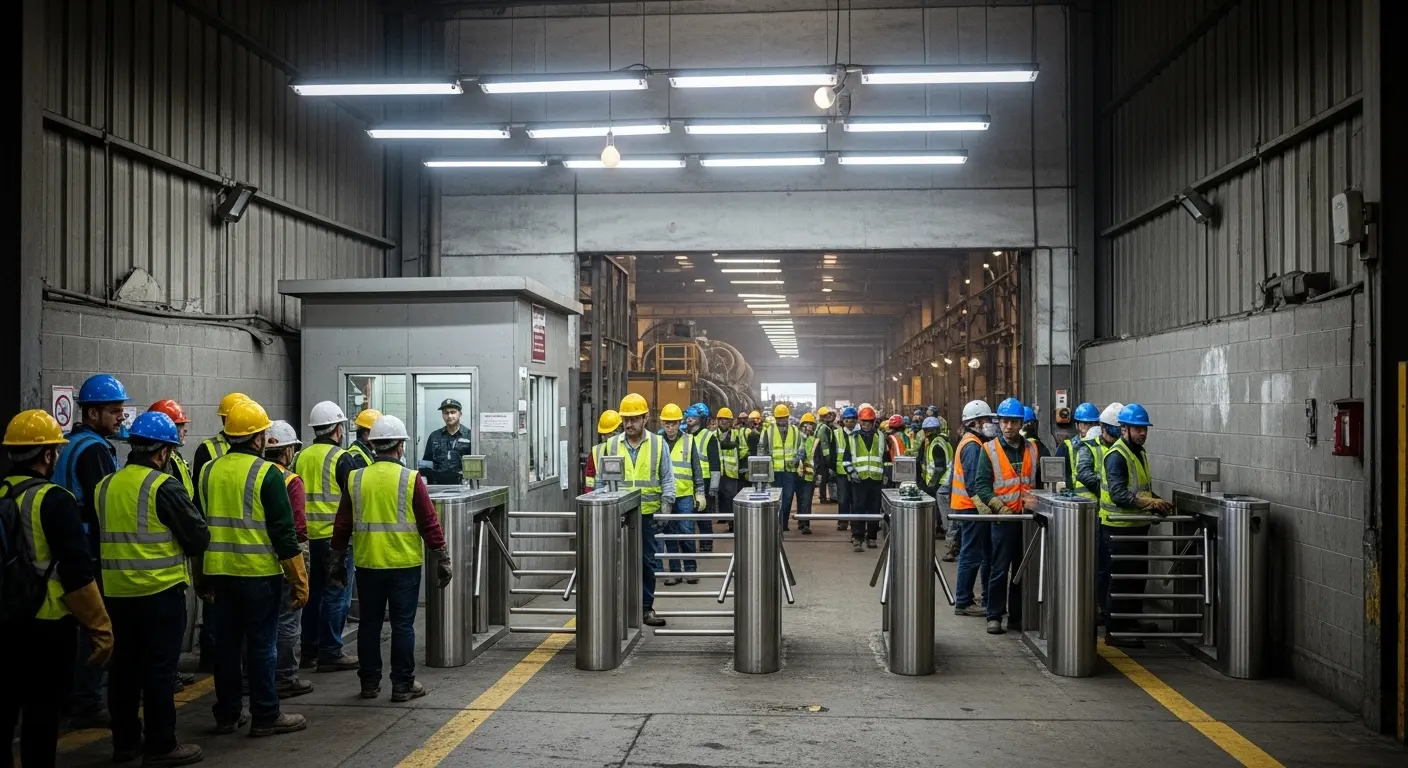
Managing a factory gate means solving two problems at once: controlling who enters during shift changes, and recording exactly when each worker arrives for payroll and safety compliance.
A factory tripod turnstile handles both — but only if it is specified correctly for industrial conditions. This guide covers IP rating requirements by site type, shift-change lane calculations, how to connect a tripod turnstile to your time-and-attendance system, and how to choose between tripod and full-height for different zones on your site.
Why Factory Environments Require a Specific Tripod Turnstile Specification
An office-grade tripod turnstile will not survive a factory gate. The environment is different, and so are the operational demands.
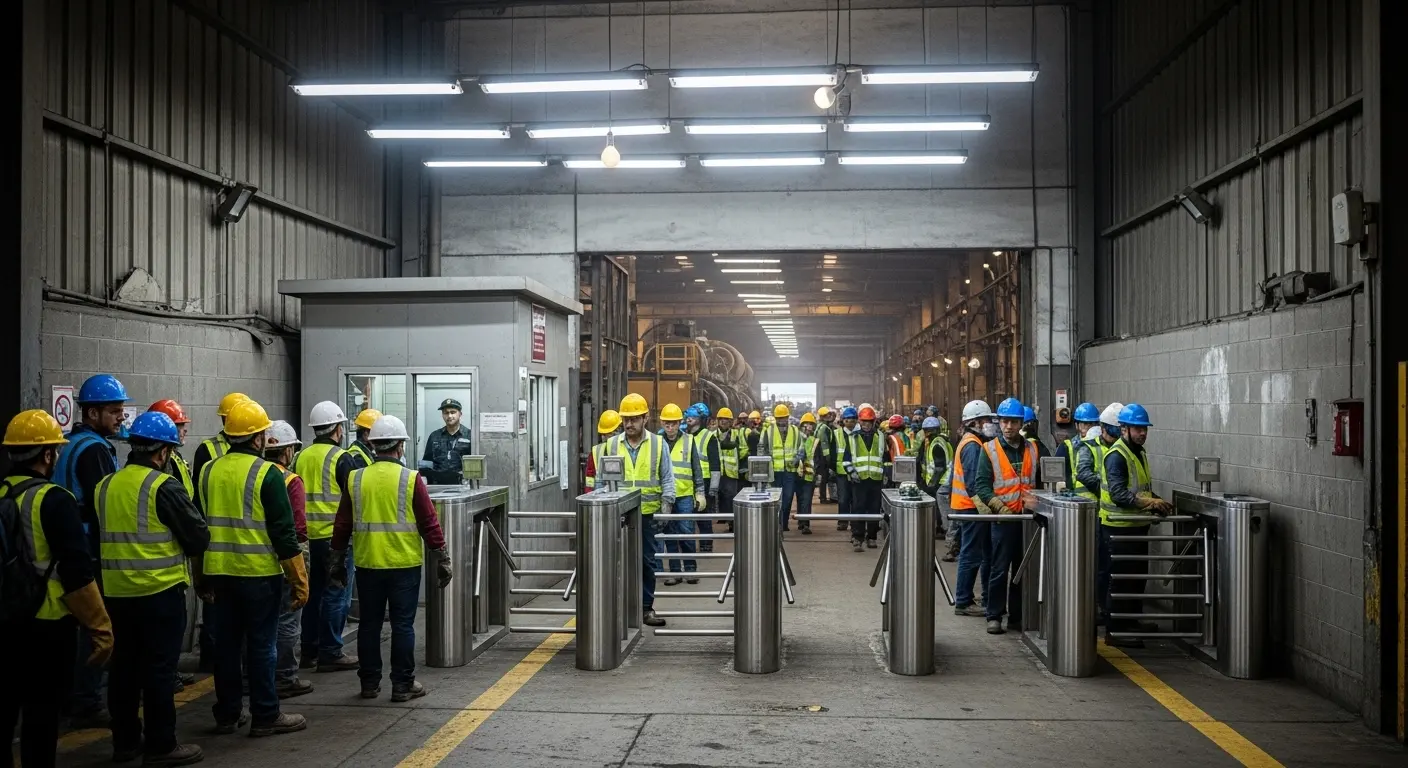
Three requirements set factory deployments apart:
- Industrial housing: Factory gates face dust, humidity, temperature swings, and in some cases chemical exposure. A model without the right IP rating will corrode or fail within months in these conditions.
- T&A data output: At a factory, the turnstile is the primary tool for recording worker attendance. If it doesn't connect to your HR or payroll platform, you've replaced one manual process with another.
- Shift-change volume: Hundreds of workers may need to pass through the same gate in a 10–15 minute window. Lane count and throughput are operational decisions, not afterthoughts.
The global access control market was valued at over $10 billion in 2024, with industrial facilities driving significant demand. Getting the factory specification right matters more than ever.
For context on higher-security factory applications, see factory access control solutions including full-height options.
What Should a Factory Tripod Turnstile Include?
Factory buyers often compare spec sheets that look similar on paper. These six criteria separate a factory-grade specification from a generic purchase.
Environmental and Material Criteria
IP Rating: IP54 is the minimum for factory entrances with dust exposure, humidity, or semi-outdoor positioning. It protects against directional water spray and dust ingress. For fully outdoor factory gates or coastal industrial sites, IP65 is required — this rating handles direct water jets and total dust exclusion. Standard indoor-grade units without IP certification are not appropriate for most factory gates.
Operating temperature range: Factory environments in northern climates or high-heat production areas demand a turnstile rated for a wide operating range. Industrial-grade models typically operate from -35°C to +60°C, covering most manufacturing environments globally.
Material grade: SUS304 stainless steel suits covered or indoor factory checkpoints. For outdoor, coastal, or chemically aggressive environments, SUS316 provides higher corrosion resistance and is the better long-term investment.
Operational Criteria
Time-and-attendance output: Confirm the unit outputs event data via RS485, TCP/IP, or Wiegand to your HR or payroll platform. This is the primary functional requirement for most factory buyers — not a secondary feature.
Credential type for workers in PPE: RFID card or fob readers are the most reliable for workers who wear gloves. Long-range RFID handles heavy-PPE environments without requiring a physical tap. Fingerprint readers are generally not appropriate for industrial workers. Facial recognition is growing in adoption and works well where hygiene or glove use makes card scanning impractical.
Throughput: Brushless motor automatic models process approximately 30–35 persons per minute per lane. Semi-automatic models run at around 20 ppm and create bottlenecks during shift changes at larger factories.
For RFID configuration options compatible with factory credential systems, see RFID-compatible tripod turnstile configurations.
How Many Lanes Does Your Factory Actually Need?
Divide your peak shift headcount by 30–35 (per-lane throughput per minute for an automatic model), then divide by your acceptable clearance window in minutes. For a 400-worker shift in 15 minutes, two automatic lanes at 30 ppm clear 900 passes — comfortably sufficient.
Here is the math in practice:
- Count the workers in your largest single shift
- Define your acceptable arrival window (typically 10–20 minutes)
- Multiply lane count × 30 (ppm) × window (minutes) = total capacity
- Add one lane if the result is within 20% of your peak headcount
Example: 500 workers, 15-minute window. One lane at 30 ppm = 450 passes. Not enough. Two lanes = 900 passes. Sufficient with margin.
Semi-automatic models at ~20 ppm produce a different result: two lanes for 500 workers in 15 minutes gives 600 passes — workable, but with a tight margin that creates queues if even a few workers swipe slowly.
Browse the full factory tripod turnstile range for automatic and semi-automatic models with published throughput specs.
Factory Tripod Turnstile vs. Full-Height Turnstile — Which Does Your Site Need?
Tripod turnstiles are right for standard factory worker gates. Full-height turnstiles are necessary only for restricted zones where physical bypass prevention is a hard requirement — chemical storage, server rooms, or high-value material areas.
Most factory sites use both. The main gate and internal production area checkpoints use tripod turnstiles for fast, high-volume access. A small number of restricted zones use full-height units where no one should be able to step over or bypass the barrier.
| Factor | Tripod Turnstile | Full-Height Turnstile |
|---|---|---|
| Cost per Lane | $300–$800 | $700–$1,500+ |
| Throughput | 20–35 ppm | 10–15 ppm |
| Bypass risk | Can step over | Cannot bypass |
| T&A integration | Yes | Yes |
| Best factory use | Main gate, production entry, canteen | Chemical store, server room, high-security perimeter |
| Installation footprint | Compact | Large |
For most factory buyers, the answer is tripod for the majority of gates, full-height for a small number of restricted checkpoints. If you are considering full-height for your main worker entrance, the throughput implications at shift change are worth calculating carefully.
See the full-height factory access control guide for restricted-zone applications.
Matching the Right Factory Tripod Turnstile to Your Site
The right model depends on your gate environment, daily traffic, and credential requirements. Here is a practical three-tier framework.
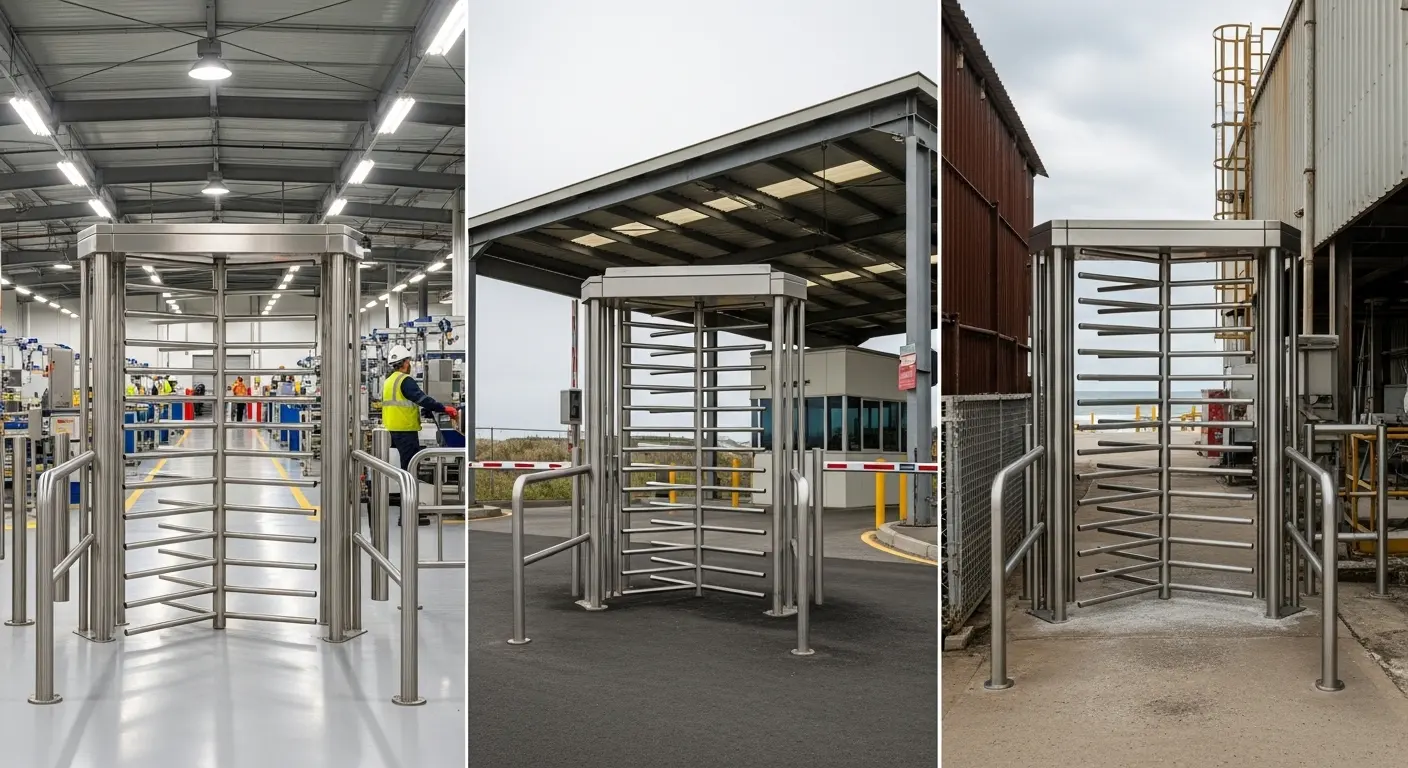
Tier 1 — Covered Indoor or Semi-Indoor Gate
Workshop entrance, internal production zone checkpoint, or factory canteen gate. Standard temperature range, no direct weather exposure. Dust and humidity may be present.
A slim automatic vertical-type model with SUS304 housing, IP54 rating, and RFID + QR integration covers this well. Turboo's automatic tripod turnstile fits this tier — brushless motor, bi-directional operation, RS485/TCP/IP output for T&A integration.
Tier 2 — Outdoor Factory Gate (Covered Canopy)
Main factory entrance under a roof canopy, industrial park gate, or warehouse loading area checkpoint. Exposure to wind, dust, and humidity, but not direct rainfall.
This tier needs a fully automatic model with IP54, brushless motor, and SUS304 or SUS316 housing depending on the local environment. Turboo's full automatic tripod turnstile is built for this environment — fast cycling, weather-aware assembly, and full credential compatibility.
Tier 3 — Fully Outdoor or Harsh Industrial Environment
Open-air gate at a coastal plant, petrochemical facility, heavy manufacturing site, or semiconductor factory with ESD requirements. Direct weather exposure, high dust, or chemical atmosphere.
This tier requires IP65 rating, SUS316 housing, and an outdoor-rated mechanism with the highest MCBF available. Turboo carries CE and ISO9001 certified models suited to this environment across its industrial range. Contact the team directly to confirm the right outdoor-rated configuration for your site's specific conditions.
How Does a Factory Tripod Turnstile Connect to Time-and-Attendance Systems?
A factory tripod turnstile connects to time-and-attendance software via RS485, TCP/IP, or Wiegand. Each credential swipe generates a time-stamped entry or exit event that feeds directly into HR or payroll platforms, replacing manual sign-in sheets with real-time automated records.
In practice, integration follows four steps:
- Select credential type (RFID card, biometric, QR code, or long-range RFID for PPE workers)
- Mount the reader module on or alongside the turnstile chassis
- Connect via RS485, TCP/IP, or Wiegand to your access control panel
- Link the panel to your T&A, HR, or payroll software
Most modern factory tripod turnstiles support multiple credential types on the same unit. You can start with RFID cards and add facial recognition later without replacing the gate hardware.
Turnstile systems with T&A integration allow real-time monitoring of worker entry and exit, which reduces payroll disputes and simplifies shift reporting. One additional benefit: demonstrating controlled site access can contribute to lower insurance premiums at industrial facilities.
For physical wiring and installation preparation, the turnstile installation guide covers factory gate setup requirements.
What Does a Factory Tripod Turnstile Cost?
Unit prices range from $300 for basic semi-automatic indoor models to $1,500+ for heavy-duty outdoor units with IP65 rating and integrated biometrics. Total installed cost — including cabling, credential hardware, and T&A integration — typically adds 30–50% to unit cost.
| Model Type | Typical Unit Price (USD) |
|---|---|
| Semi-Automatic (Indoor, IP54) | $300–$500 |
| Fully Automatic (IP54, Brushless) | $500–$800+ |
| Automatic + RFID/Biometric Integration | $700–$1,200+ |
| Heavy-Duty (IP65, Outdoor/Harsh) | $900–$1,500+ |
For a two-lane factory gate, budget unit cost × 2 plus the project overhead. Beyond the upfront cost, industrial turnstile installations reduce the need for manned security checkpoints, which lowers ongoing labor costs — a meaningful factor over a 3–5 year operational horizon.
Brushless motor models also carry a lower maintenance cost per cycle compared to semi-automatic mechanical units, which matters at a factory gate processing thousands of passes per day.
Expert Tip: Before requesting a quote, document three things: the gate's environment type (indoor/semi-outdoor/fully outdoor), your largest single-shift headcount and arrival window, and which T&A or payroll system the turnstile needs to connect to. Suppliers who receive these three data points can immediately confirm the correct IP rating, lane count, and interface protocol — saving multiple rounds of back-and-forth before you get a usable specification.
Frequently Asked Questions
Is a tripod turnstile suitable for a factory entrance?
Yes. Tripod turnstiles are widely used at factory gates worldwide for standard worker access control. They handle large shift volumes, integrate with time-and-attendance systems, and work with RFID, biometric, and QR credentials. Full-height turnstiles are only more appropriate for high-security restricted zones where physical bypass prevention is required.
What IP rating does a factory tripod turnstile need?
IP54 is the minimum for most factory gates with dust, humidity, or semi-outdoor exposure. Fully outdoor factory gates or coastal industrial sites require IP65. Standard indoor-grade units without an IP rating are not appropriate for most factory gate environments and will degrade quickly.
How does a factory tripod turnstile handle shift changes?
Automatic brushless models process approximately 30–35 persons per minute per lane. Two automatic lanes can process 900 passes in a 15-minute window — sufficient for most single-shift arrivals of up to 500 workers. Semi-automatic models at around 20 ppm create queues for larger shift volumes.
Can a factory tripod turnstile connect to time-and-attendance software?
Yes. Most factory tripod turnstiles connect to T&A and HR platforms via RS485, TCP/IP, or Wiegand interfaces. Each credential swipe generates a time-stamped record that feeds directly into payroll or workforce management software, replacing manual sign-in processes with automated data collection.
What credentials work best for factory workers in PPE?
RFID card or fob readers are the most reliable option for workers who wear gloves or protective equipment. Long-range RFID handles heavy-PPE environments without requiring a physical tap. Fingerprint readers are generally not recommended for factory workers due to glove interference. Facial recognition is a growing alternative where hygiene or PPE makes card scanning impractical.
What is the difference between a tripod and full-height turnstile for a factory?
Tripod turnstiles are waist-height, faster (30–35 ppm), and suited for standard factory worker gates. Full-height turnstiles create a floor-to-ceiling barrier that prevents climbing or bypassing, suited for high-security restricted areas. Most factory sites use tripod turnstiles for the majority of gates and full-height only at a small number of restricted-access zones.
How much does a factory tripod turnstile cost?
Unit prices range from approximately $300 for basic semi-automatic indoor models to $1,500+ for heavy-duty outdoor models with IP65 rating and integrated biometrics. Total project cost, including cabling, credentials, and T&A software integration, typically adds 30–50% to unit cost. A two-lane factory gate installation usually runs $2,000–$4,000+ depending on model tier and site complexity.
Ready to Specify Your Factory Gate?
Every factory site has different gate environments, shift volumes, and T&A requirements. Turboo's industrial access control team can review your site conditions and recommend the right model, IP rating, and lane configuration — with a project quote included.
Contact the team or browse the full tripod turnstile range to start your factory gate specification.