


Tripod Turnstile Gate: The Complete Buyer's Guide for 2026

A tripod turnstile gate is the most widely deployed pedestrian access control gate in the world — and it earns that title by being reliable, affordable, and simple to integrate. Whether you run a factory, a gym, a university, or a metro station, this guide gives you everything you need: how it works, which type fits your site, what specs actually matter, and which Turboo models are worth your attention.
No fluff. Just the information you need to make a confident decision.
What Is a Tripod Turnstile Gate?
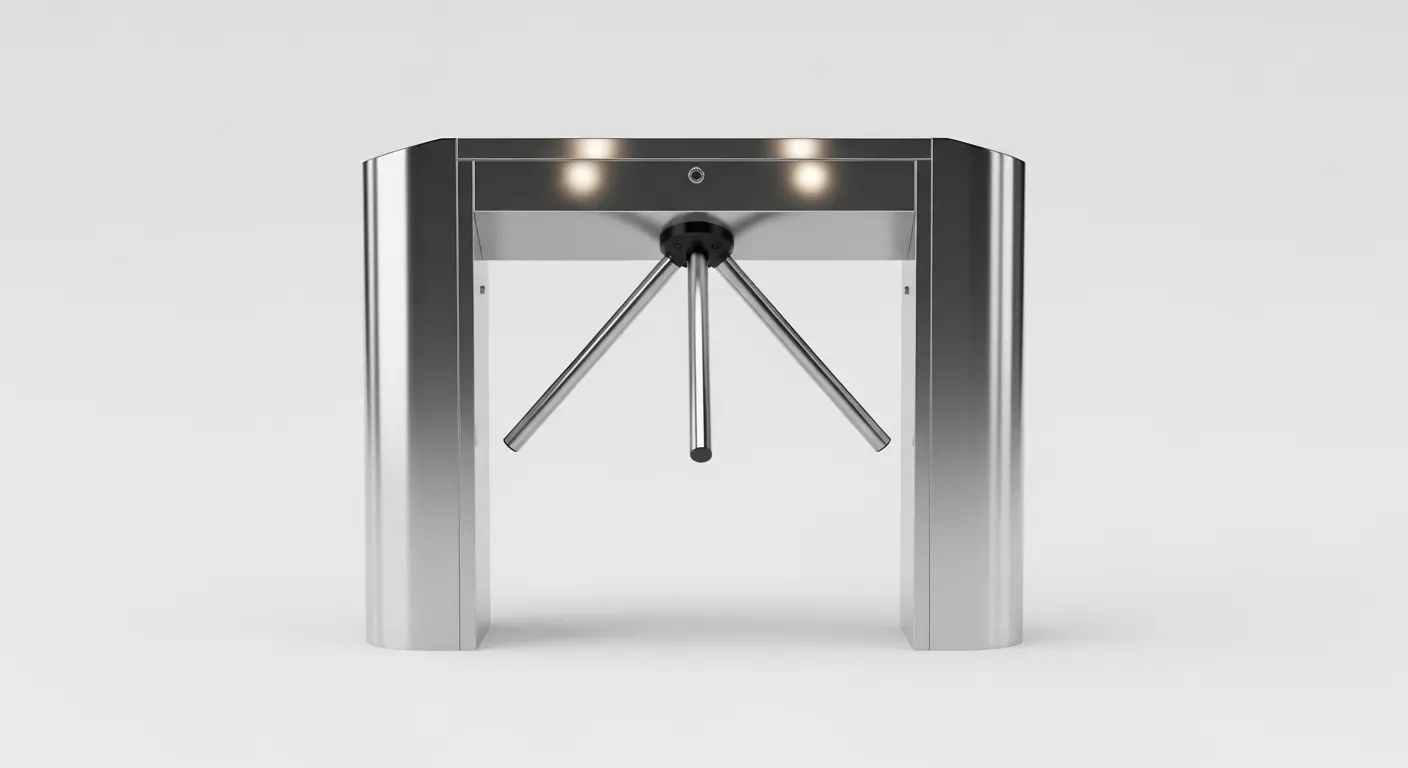
A tripod turnstile gate is a waist-height access control barrier with three rotating arms arranged 120° apart. When a valid credential — RFID card, QR code, fingerprint, or face scan — is presented to the reader, the gate releases one arm rotation. One person passes. The arm resets. The gate locks again.
This "one credential, one passage" design is the core of its security value. It physically enforces individual access, which no door with a card reader can do on its own.
Key Components of a Tripod Turnstile Gate
Understanding the parts helps you evaluate quality during procurement:
- Cabinet (chassis): SUS304 or SUS316 stainless steel housing; wall thickness of 1.0–1.2mm for commercial grade
- Three rotating arms: SUS201 or SUS304 stainless steel; standard arm length 500mm
- Mechanism core: Contains the motor (in automatic models), gears, springs, and transmission shaft — this is the "heart" of the gate
- Control board (PCB): Processes signals from access readers, manages arm timing, and handles communication protocols
- LED indicator: Green for valid access; red for rejection — visible at a glance in high-traffic lanes
- Solenoid or DC motor: Releases or drives the arm depending on whether the unit is semi-automatic or fully automatic
How a Tripod Turnstile Gate Works
The operation is straightforward, which is exactly why it scales so reliably.
First, a pedestrian presents a credential to the mounted reader. The reader validates it and sends a dry contact or RS485 signal to the control board. The control board then either releases the solenoid lock (semi-automatic) or activates the motor (fully automatic). The arm rotates 120°, the person walks through, and the gate resets to the locked position automatically after a preset time window.
Anti-tailgating works through the physical arm itself — one rotation allows one body width. Additionally, anti-reverse logic detects and blocks anyone trying to push through in the unauthorized direction.
Emergency drop-arm function is critical for fire safety compliance. On power failure, all arms drop to the horizontal position, allowing completely unrestricted evacuation. This is mandatory in commercial and public buildings under most fire codes.
For facilities prioritizing tight-space access management, the tripod turnstile access control guide covers how these gates handle compact lobbies and narrow lane configurations in detail.
Types of Tripod Turnstile Gate
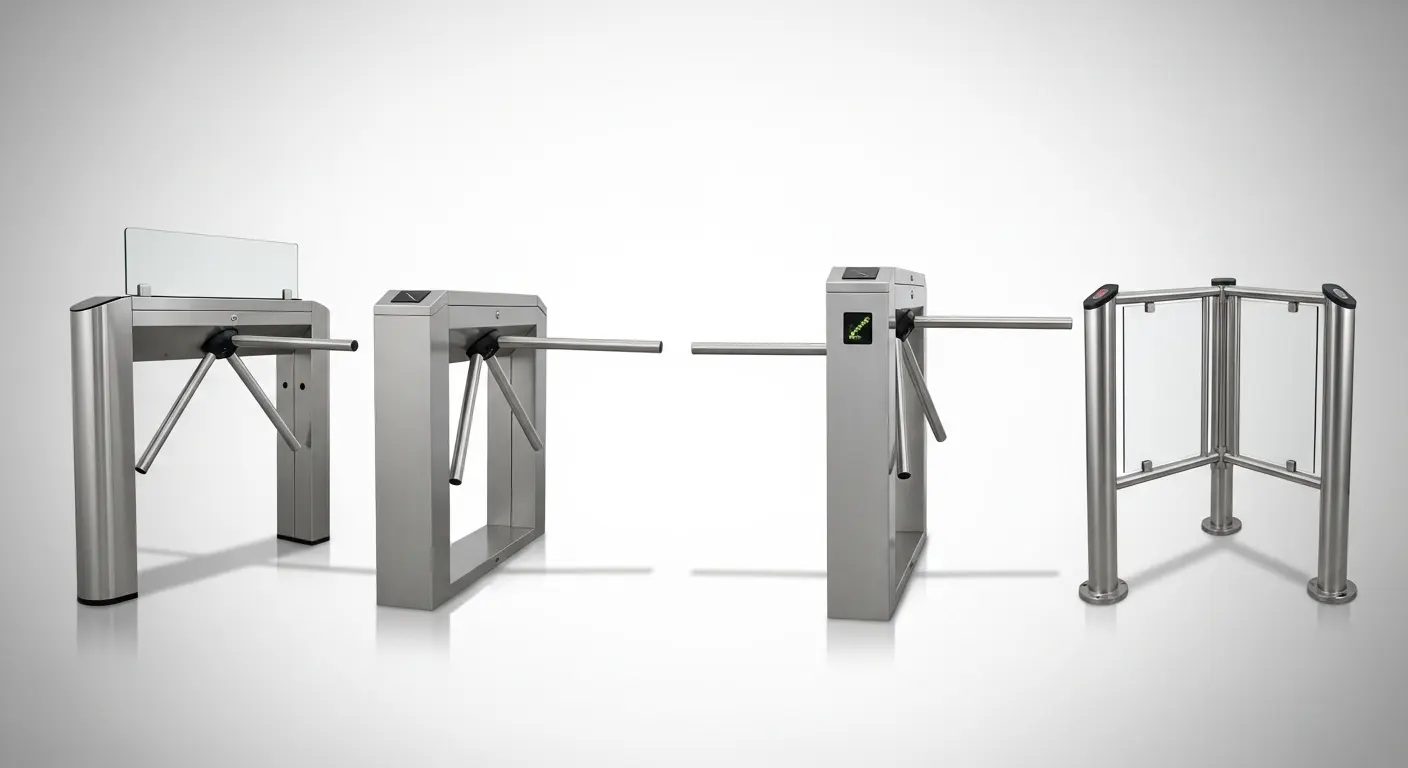
Not all tripod gates are built the same. There are four main configurations — and selecting the wrong one for your environment is one of the most common mistakes buyers make.
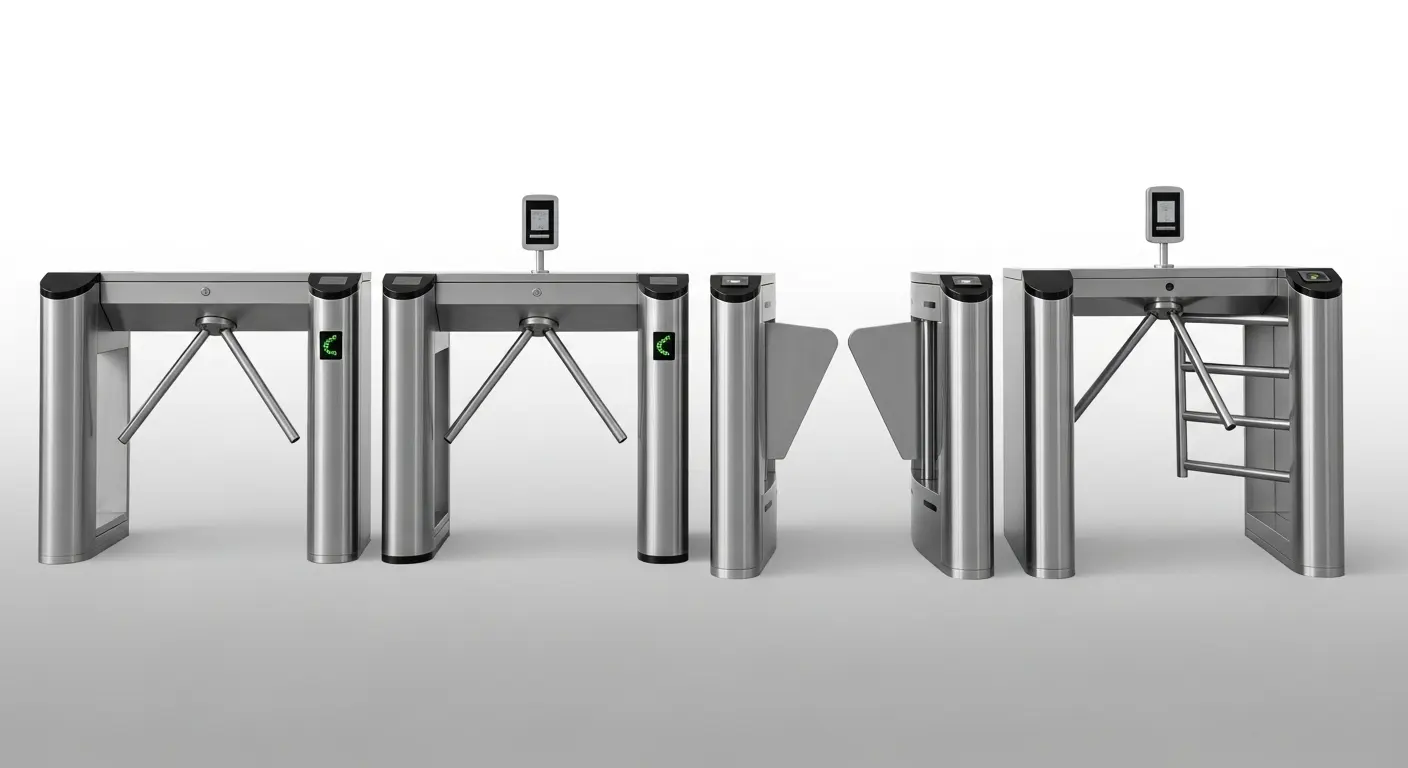
1. Semi-Automatic Tripod Turnstile Gate
Uses a solenoid to release the arm lock. The user pushes through manually. This is the most common and most cost-effective configuration. It works well for offices, schools, factories, and sports facilities with moderate daily traffic. Turboo's classic tripod turnstile gate (E142) is a well-proven example of this type — semi-automatic movement, anti-pass back function, and support for IC/ID cards, QR codes, face recognition, and temperature detection.
2. Full Automatic Tripod Turnstile Gate
Uses a brushless DC motor to rotate the arms automatically after each access event. No pushing required. Higher throughput — 35–50 persons per minute — and a premium user experience. Turboo's full automatic tripod turnstile (LB123) includes blue tempered glass covers, RGB status indicators, and face recognition compatibility, making it the right choice for corporate lobbies and high-traffic entry points.
3. Vertical Tripod Turnstile Gate
A more compact cabinet form factor — the control reader is mounted separately rather than integrated into a bridge housing. The vertical tripod turnstile gate (EL128) measures just 480×280×960mm, making it ideal for extremely tight lane layouts where a standard bridge cabinet would be too wide.
4. Bridge Tripod Turnstile Gate (Dual-Head)
Two cabinets face each other to form a bridge configuration, with the reader mounted directly on the cabinet tops. This creates a clean, professional-looking lane and is the standard form for modern commercial buildings. The narrow mechanism bridge tripod turnstile (ES1216) achieves a full bridge configuration in a slimmer 1200×220mm footprint — purpose-built for space-constrained lobbies.
Key Specifications to Check Before You Buy
When evaluating any tripod turnstile gate, these are the technical parameters that actually determine long-term performance — not the brochure photos.
Cabinet Material and Thickness
SUS304 stainless steel is the commercial standard. Wall thickness of 1.2mm for the top panel and 1.0mm for the body is adequate for most indoor and sheltered outdoor applications. Anything thinner will dent and corrode faster under daily contact.
IP Rating
IP4X covers indoor and covered outdoor use. For fully exposed outdoor installations, look for IP54 minimum — this ensures protection against dust and water splashing from any direction. Turboo's standard tripod turnstile gate models are rated IP4X for indoor/canopy outdoor use; heavy-duty outdoor variants reach IP54+.
Pass Rate
25–35 persons per minute for semi-automatic. 35–50 persons per minute for fully automatic. For high-volume transit environments, motorized models are the correct choice. For offices and schools with moderate peaks, semi-automatic handles typical flows efficiently.
Communication Interface
Look for both dry contact (compatible with virtually every third-party reader) and RS485 (enables real-time data logging with access management and attendance software). Turboo's control boards support both as standard.
Operating Temperature Range
The standard commercial range is -20°C to +70°C. Confirm this matches your deployment environment, especially for outdoor installations in extreme climates.
Fail-Safe vs. Fail-Secure Mode
Fail-safe means arms drop on power loss — best for fire evacuation compliance. Fail-secure means arms lock on power loss — used in high-security restricted zones. Most commercial facilities need fail-safe. Confirm which mode your chosen gate operates in before installation.
For facilities deploying RFID reader systems alongside their gates, Turboo's RFID tripod turnstiles page covers compatible reader formats and real-time attendance integration in depth.
Where Tripod Turnstile Gates Are Used
A tripod turnstile gate suits any environment where individual-entry control is needed without full height barriers. Here are the most common deployment sectors:
Factories and Warehouses
Control worker entry, enforce zone restrictions, and integrate with payroll and attendance systems. The semi-automatic mechanism handles thousands of daily cycles reliably.
Corporate Office Buildings
Manage employee access and visitor flows at lobby entry points. Bridge-style models with face recognition create a professional, modern first impression without slowing down arrival peaks.
Schools and Universities
Student ID card, QR code, or mobile credential access at campus gates and building entrances. Anti-tailgating prevents unauthorized entry during busy class changeovers.
Gyms and Recreation Centers
Member-only access using RFID or app-generated QR codes. The compact footprint of vertical or narrow bridge models fits tight lobby spaces effectively.
Stadiums and Event Venues
Ticket-based QR or barcode validation at multi-lane entry points. High-throughput automatic models process large crowds efficiently during peak arrival windows.
Metro and Transit Stations
For mid-volume stations, motorized automatic models with high-cycle mechanisms and vandal-resistant stainless steel construction are the standard choice. Turboo's heavy duty tripod turnstile range is designed specifically for transit-grade daily cycle requirements.
Tripod Turnstile Gate vs. Other Gate Types
Before committing to a tripod gate, it's worth confirming it's the right gate type for your application.
| Feature | Tripod Turnstile Gate | Flap Barrier | Full Height Turnstile | Speed Gate |
|---|---|---|---|---|
| Security Level | Moderate (waist-height) | Moderate | High (full body) | Moderate (sensor-based) |
| Throughput | 25–50 ppm | 40–60 ppm | 15–25 ppm | 50–80 ppm |
| Cost | Lowest | Mid-range | Higher | Highest |
| Space Required | Compact | Compact | Large footprint | Mid-range |
| ADA Compliance | Limited | Better | Limited | Best |
| Best For | Factories, schools, gyms | Offices, hospitals | Stadiums, prisons | Airports, premium lobbies |
The tripod turnstile gate wins on cost, simplicity, and maintenance. However, if your priority is premium aesthetics or ADA compliance, a flap barrier or speed gate is worth considering instead.
How to Install a Tripod Turnstile Gate
Correct installation determines reliability. A perfectly specified gate installed incorrectly will produce noise, false alarms, and accelerated wear. Here is what the process involves:
- Prepare a level, solid floor base. Uneven floors cause arm misalignment, noise, and premature mechanism wear.
- Mark and drill anchor bolt positions according to the unit's floor plan drawing.
- Route power and reader cables before fixing the unit permanently. Plan cable routing clean — exposed cables invite damage in high-traffic areas.
- Connect reader wiring to the control board input terminals using the supplied wiring diagram.
- Power on and run the self-test cycle. The gate completes multiple test rotations automatically. Do not interfere with this cycle.
- Test all credential types — run at least five valid passes and five rejected attempts in each direction.
- Test fail-safe drop. Simulate a power cut and confirm all arms drop freely to horizontal.
- Adjust reset timer and mode settings based on your traffic behavior.
For a detailed step-by-step walkthrough, Turboo's turnstile installation guide covers every stage from site preparation through commissioning and routine maintenance.
How Much Does a Tripod Turnstile Gate Cost?
Price varies by configuration, material grade, and supplier type. Here is a general reference range:
| Configuration | Typical Price Range |
|---|---|
| Basic semi-automatic (indoor) | $150 – $400 per unit |
| Commercial semi-automatic (SUS304) | $300 – $700 per unit |
| Full automatic with glass cover | $500 – $1,200 per unit |
| Heavy-duty outdoor (IP54+, high cycle) | $600 – $1,500 per unit |
These are factory-direct ranges. Trading company or reseller pricing typically runs 20–40% higher for the same hardware. Buying directly from a manufacturer like Turboo eliminates that markup while giving you direct access to engineering support and spare parts.
FAQ: Tripod Turnstile Gate
What is a tripod turnstile gate?
A tripod turnstile gate is a waist-height, three-arm pedestrian access control barrier. It allows one person to pass per valid credential — RFID card, QR code, biometric, or face recognition. The arms rotate 120° per passage and automatically reset to the locked position. It is the most widely used gate type for factories, schools, offices, gyms, stadiums, and transit stations globally.
What is the difference between semi-automatic and full automatic tripod turnstile gates?
A semi-automatic model uses a solenoid to release the arm lock — the user pushes through manually. A full automatic model uses a brushless DC motor to rotate the arms independently after access is granted. Automatic models offer higher throughput (35–50 ppm) and a more premium user experience, while semi-automatic models cost less and require less maintenance.
Can a tripod turnstile gate be used outdoors?
Yes, but check the IP rating first. Standard indoor models carry IP4X. Fully exposed outdoor deployments require IP54 or higher. Additionally, even IP54-rated units benefit from a protective canopy to extend the service life of electronics. Turboo's heavy-duty range includes models rated for outdoor exposure.
What happens to a tripod turnstile gate during a power failure?
All arms drop to the horizontal position automatically — this is the fail-safe function. It enables unobstructed pedestrian evacuation and meets fire safety requirements for commercial buildings. Fail-secure mode (arms lock on power loss) is only appropriate for specific high-security applications.
What credentials can a tripod turnstile gate work with?
Modern tripod turnstile gates integrate with IC/ID cards, NFC, RFID (multiple formats), QR codes, barcodes, fingerprint readers, face recognition cameras, and temperature detection systems. The control board accepts signals via dry contact or RS485, making it compatible with virtually all third-party access control platforms.
How long does a tripod turnstile gate last?
Quality commercial units are rated for 5 million or more arm rotations. At 500–1,000 passes per day in a typical office or factory, that translates to well over 10 years of service. Regular lubrication of the mechanism and periodic inspection of bearings and control board connections maintain performance across that full service life.