


Ticketing Tripod Turnstile: From Ticket Sale to Gate Open, A Complete Event Venue Guide

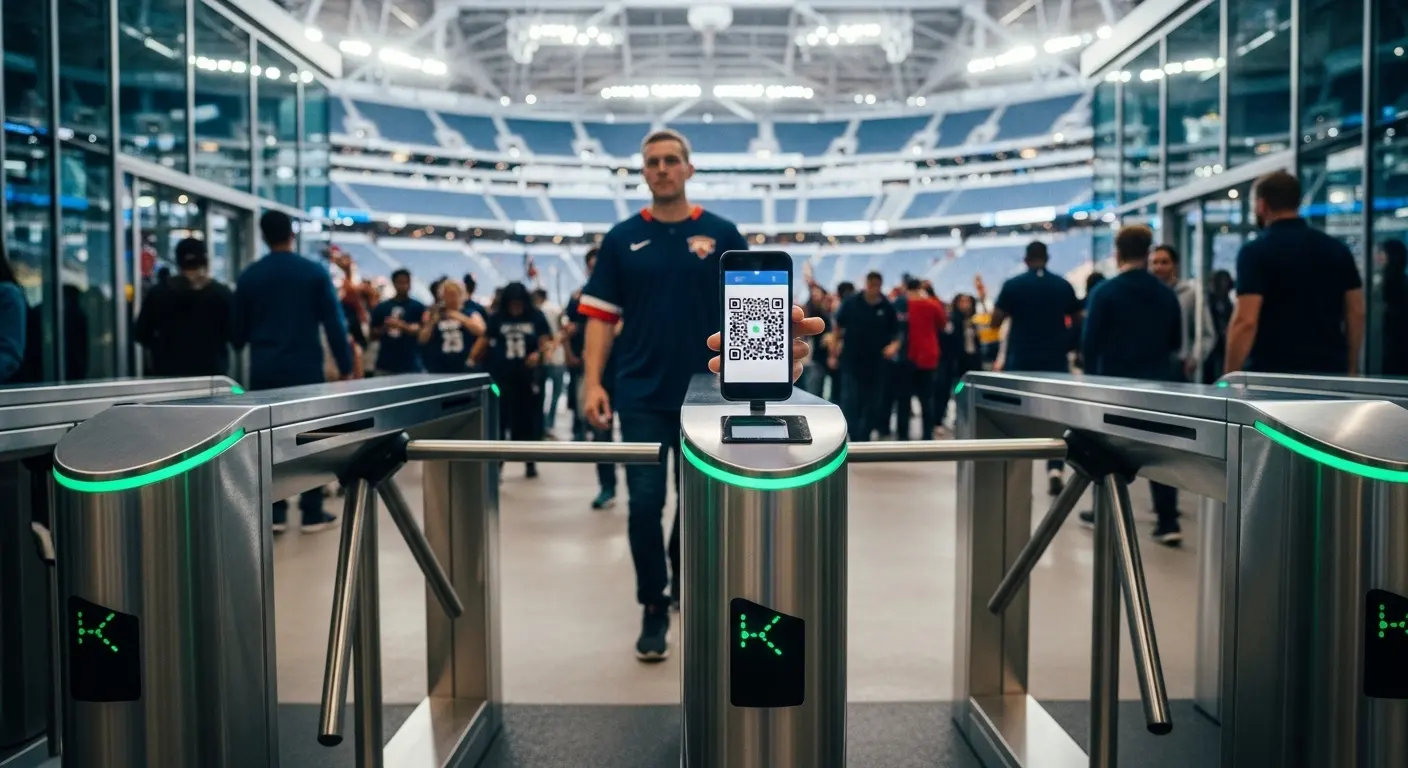
A ticketing tripod turnstile automates the complete validation workflow — from the moment a ticket is sold to the moment the arm rotates and the attendee walks through. Long entry queues, duplicated QR codes, and the cost of manual ticket checkers are familiar problems at stadiums, concert venues, and festivals worldwide. The right gate hardware eliminates all three simultaneously.
This guide covers everything a venue operations manager or event procurement team needs to specify a system correctly: how the validation workflow works, which credential types are supported, how anti-passback prevents ticket fraud, what happens when the network drops mid-event, and which configuration fits each venue type. For a full overview of Turboo's tripod turnstile product range, see our tripod turnstile category page before continuing.
How a Ticketing Tripod Turnstile Validates Tickets, Step by Step
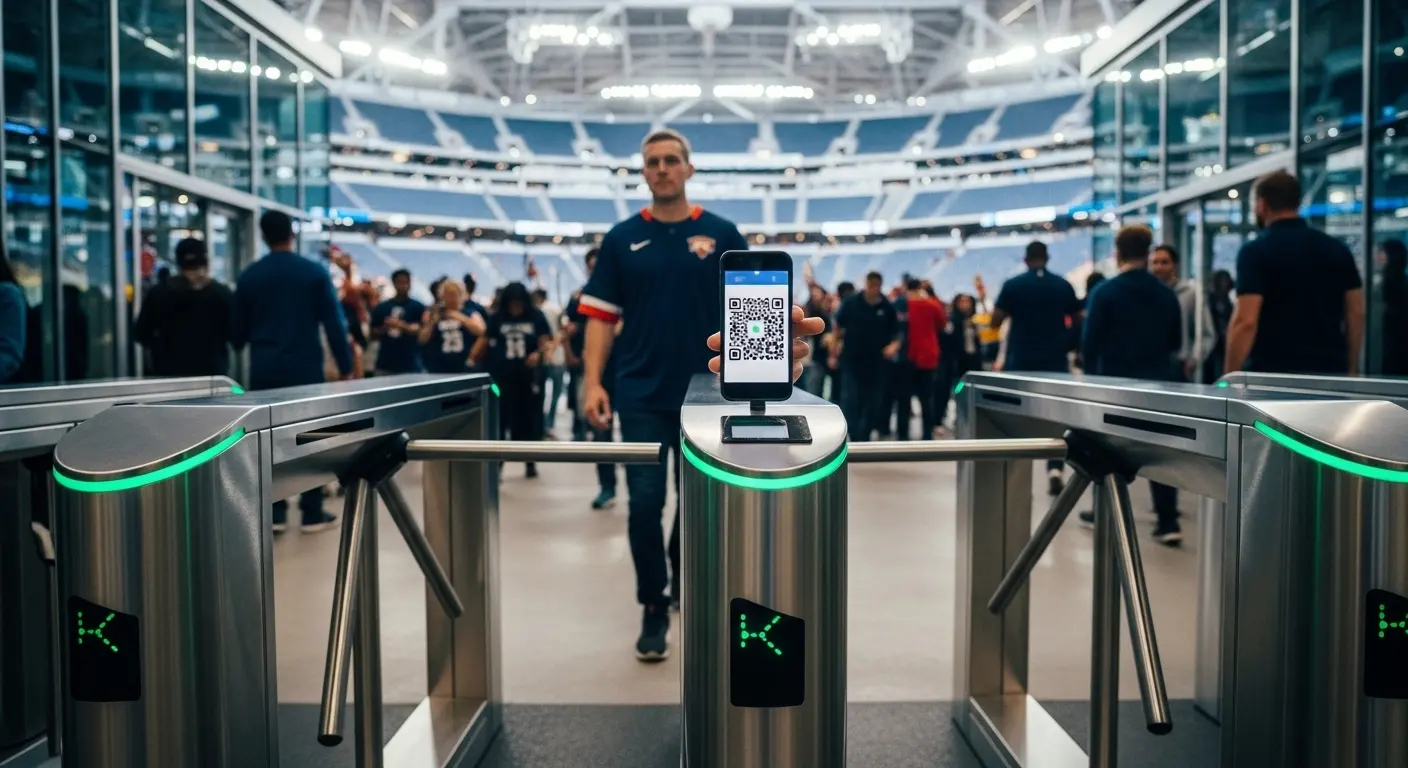
A ticketing tripod turnstile validates a ticket by scanning its credential, checking it against a live database, and rotating the arm for one person if the ticket is valid — the entire process takes under 0.5 seconds.
The Validation Sequence
Here is the exact process from attendee arrival to gate open:
- The attendee purchases a ticket online. A unique QR code or barcode is generated and sent to their phone or email.
- The attendee presents their credential at the turnstile reader — scan, tap, or swipe depending on ticket type.
- The reader captures the credential and sends it to the access control system via network connection.
- The system validates it against the live ticketing database — checking the event, date, and whether the code has already been used.
- A valid result triggers the controller to send an unlock signal. The arm rotates and one person passes through.
- The system logs the entry with a timestamp and seat or zone assignment. The QR code is marked as used immediately.
- An invalid result keeps the arm locked. An optional audio or visual alert guides the attendee to a staffed help point.
What Happens at the Gate Hardware Level
The tripod arm mechanism plays a critical physical role here. It admits exactly one person per unlock cycle, then re-locks immediately. Therefore, no second person can follow through on the same validated credential — regardless of how quickly they move.
In our experience supplying ticketing systems to stadium and event clients, the most commonly underestimated specification point is reader placement height. Positioning the QR reader at 900–1,000mm from the ground covers both standing adults and attendees in wheelchairs without requiring a separate accessible lane.
Ticket Credential Types, QR, Barcode, NFC, and More
The credential type you choose depends on your ticketing platform's output format. Match the gate hardware to what your platform already generates — not the other way around.
Credential Comparison Table
| Credential Type | Scan Speed | Mobile-Ready | Best For |
|---|---|---|---|
| 2D QR Code | < 0.5 sec | ✅ Yes | Concerts, sports events, festivals |
| 1D Barcode | < 0.5 sec | ✅ Printed | Transit, lower-budget setups |
| NFC / RFID Card | < 0.3 sec | ✅ Wallet | Season passes, membership venues |
| Magnetic Stripe | Moderate | ❌ No | Legacy transit systems |
| Facial Recognition | < 0.3 sec | ✅ App-based | VIP zones, registered-member venues |
QR codes dominate event ticketing. They are free to generate, work on any smartphone, and integrate with all major ticketing platforms. Additionally, they require no physical card issuance or postal delivery — reducing cost and friction for both the organizer and the attendee.
Multi-Modal Readers for Multi-Channel Venues
Many venues sell tickets through multiple channels simultaneously — their own box office, Ticketmaster, and a mobile app. Each channel may generate a different credential type. A multi-modal reader supports QR, NFC, and barcode at the same gate unit. Consequently, one gate handles all ticket types without lane separation or staff redirection.
For transit-specific ticketing deployments using RFID season passes alongside QR single-ride tickets, see Turboo's transportation hubs solution for integrated configuration guidance.
Anti-Passback: How Ticketing Turnstiles Prevent Duplicate Tickets
Anti-passback means that once a QR code is scanned and used to open a gate, the system marks it as consumed — scanning the same code again at any lane triggers an immediate rejection.
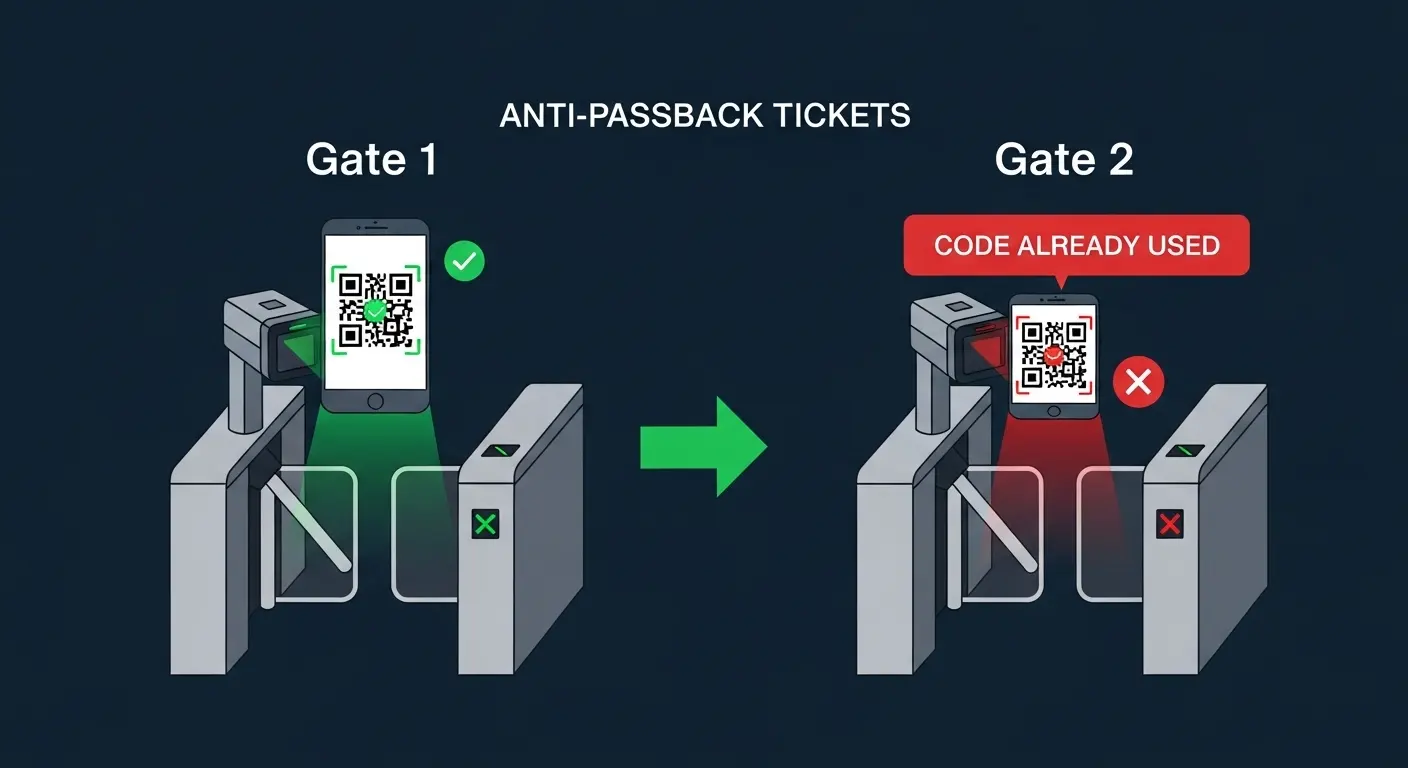
Without anti-passback, one screenshot of a digital ticket can let multiple people enter across different gate lanes. This is the most common ticket fraud vector at multi-lane events. Anti-passback closes it entirely.
How Anti-Passback Works Technically
Each scan writes a "used" flag to the central ticketing database. All gates query the same database in real time. Therefore, a duplicate attempt at Lane 5 fails immediately — even if the original scan happened at Lane 1 seconds earlier.
Anti-passback also applies to re-entry scenarios. If the venue allows re-entry, the system is configured to permit it and reset the flag on exit. If re-entry is not permitted, the exit scan also writes to the database. Either way, the logic runs automatically with no staff intervention required.
In our experience across event deployments, anti-passback configuration is the single most frequently requested feature after basic QR scanning. Venues that skip it during initial setup almost always retrofit it after their first large-scale event.
Offline Validation: What Happens If the Network Drops Mid-Event?
This is the most overlooked specification question in ticketing turnstile procurement — and one of the costliest to get wrong.
Online vs. Offline Validation Modes
Online mode queries the live central database on every scan. It delivers full anti-passback enforcement and real-time attendance counts. However, it requires a stable network connection at every gate.
Offline mode works from a local cache. The controller downloads a copy of all valid ticket codes before the event opens. During a network outage, it validates against that cached list and re-syncs when the connection restores.
The limitation is important to understand. Offline mode cannot apply anti-passback across multiple gates in real time during an outage. Two gates with the same cached code can each admit one person before the re-sync resolves the duplicate. Therefore, outdoor festival deployments — where connectivity is less reliable — should always specify offline-capable controllers with sufficient local cache storage to hold the full event ticket volume.
For outdoor tripod turnstile installations in festival and open-air environments, see Turboo's outdoor turnstile gate range for IP-rated and portable configuration options.
Ticketing Tripod Turnstile vs. Full-Height and Swing Gate for Events
Choosing the wrong gate type for a ticketed event creates operational problems that hardware cannot fix after installation. Here is how the three main options compare:
| Feature | Tripod Turnstile | Full-Height Turnstile | Swing Gate |
|---|---|---|---|
| Throughput | 20–35 ppm | 10–15 ppm | 30–40 ppm |
| Physical security | Mechanical arms | Maximum (floor to ceiling) | Sensor-based panels |
| Cost | Low | Medium | High |
| Outdoor suitability | Yes (IP54–IP65) | Yes | Limited |
| ADA wide passage | Separate lane needed | Separate lane needed | Available motorized |
| Best event use | Festivals, general admission | High-security, outdoor risk areas | Premium indoor stadiums, VIP |
Tripod turnstiles offer the best cost-to-performance ratio for most general-admission ticketed events. Full-height gates are appropriate where jumping or crawling under a barrier is a realistic threat — high-risk outdoor festivals or access-restricted service areas. Swing gates suit premium indoor lobbies where aesthetics drive the specification, such as arena VIP entrances.
For heavy-duty event deployments where gate durability under sustained high volume is the priority, see Turboo's heavy duty tripod turnstile range, which is engineered for a 10 million throughput cycle design life.
Venue-by-Venue Guide: The Right Ticketing Tripod Turnstile for Each Event Type
The correct configuration depends on your specific venue type. Here is how to match hardware to environment across four common ticketed scenarios.
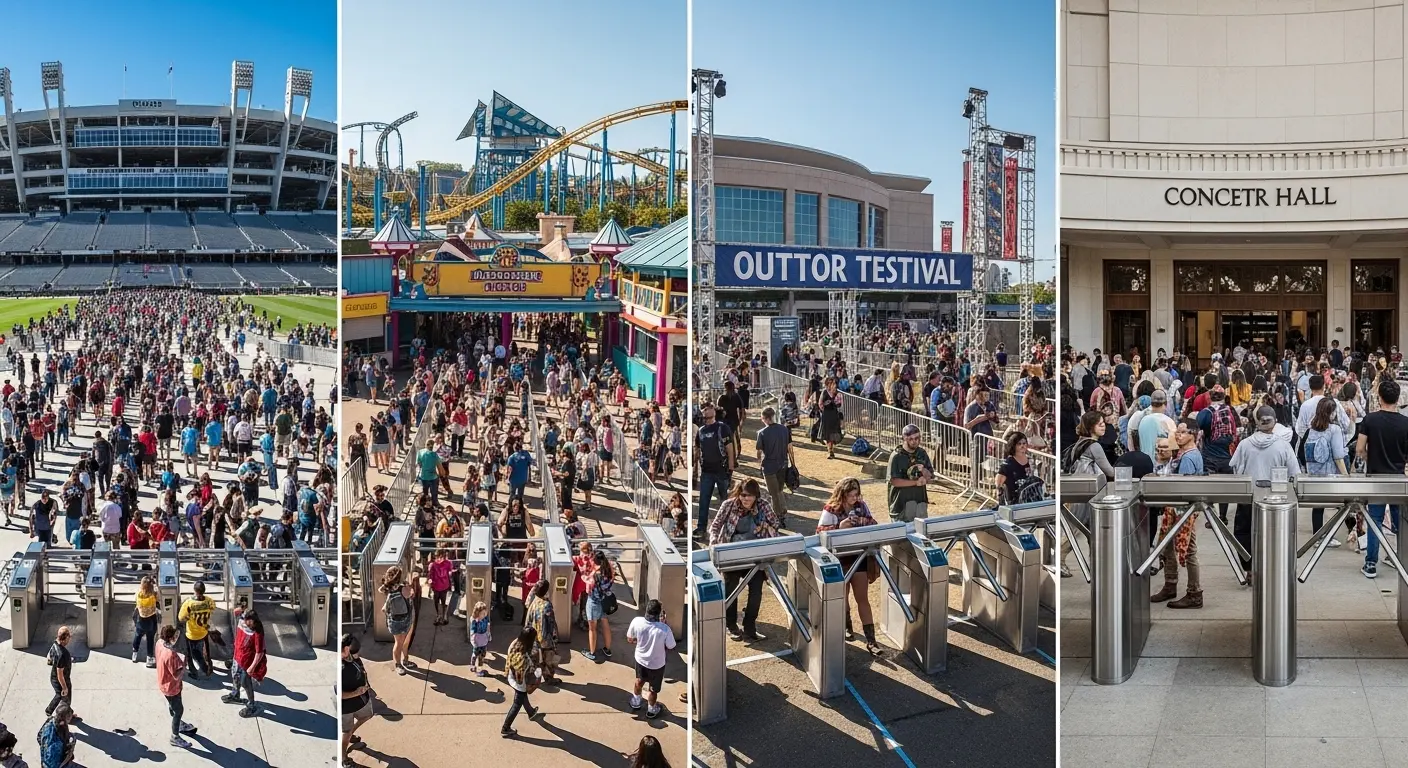
Stadium and Sports Arena
Stadiums face the highest single-burst entry volume of any ticketed venue. More than 2,000 fans per hour must clear the gates before kickoff. This demands a multi-lane configuration — typically 6 to 20+ lanes depending on capacity — with QR as the primary credential and NFC for season pass holders.
Anti-passback is mandatory. Additionally, real-time attendance data must feed into a legal capacity compliance dashboard managed from the venue control room. Dedicated staff or VIP lanes use separate credential logic on the same gate network. For purpose-built stadium gate solutions, see Turboo's stadium turnstile gates range.
Amusement Park and Attraction
Amusement parks require a different logic. Day passes, ride-specific tickets, and annual memberships all operate simultaneously on the same gate network. Each ride zone entrance validates a different ticket type. Furthermore, high outdoor exposure means IP65-rated housing is essential across the entire estate.
Season pass holders use RFID or NFC cards for fast repeated access throughout the day. QR codes handle single-ride or one-time entries. Offline capability is critical — outdoor ride zones frequently have poor network coverage. See Turboo's amusement park turnstile solutions for multi-zone ticketing configurations.
Festival and Open-Air Event
Festivals present the highest operational risk for network-dependent gate systems. They run on temporary infrastructure with no permanent cabling or reliable connectivity. Therefore, offline-capable controllers with full-event cache storage are non-negotiable.
IP65 or higher housing is required. Freestanding or anchor-mounted bases replace permanent floor installation. QR-only credentials are the norm — no venue-issued cards for one-time events. Specify modular units that deploy and demount quickly across multi-day touring events.
Concert Venue and Performing Arts Center
Concert venues operate a compressed entry window — doors open 60 to 90 minutes before showtime, and the entire audience must clear before the performance begins. QR plus NFC multi-modal readers are the standard recommendation. Compact tripod footprints suit indoor lobbies with limited floor space, and tiered access (floor vs. seating zones) adds a credential layer to the same gate hardware.
Real-Time Attendance Counting and Event Analytics
Every gate scan generates a timestamped entry record. Cumulatively, these records become a real-time attendance count across all lanes — updated continuously from the moment the first gate opens.
What the Data Outputs
- Current occupancy — total verified entries minus verified exits at any moment
- Entries per gate per minute — identifies bottleneck lanes for on-the-fly staffing reallocation
- Peak entry rate — documented for post-event safety and operations reviews
- Zone-by-zone breakdown — useful for multi-zone venues managing capacity per section
This data exports via RS485, TCP/IP, or API to your event management platform or venue operations dashboard. Based on our deployments at stadium clients, per-minute gate flow data available in the venue control room enables real-time staffing decisions that manual check-in systems simply cannot support.
The Security Industry Association highlights real-time access monitoring as a core component of event venue security best practice — and ticketing turnstile data provides exactly this capability automatically, at zero additional cost beyond the gate installation.
Frequently Asked Questions
Q1: How does a ticketing tripod turnstile validate QR code tickets?
A ticketing tripod turnstile validates a QR code by scanning it with an integrated 2D reader, then querying the ticketing database to confirm the code is valid, matches the correct event and date, and has not already been used. The entire process takes under 0.5 seconds. If valid, the controller sends an unlock signal and the arm rotates to admit one person. The code is immediately marked as used in the database to prevent duplicate entry at any other gate.
Q2: What is anti-passback and why do event venues need it?
Anti-passback is a system feature that marks a ticket code as consumed the moment it is first scanned. Any subsequent scan of the same code — at any gate lane — is rejected immediately. Event venues need it to prevent ticket sharing, where one digital screenshot is used by multiple people at different lanes. Without anti-passback, paid-ticket revenue loss and illegal over-capacity are both realistic risks at multi-lane events.
Q3: Can a ticketing tripod turnstile integrate with Ticketmaster or Eventbrite?
Yes, most commercial-grade ticketing tripod turnstiles integrate with third-party ticketing platforms through an open API or standard data export protocol. The gate controller queries a database populated by the ticketing platform — whether that is a proprietary box office system, Ticketmaster, Eventbrite, or another provider. Integration requires an API connection between the turnstile's access control software and the ticketing platform's database. Confirm API compatibility with your turnstile supplier before finalizing your ticketing platform contract.
Q4: What IP rating does an outdoor ticketing tripod turnstile need for festival use?
Outdoor festival deployments require a minimum IP65 rating. IP65 provides complete dust protection and resistance to water jets from any direction — covering rain, power-washing between events, and high-humidity environments. For high-rainfall regions or waterfront venues, IP67 adds protection against temporary submersion. Always confirm the IP rating of both the gate housing and the ticket reader module separately, as readers are sometimes rated lower than the main body.
Q5: What happens if the internet goes offline during an event?
A ticketing tripod turnstile with offline capability switches to local cache validation automatically when the network drops. The controller uses a pre-downloaded list of valid ticket codes to validate entries without a live database connection. The limitation is that real-time anti-passback enforcement across multiple lanes is suspended during the outage — duplicate entries may occur until the system re-syncs on reconnection. Always specify offline-capable controllers for outdoor and festival events, and ensure the cache storage capacity covers your full event ticket volume.
Conclusion
Three specification decisions separate a high-performing ticketing turnstile deployment from one that fails under real event conditions. First, confirm your offline validation capability before purchasing — network reliability at your venue determines how critical this is. Second, always enable anti-passback from day one. Third, match your gate type and IP rating to your specific venue environment before finalizing hardware.
A well-specified ticketing tripod turnstile does more than open a gate. It eliminates manual ticket checking, closes duplicate-entry fraud, and generates real-time attendance data that improves every operational decision from staffing to capacity compliance.
To specify a ticketing tripod turnstile for your venue or event, explore Turboo's full tripod turnstile range or contact our event access control team for a venue-specific configuration recommendation.