


Corporate Entrance Tripod Turnstile: How to Specify the Right Gate for Your Building

TL;DR: A corporate entrance tripod turnstile controls pedestrian access one person at a time, integrates with RFID, biometric, and visitor management systems, and suits most corporate building entrances. For corporate environments, the critical selection factors are noise level, chassis aesthetics, dual-flow support for employees and visitors, and fire safety compliance. Fully automatic brushless motor models are the standard for professional lobbies.
A corporate entrance tripod turnstile is not just a security device — it is the first physical experience your building delivers to every employee, client, and visitor who walks through the door.
This guide helps procurement leads and facilities managers specify the right tripod turnstile for a corporate entrance. You will find the criteria that matter in this specific context, a lobby-tier selection framework, a comparison against alternative gate types, and practical integration and cost guidance.
Why the Corporate Entrance Demands a Different Approach
Most tripod turnstile guides treat every installation the same. A corporate entrance is not the same as a factory gate or stadium access point.
Three requirements are unique to this context:
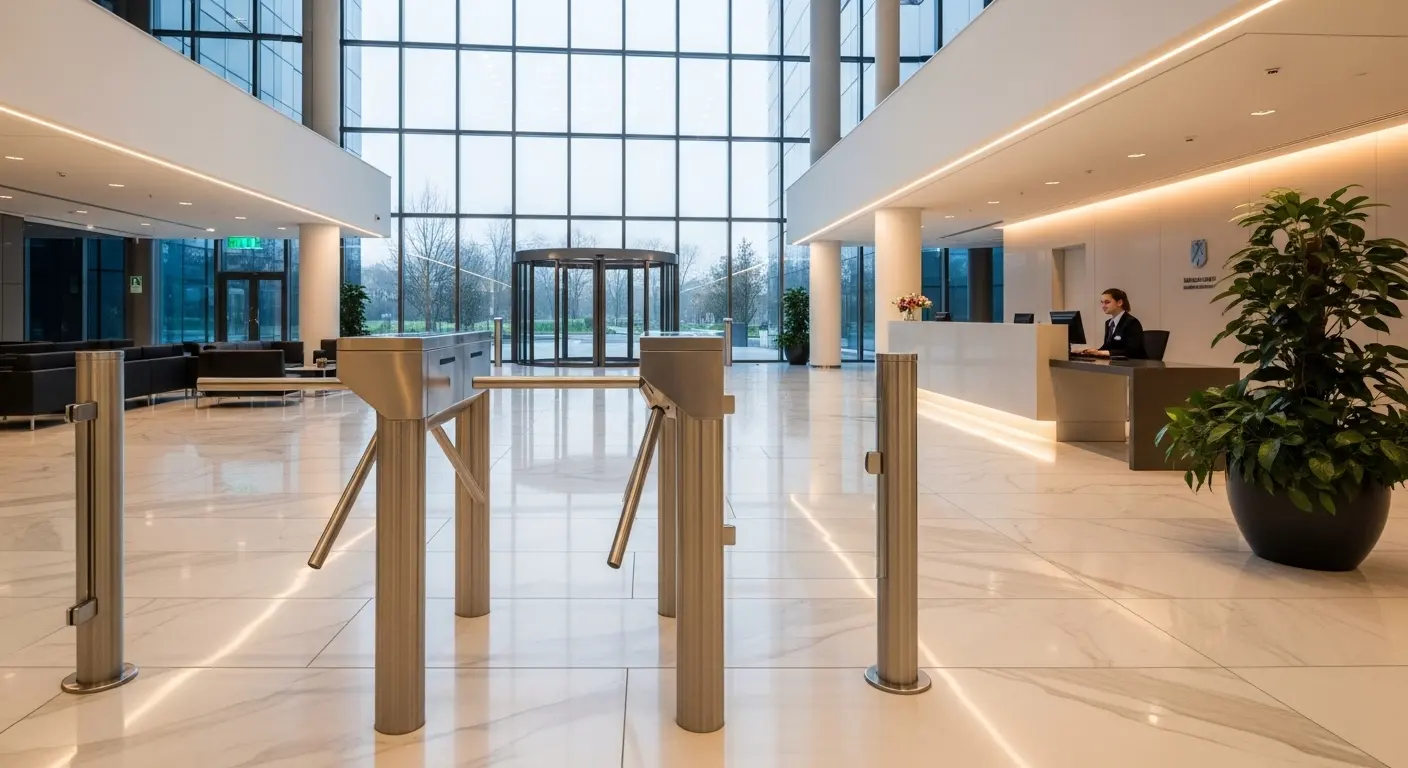
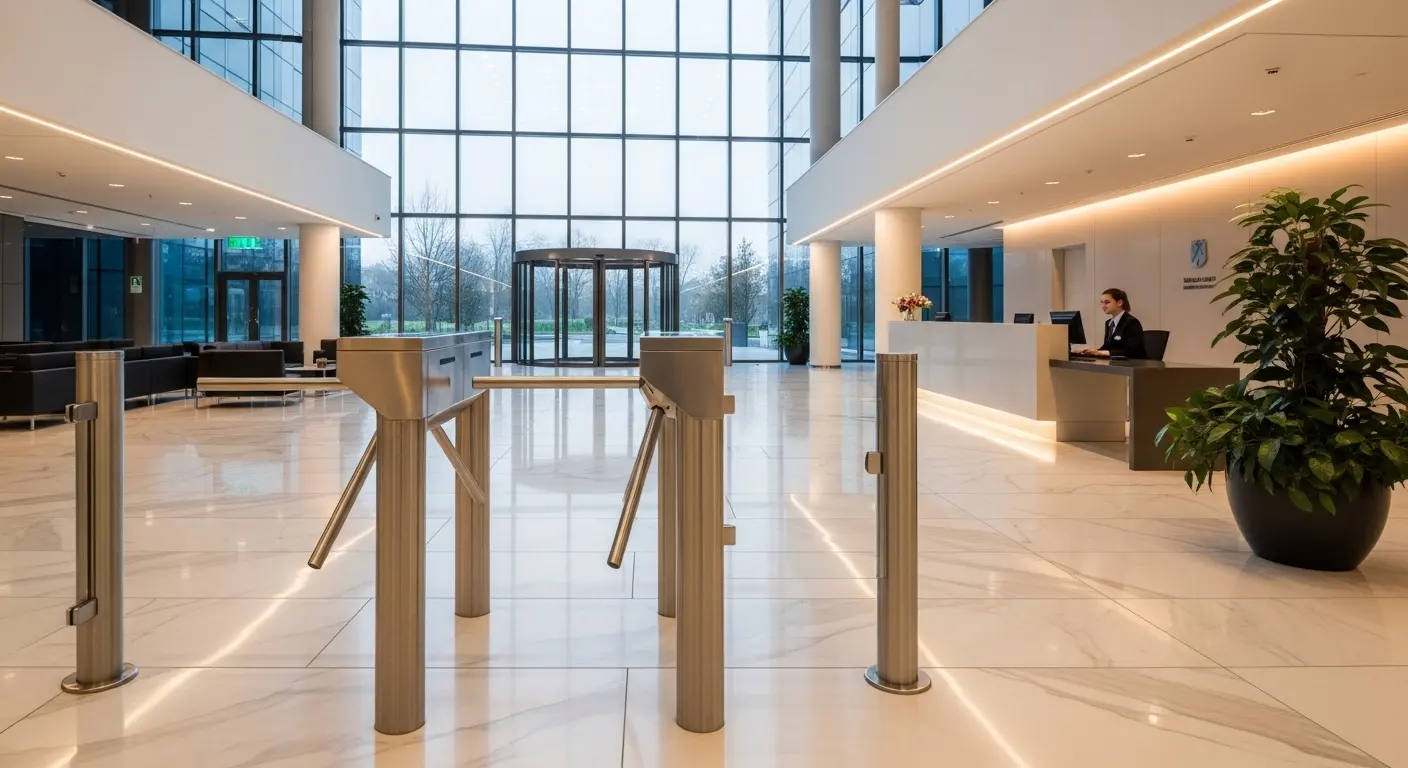
- Aesthetic fit: The gate sits in the primary client-facing space. An industrial or mismatched unit undermines the brand image the building was designed to project.
- Noise environment: Corporate lobbies are adjacent to reception desks and open-plan areas. A gate that clicks and clunks every 30 seconds becomes a problem quickly.
- Dual user flows: Employees repeat the same access routine daily. Visitors arrive unpredictably, need temporary credentials, and require a different workflow. Both must work without creating queues.
The pedestrian entrance control systems market is projected to grow from $1.2 billion in 2024 to $2.5 billion by 2034, with commercial buildings as a core demand segment. Getting the specification right at the entrance level has never mattered more.
For a broader overview of deployment contexts, the tripod turnstile for office building page covers how these environments compare.
What Should a Corporate Entrance Tripod Turnstile Include?
Not all models are suited for a corporate lobby. These are the criteria that separate a professional-grade specification from a generic purchase.
Performance Criteria
Motor type: Fully automatic brushless DC motor models open in under 0.5 seconds and run near-silently. Semi-automatic models use an electromagnet mechanism that produces a noticeable mechanical sound on every cycle. For corporate lobbies, the brushless motor is not a preference — it is a specification requirement.
Throughput: Automatic models typically process 35–50 persons per minute per lane. For offices where 200+ employees arrive in a concentrated morning window, this is sufficient for a single lane. Shift-heavy environments may need two lanes.
MCBF: Look for a Mean Cycles Before Failure rating of 5 million or higher. At 1,000 cycles per day, that is over 13 years of operation before major mechanism service.
Design and Compliance Criteria
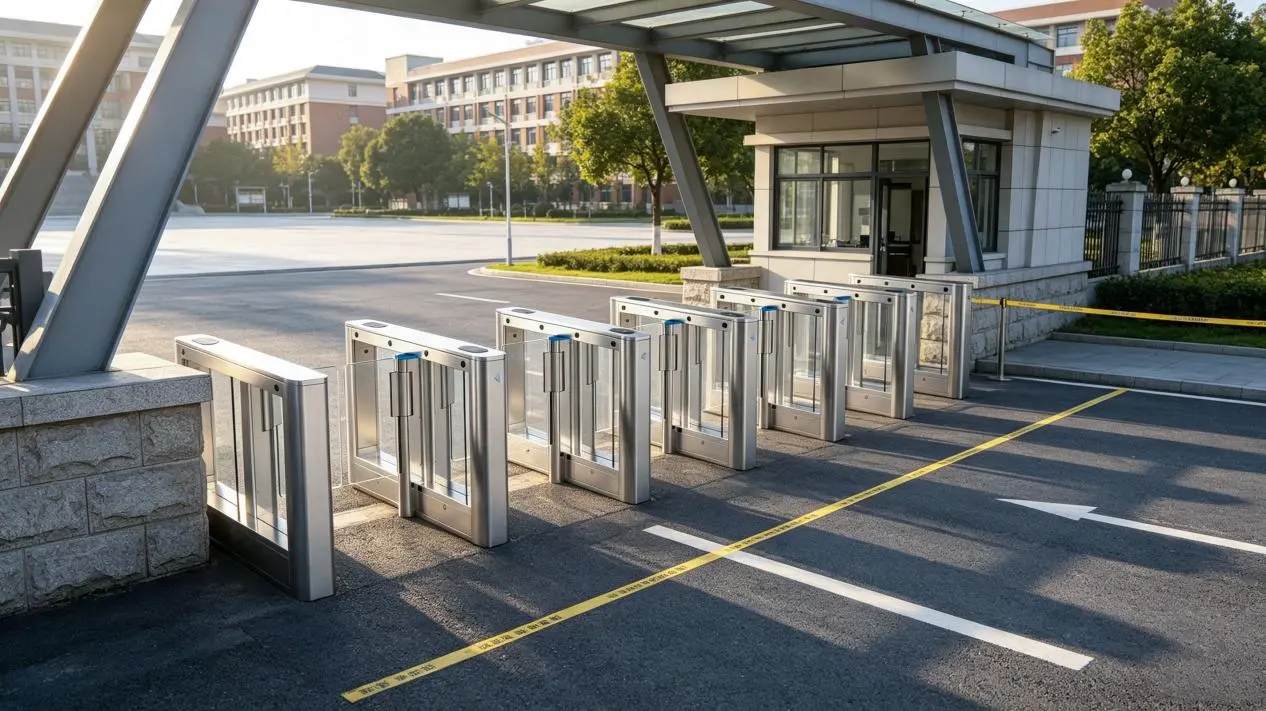
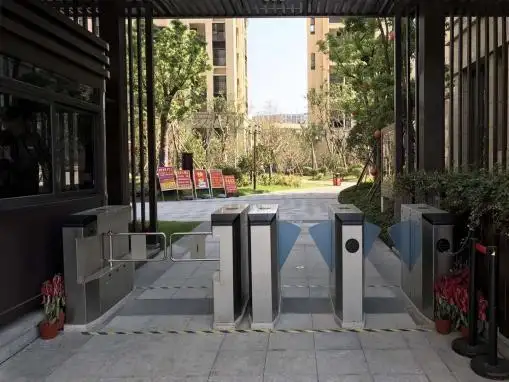
Chassis and finish: Brushed SUS304 stainless steel in a bridge-type or slim-vertical chassis suits most corporate lobbies. Bridge-type units read as more architecturally refined. Slim-vertical units perform well in narrower corridor entrances.
Credential flexibility: Corporate entrances need to handle two different access workflows. Employees use persistent credentials (RFID badges, biometrics, or mobile NFC). Visitors need temporary passes — QR codes, host-authorized access, or receptionist-issued credentials — supported by your visitor management platform.
Drop-arm fail-safe: Most commercial building regulations require this function. During a fire alarm or power failure, the barrier releases automatically. Always confirm the model includes a certified drop-arm mechanism before purchasing.
ADA-accessible lane: A tripod turnstile does not accommodate wheelchair users, luggage, or mobility aids. A parallel accessible gate lane is required alongside any turnstile bank in a compliant corporate building.
For credential-specific configurations, RFID-compatible tripod turnstile options cover the full range of reader and interface combinations.
How Does a Corporate Entrance Handle Employees and Visitors Differently?
Employees use persistent credentials for fast daily access. Visitors require temporary, system-issued passes that work once or within a defined time window. A corporate entrance must support both without creating secondary queues or receptionist bottlenecks.
In practice, the two workflows are quite different.
Employee access is high-frequency and low-friction. An RFID card, mobile NFC credential, or biometric scan at the reader triggers a gate release in under a second. The employee walks through without breaking stride.
Visitor access requires pre-registration or on-arrival authorization. Most modern corporate entrances now use a visitor management platform to issue QR codes before arrival. The visitor scans the code at the gate, which has been pre-authorized by the host. No receptionist intervention needed.
The turnstile hardware must support both workflows from the same reader interface, or the entrance needs two distinct credential channels. Planning this before specifying the unit avoids an expensive retrofit.
Biometric adoption in entrance control is growing at approximately 15% annually, which means future-proofing for biometric visitor credentialing is worth building into the initial specification.
Corporate Entrance Tripod Turnstile vs. Other Gate Types
Before committing to a tripod, it is worth a clear comparison. The right gate type depends on your budget, traffic volume, and the aesthetic standard of your lobby.
| Feature | Tripod Turnstile | Flap Barrier | Speed Gate | Full-Height |
|---|---|---|---|---|
| Cost per Lane | $300–$800 | $800–$2,000+ | $1,500–$4,000+ | $700–$1,500 |
| Throughput | 20–50 ppm | 40–55 ppm | 40–60 ppm | 10–15 ppm |
| Lobby Aesthetics | Good (modern models) | Excellent | Excellent | Poor |
| Noise (Brushless) | Low | Very Low | Very Low | Medium |
| ADA / Luggage-Friendly | No | Yes | Yes | No |
| Visitor Pass Support | Yes | Yes | Yes | Limited |
| Best Fit | Most corporate entrances | Premium lobbies, banks | Tech campuses, large HQs | High-security only |
For most corporate entrances — particularly those with per-lane budgets under $1,000 — a tripod turnstile delivers the right balance of cost, performance, and professional appearance.
Flap barriers and speed gates are worth considering for premium reception areas where aesthetics outweigh budget constraints. Full-height turnstiles are appropriate only for high-security corporate environments such as data centers, financial vaults, or government contractors.
Explore the full range of commercial building access control solutions for context across all gate types.
Matching the Right Tripod Turnstile to Your Corporate Lobby Tier
The right model depends on your lobby's daily traffic, aesthetic standards, and credential complexity. Here is a practical three-tier framework.
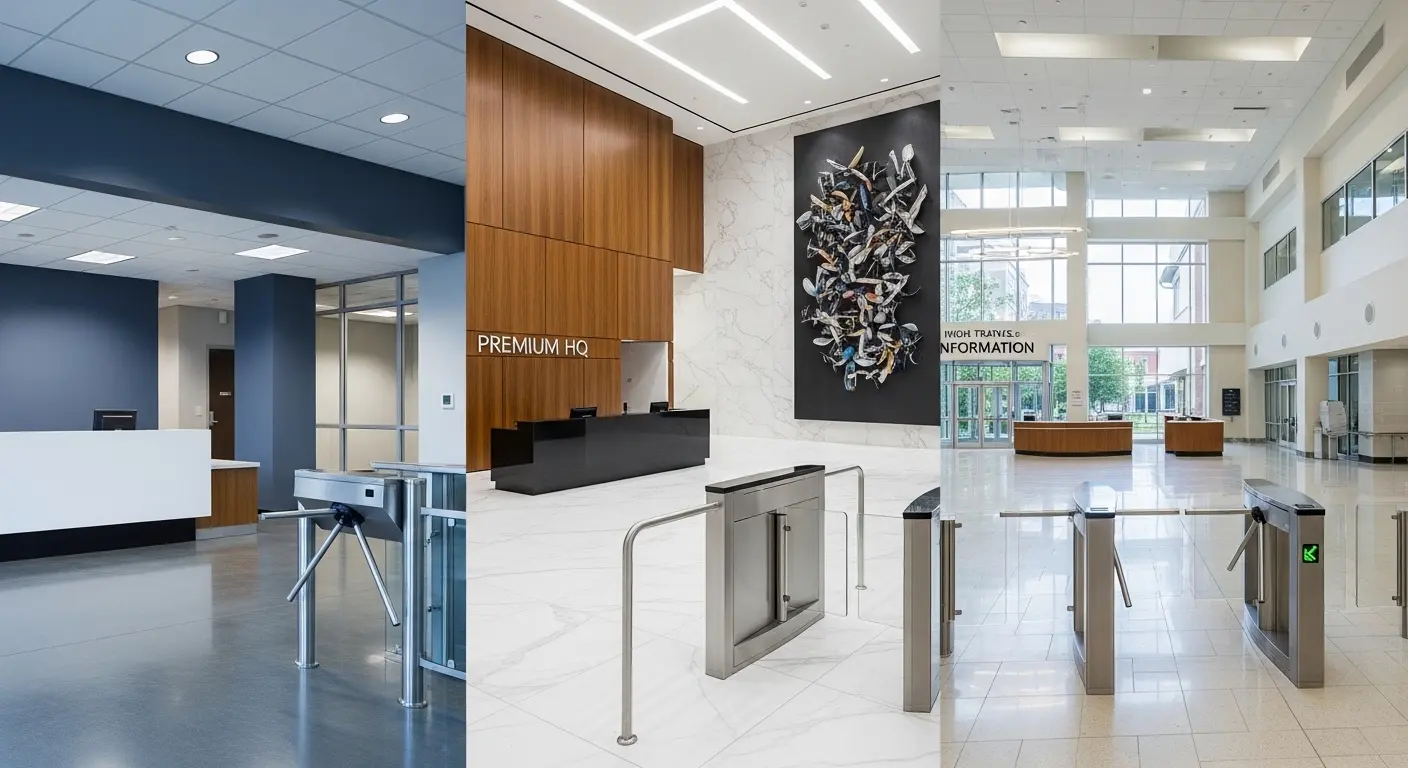
Tier 1 — Standard Commercial Lobby
Mid-rise office tower, 100–500 employees, standard or contemporary interior. Priority: quiet operation, RFID and QR credential support, compact footprint.
A slim automatic vertical-type brushless model covers this well. Turboo's full automatic tripod turnstile line fits here — brushless motor, standard SUS304 finish, bi-directional operation. View the full range of tripod turnstile models for Tier 1 options.
Tier 2 — Premium Corporate Reception
HQ building, client-facing reception, polished lobby with architectural intent. Priority: bridge-type chassis for a longer, more refined silhouette, full credential stack (RFID + QR + facial recognition), higher MCBF for heavy daily use.
A bridge-type chassis with full biometric integration suits this tier. Turboo's bridge-type tripod turnstile is built for lobbies where the gate is a visible design element.
Tier 3 — High-Traffic Campus or HQ
Multi-thousand employee site, dual-lane entrance, mixed employee and visitor flows, integrated with building management systems. Priority: maximum MCBF, dual-lane capacity, visitor management platform integration, IoT occupancy data output.
For this tier, a heavy-duty mechanism is essential. The heavy-duty tripod turnstile is engineered for sites where throughput consistency and long service life are non-negotiable.
How Does a Corporate Entrance Tripod Turnstile Integrate with Building Systems?
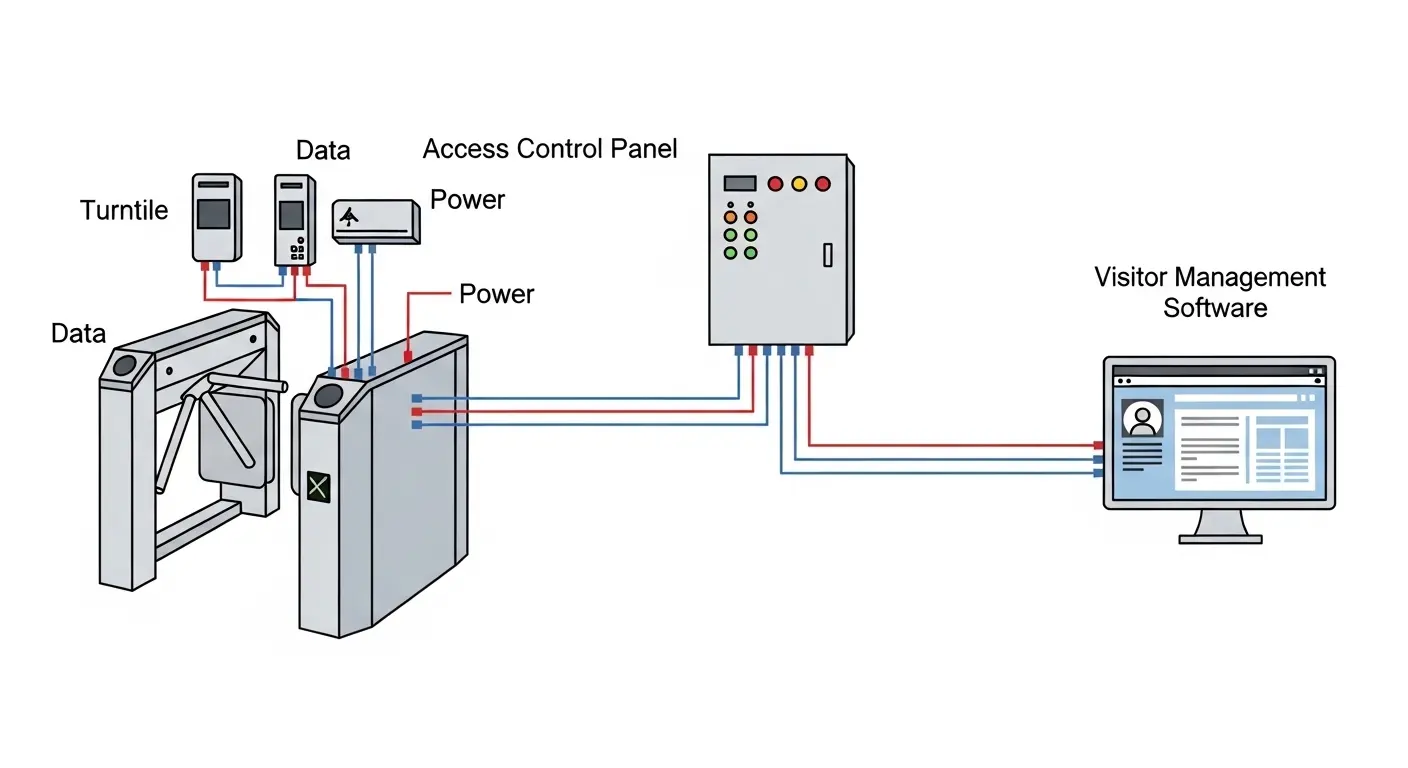
Corporate entrance tripod turnstiles connect to access control infrastructure via Wiegand, RS485, or TCP/IP interfaces. They accept RFID, biometric, and QR signals, and output data to visitor management platforms, time-and-attendance systems, and building management systems for occupancy monitoring.
In practice, integration follows a straightforward path:
- Select credential types (RFID card, biometric module, QR scanner, or a combination)
- Mount reader hardware on or alongside the turnstile chassis
- Connect via Wiegand, RS485, or TCP/IP to the access control panel
- Link the panel to time-and-attendance software, the VMS, or the BMS
Most modern models support multiple credential types on the same unit. You can start with RFID badge access and add facial recognition later without replacing the gate.
IoT integration in entrance control is growing at roughly 20% annually, enabling real-time occupancy dashboards and predictive maintenance. For corporate buildings already running smart BMS infrastructure, this data feed is increasingly a procurement requirement.
For physical wiring and installation requirements, the corporate entrance turnstile installation guide covers the key preparation steps before a site visit.
What Does a Corporate Entrance Tripod Turnstile Cost?
Unit prices range from $300 for basic semi-automatic models to $1,500+ for bridge-type configurations with a full biometric credential stack. Total installed cost for a corporate entrance is typically 30–50% above unit price once cabling, credential hardware, and software are included.
| Model Type | Typical Unit Price (USD) |
|---|---|
| Semi-Automatic | $300–$500 |
| Fully Automatic (Brushless) | $500–$800+ |
| Automatic + Biometric Integration | $700–$1,200+ |
| Bridge-Type Premium | $800–$1,500+ |
Current marketplace listings for corporate entrance turnstiles reflect a $230–$800+ range for standard units, though these figures exclude certification documentation, installation support, or integration services.
For a two-lane corporate entrance, budget the unit cost times two, plus the 30–50% project overhead. Brushless motor models cost more upfront but carry significantly lower maintenance costs over a 3–5 year window — a meaningful factor for facilities budgets on high-traffic sites.
Expert Tip: Before requesting quotes, document four things: your lobby's lane width, your peak daily headcount and arrival window, whether you need visitor QR code or biometric support, and which access control panel or VMS the unit must connect to. Suppliers who receive this information can confirm model compatibility immediately and provide an accurate project cost in a single exchange rather than multiple rounds of clarification.
Frequently Asked Questions
What is the best tripod turnstile for a corporate entrance?
For most corporate entrances, a fully automatic brushless-motor model in brushed SUS304 stainless steel with RFID and QR code support is the right specification. Bridge-type chassis are better suited for premium reception areas. Match your choice to lobby tier, expected daily throughput, and whether you need dual credential support.
How does a corporate entrance tripod turnstile manage visitor access?
Visitors receive temporary QR codes or RFID passes through a visitor management platform, pre-authorized by the host. The turnstile reads the credential and grants single-use or time-limited access. Pre-issued digital passes eliminate reception queues and reduce front-desk involvement significantly.
What is the difference between a tripod turnstile and a speed gate for a corporate entrance?
A speed gate offers faster throughput (40–60 ppm), a lower profile, and ADA-friendly lane width, but costs two to five times more per lane. A tripod turnstile handles most corporate entrance volumes at a fraction of the cost. Budget, traffic volume, and lobby aesthetic standard should drive the decision.
Do corporate entrance turnstiles require fire safety compliance?
Yes. Most commercial building regulations require a drop-arm fail-safe that releases the barrier automatically during a fire alarm or power failure. Confirm the model includes a certified drop-arm function and that installation connects to the building's fire alarm circuit before finalizing any purchase.
How long does a corporate entrance tripod turnstile last?
A high-quality brushless-motor tripod turnstile typically carries an MCBF of 5 million cycles or more. For a 500-person office logging 1,000 daily entries, that represents over 13 years of continuous operation before major mechanism service.
What protocols do corporate entrance tripod turnstiles use for system integration?
Most models communicate via Wiegand, RS485, or TCP/IP — the standard protocols supported by access control panels, visitor management platforms, and time-and-attendance software. Confirm the interface matches your existing infrastructure before ordering. Most modern units support multiple protocols simultaneously.
What certifications should a corporate entrance tripod turnstile carry?
Look for CE (European safety compliance), ISO9001 (quality management), and ROHS (materials compliance). North American projects should also require FCC certification. These confirm independent testing against international standards and are frequently required by procurement policies in commercial building projects. Turboo's product line carries CE, ISO9001, ROHS, and FCC certifications across its corporate-grade models.
Ready to Specify Your Corporate Entrance?
Every corporate entrance has different constraints — lobby dimensions, daily volumes, credential infrastructure, and aesthetic standards all shape the right specification.
Turboo's access control engineers can review your entrance requirements, recommend the right model and lane configuration, and confirm integration compatibility. Explore the corporate entrance access control range or contact the team directly for a project consultation.