


Transit Tripod Turnstile: Multi-Modal Deployment Guide for Bus, BRT, and Rail


A transit tripod turnstile handles 25–40 passengers per minute and works across bus terminals, BRT platforms, railway stations, and onboard bus installations. Tripod is the most widely deployed fare gate in global BRT and transit hub environments. Key specifications vary by transit mode: IP54 for enclosed stations, IP65 for exposed outdoor platforms, and IP44–IP54 for onboard bus and tram installations.
A transit tripod turnstile is not one product serving one environment. It is a specification category that spans bus terminals, BRT platforms, railway station concourses, and compact onboard bus units — each with different IP, power, and credential requirements.
This guide maps the right tripod specification to each transit context, covers throughput and ticketing integration, compares tripod against flap barrier across transit modes, and explains the environmental specs that determine long-term field performance.
Which Transit Environments Use a Tripod Turnstile?
Tripod turnstiles are used in BRT stations, enclosed bus terminals, railway station concourses, light rail stops, and onboard bus and tram installations. According to the ITDP BRT Planning Guide, tripod is the most common access control gate used in BRT systems globally — deployed across South America, Asia, and Africa.
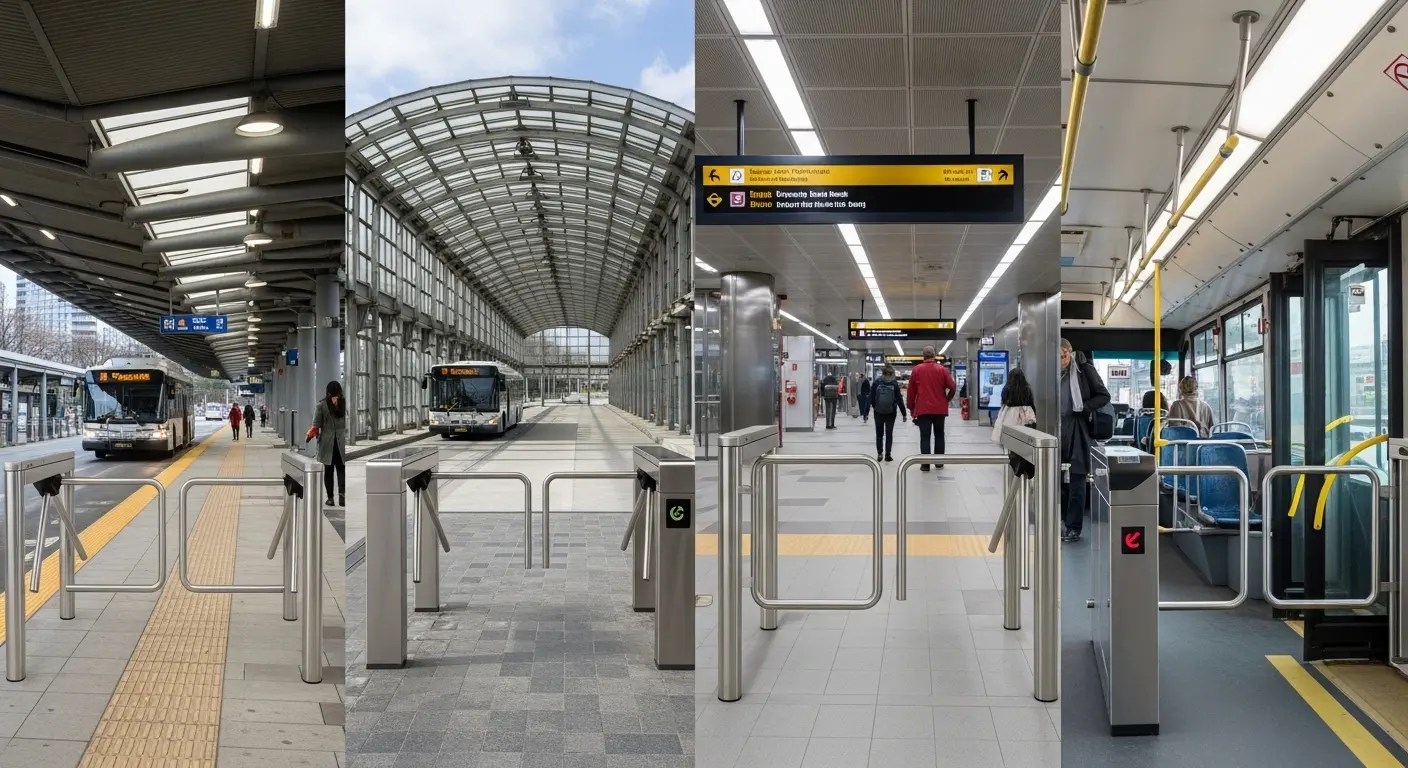
Each transit mode carries its own deployment conditions:
- BRT platforms — off-board fare collection; tripod at all fare gate positions; the global standard
- Bus terminals — enclosed station-side fare validation for city and inter-city bus networks
- Railway and light rail stations — concourse-level fare control at commuter rail and transit interchanges
- Onboard bus and tram — compact tripod units mounted at exit doors inside vehicles for distance-based fare validation
- Airport transit links — airside and landside access control at transit connectors and departure processing lanes
For multi-modal transit hub deployments covering rail, bus, and BRT interchange environments, see Turboo's transportation hub access control solutions.
What Throughput Does a Transit Tripod Turnstile Deliver?
A standard transit tripod delivers 25–40 passengers per minute per lane. Flap barriers (retractable wing gates) deliver 60 ppm. Full-height turnstiles deliver around 20 ppm. For peak-hour transit planning, divide your expected 30-minute peak entry volume by 30 to calculate minimum lane count.
| Gate Type | Throughput |
|---|---|
| Flap barrier (wing gate) | 60 ppm |
| Tripod turnstile | 25–40 ppm |
| Full-height turnstile | ~20 ppm |
Throughput is the primary specification decision in transit. A busy BRT terminal processing 600 passengers in a 30-minute peak period needs a minimum of 20 active tripod lane-minutes. Apply a 15–20% buffer for credential errors and uneven lane distribution.
At most BRT stations and lower-volume railway concourses, the 25–40 ppm range is sufficient without additional lanes. Where peaks exceed tripod capacity, the correct response is either more lanes or a specification upgrade to flap barrier.
See Turboo's high-efficiency pedestrian tripod turnstile models for transit-rated throughput configurations.
Tripod vs. Flap Barrier for Transit Hubs: Which Should You Specify?
The choice depends on the transit mode, the expected throughput, and the project's capital budget.
| Criteria | Tripod | Flap Barrier |
|---|---|---|
| Throughput | 25–40 ppm | 60 ppm |
| Anti-tailgating | Mechanical arm | Optical sensor array (10+ pairs) |
| Lane opening width | 430–520 mm | 500–990 mm |
| Capital cost | Lower | Higher |
| Best for | BRT, bus terminal, railway secondary exits, onboard bus | High-volume metro primary gates, premium transit hubs |
| Maintenance complexity | Lower | Higher |
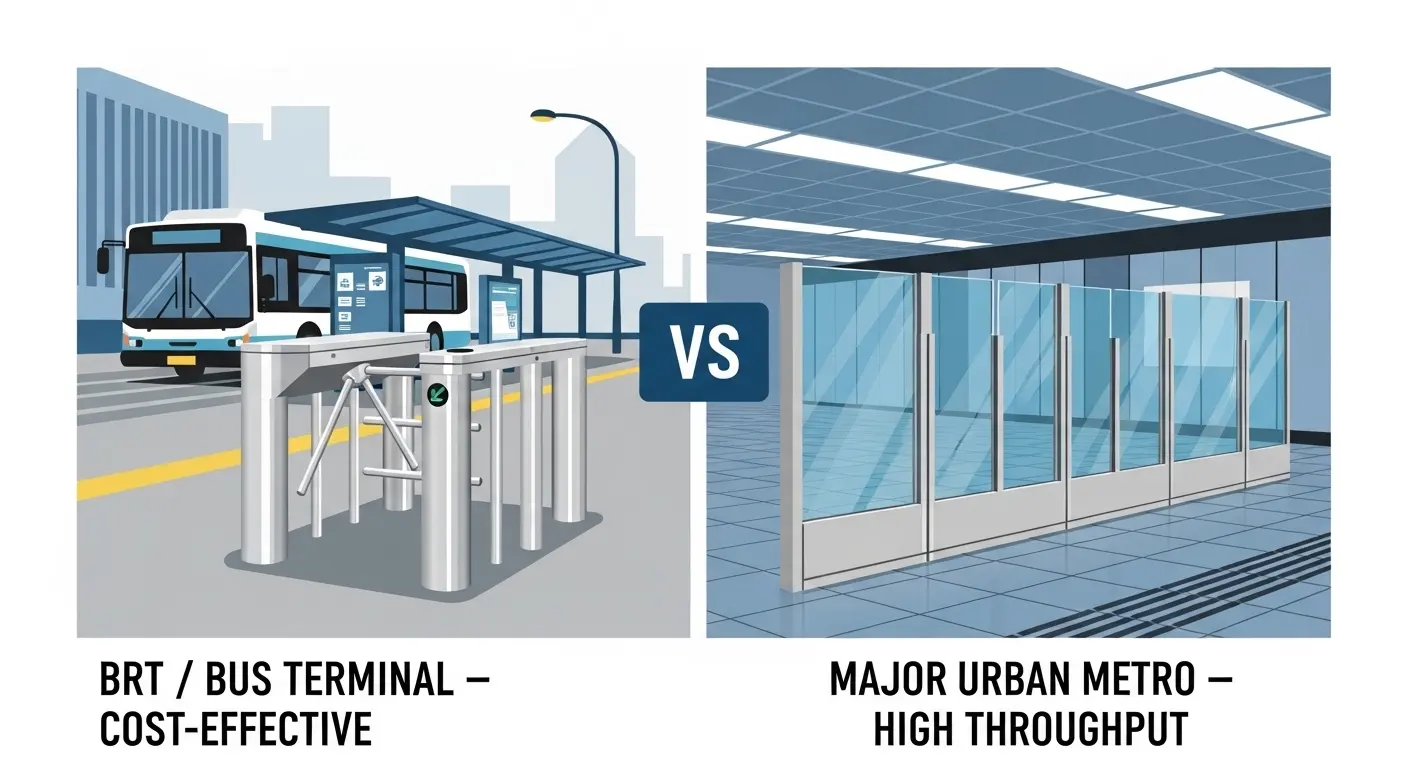
Flap barriers suit high-density transit environments where 60 ppm throughput justifies the higher capital outlay. However, most BRT systems and mid-tier transit terminals operate well within tripod's throughput range.
A common approach in large railway stations is to specify flap barriers at the primary concourse and tripod at secondary exits, internal zone barriers, and overflow lanes. This mixed-gate architecture balances performance and cost at each specific position.
For a detailed total cost comparison between gate types in transit contexts, see the flap barrier price comparison guide.
What IP Rating Does a Transit Tripod Turnstile Need?
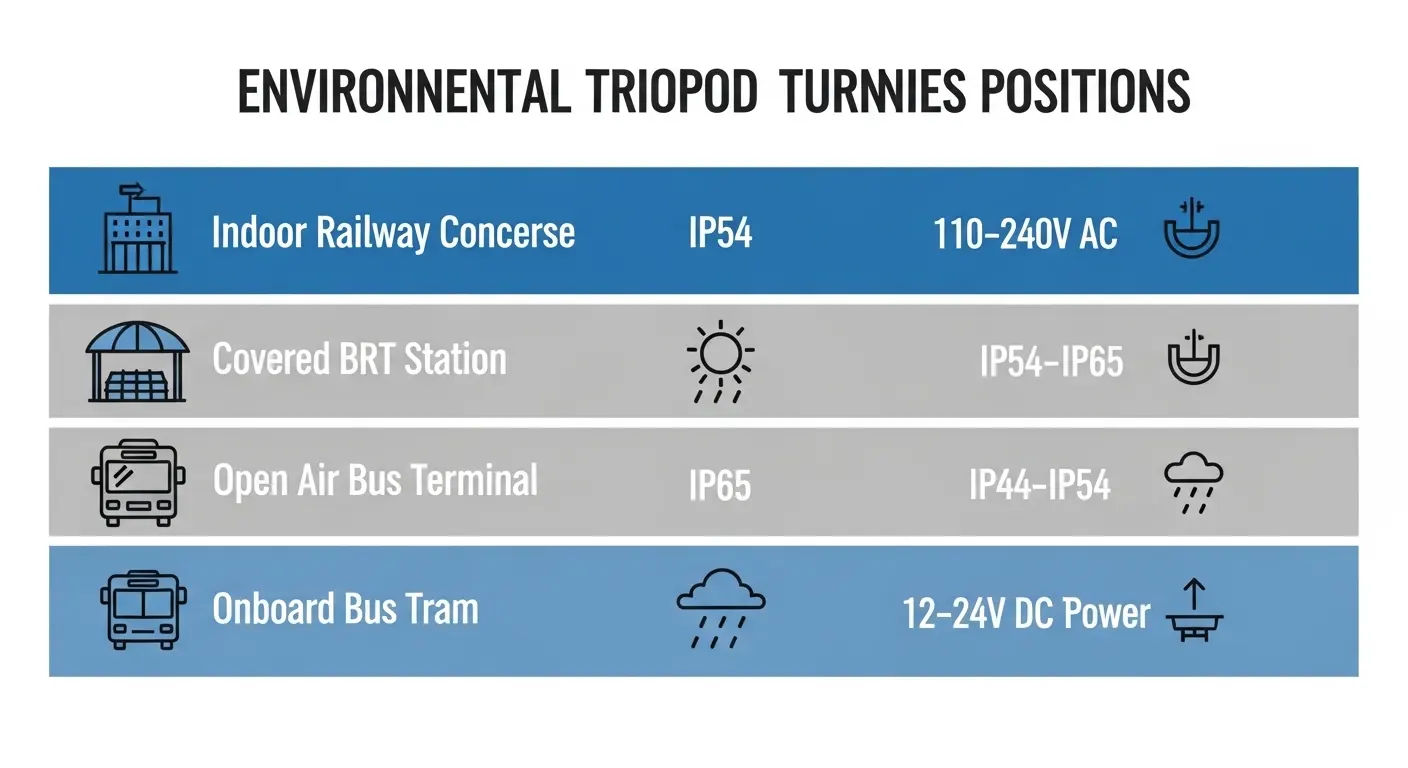
The correct IP rating depends on the transit position. IP54 applies to enclosed station concourses. IP65 applies to exposed outdoor BRT platforms and open bus terminals. IP44 to IP54 applies to onboard bus and tram installations, where vibration tolerance and vehicle power supply are additional requirements.
| Transit Position | Environment | IP Requirement | Housing | Power |
|---|---|---|---|---|
| Indoor railway/metro concourse | Enclosed; controlled | IP54 | SUS304 stainless | 110–240V AC |
| Covered BRT platform (canopy) | Semi-outdoor; rain splash | IP54–IP65 | SUS304 stainless | 110–240V AC |
| Exposed outdoor bus terminal | Open-air; direct rain, dust | IP65 | SUS316 stainless | 110–240V AC |
| Onboard bus or tram | Vehicle interior; vibration, temperature cycling | IP44–IP54 | SUS316 stainless | 12–24V DC |
Gunnebo's Metro Tripod data sheet confirms that transit tripod designs should be compact enough to fit on board buses and trams, with onboard variants requiring vehicle power and tighter mechanical profiles than station-side units.
SUS316 stainless steel is recommended over SUS304 for outdoor exposed positions and onboard bus installations. It offers superior corrosion resistance in high-humidity, coastal, and temperature-cycling environments.
For outdoor transit positions, Turboo's outdoor turnstile gate range covers IP65-rated configurations designed for open-air BRT platforms and bus terminal entrances.
How Does a Transit Tripod Turnstile Integrate with a Ticketing System?
Transit tripod turnstiles connect to the ticketing platform via RS485 or TCP/IP. The ticketing system validates the credential and returns a pass or fail signal in under 300ms. In transit, contactless credentials — smart card, NFC, QR code — are now standard across the majority of new deployments.
The integration workflow:
- Passenger presents credential to the reader mounted on the turnstile
- Reader transmits data to the station or vehicle control unit via RS485 or TCP/IP
- Ticketing system validates credential: zone, balance, or ticket status
- Pass or fail signal returned to gate controller in under 300ms
- Gate opens or stays locked; entry event logged with timestamp, credential ID, and gate ID
Credential Types in Transit
| Credential | Status | Transit Context |
|---|---|---|
| Contactless smart card (RFID/NFC) | Standard | All transit modes |
| NFC mobile (Apple Pay, Google Pay) | Growing fast | Metro, BRT, light rail |
| QR code | Widely deployed in Asia; growing globally | Bus, metro, railway |
| Paper barcode ticket | Legacy; being phased out | Inter-city rail |
| Single-use token | Supplemental | Older metro systems |
QR-based ticketing is now the fastest-growing credential format in transit systems across Southeast Asia, South America, and parts of Europe. For transit tripod models with integrated QR and multi-credential reader support, see the QR code turnstile range for transit deployments.
The Onboard Bus Turnstile: A Unique Transit Application
Most access control guides stop at station-side gate deployment. However, onboard bus tripod turnstiles are a distinct and growing application — particularly in BRT systems using distance-based fare calculation.
In systems such as the Rea Vaya BRT in Johannesburg, tripod gates are mounted at the exit doors of feeder buses. Passengers tap to exit, enabling the system to calculate a distance-based fare. This architecture requires a compact tripod unit that runs from vehicle power (12–24V DC) and tolerates road vibration throughout its service life.
Key onboard bus tripod specification differences:
- Compact profile — narrower than station-side models to clear passenger aisle requirements
- Vehicle DC power — 12V/24V DC input instead of mains AC
- Vibration tolerance — mechanical components rated for continuous road vibration
- IP44 minimum — for bus interior conditions; IP54 for exposed door positions
- SUS316 housing — for humidity and temperature cycling in vehicle environments
For transit authorities specifying multi-environment deployments — station-side and onboard in the same project — this is the most commonly missed specification item in procurement documents.
Expert Tip: A frequent procurement mistake in multi-modal transit projects is applying a single IP specification across all gate positions in the same tender. Station-side gates in an enclosed concourse need IP54. An open-air BRT platform needs IP65. An onboard bus installation needs IP44–IP54 with vehicle DC power. Applying IP54 everywhere means some outdoor positions will underperform in the field. Always specify IP rating per position type, not per project.
Frequently Asked Questions
What type of turnstile is best for a bus terminal?
Tripod is the standard choice for most bus terminal fare gate positions. The ITDP BRT Planning Guide identifies tripod as the most common access control gate in BRT systems globally. Flap barriers are appropriate at high-volume primary gates where 60 ppm throughput is required. Most bus terminals operate within tripod's 25–40 ppm range per lane.
Can a tripod turnstile be installed on a bus?
Yes. Compact onboard bus tripod units are specifically designed for installation at exit doors inside articulated buses and trams. They run from vehicle DC power (12–24V), tolerate road vibration, and enable distance-based fare calculation by logging passenger exits. IP44 to IP54 is the standard rating for onboard bus environments.
What is the throughput of a transit tripod turnstile?
A transit tripod handles 25–40 passengers per minute per lane. For peak-hour lane planning, divide your expected 30-minute peak entry volume by 30 ppm and add a 15–20% buffer for credential errors and uneven lane use. Flap barriers deliver 60 ppm where higher throughput is required.
What IP rating does a transit tripod turnstile need?
IP54 for enclosed indoor station concourses; IP65 for exposed outdoor BRT platforms and open bus terminals; IP44–IP54 for onboard bus and tram installations. Outdoor positions should also use SUS316 stainless steel housing for corrosion resistance in coastal, humid, and high-rainfall environments.
How does a transit tripod connect to a ticketing system?
Via RS485 or TCP/IP to the station or vehicle control unit. The ticketing system validates the credential and returns a pass or fail signal in under 300ms. Supported credentials include contactless smart card, NFC mobile, QR code, and barcode paper ticket. QR code is the fastest-growing credential format in new transit deployments globally.
Is tripod being replaced by flap barriers in transit?
Only at the primary gate positions of the highest-density urban metro systems — NYC MTA is piloting modern fare gates and plans installation across 150+ stations. In BRT, bus terminal, light rail, and developing-market metro environments, tripod remains the actively specified and dominant transit gate type globally.
What credentials do transit tripod turnstiles accept?
Standard transit tripod models accept contactless smart card (RFID/NFC), NFC mobile payment, QR code, barcode ticket, and single-use token. Multi-credential reader modules that support smart card, QR, and biometric inputs in one unit are increasingly common in transit RFPs for new and upgraded fare control systems.
Plan Your Transit Gate Configuration
Transit fare gate deployments vary significantly across station type, transit mode, passenger volume, and ticketing platform. Turboo's access control specialists can review your project layout, throughput requirements, and credential system to recommend the right transit tripod configuration.
Explore the full tripod turnstile range for transit applications or request a transit-specific quotation with position-by-position specification.