


Subway Tripod Turnstile: Throughput, AFC Integration, and Station Zone Deployment Guide

TL;DR: A subway tripod turnstile handles 25–40 passengers per minute per lane and integrates with AFC fare collection systems via RS485 or TCP/IP. Tripod is the correct specification for BRT stations, smaller metro networks, and secondary station exits. Flap barriers deliver higher throughput (60 ppm) and are preferred at major urban metro primary gates. Most large transit deployments use both types at different positions.
Not every subway system is London Underground. For BRT networks, smaller metro systems, and secondary station exits across the world, a subway tripod turnstile remains the most practical and cost-effective fare gate available.
This guide covers when tripod is the right transit gate, how throughput and lane counts work in practice, how AFC integration functions, what IP and service life specifications to require, and how to deploy tripod correctly across different station zones.
Is a Tripod Turnstile the Right Gate for a Subway Station?
Yes — for BRT systems, smaller metro networks, secondary station exits, and transit projects where capital cost matters, tripod remains a correct gate specification. Most transit deployments use tripod and flap barriers at different positions within the same station.
Despite recent MTA and BART upgrade programs, tripod is far from obsolete in transit. According to the ITDP BRT Planning Guide, the tripod turnstile is probably the most common access control mechanism used in BRT systems across the world. Named examples include TransMilenio in Bogotá, Trolebús and Ecovía in Quito, and dozens of South American and Asian BRT systems.
Tripod makes sense at:
- BRT stations — all fare gate positions; the global standard
- Smaller metro systems — where throughput targets and capital budgets both favor tripod
- Secondary exits and emergency egress positions — where peak throughput is not the primary requirement
- Internal zone barriers — between fare-paid and non-fare-paid areas within a station
The "tripod is being replaced" narrative applies accurately to the top tier of high-density global metro systems. Everywhere else, tripod is still actively specified and installed.
For transit-specific gate configurations, Turboo's transportation hub turnstile solutions cover full-system deployment across metro, BRT, and rail interchange environments.
How Does a Subway Tripod Turnstile Handle Throughput?
A subway tripod turnstile delivers 25–40 passengers per minute per lane. Retractable wing gates (flap barriers) deliver 60 ppm. Full-height turnstiles deliver around 20 ppm. For peak-hour planning, divide your expected 30-minute peak entry load by 30 to find your minimum lane count.
According to ITDP transit planning data, these throughput figures are the established benchmark for transit gate specification:
| Gate Type | Throughput |
|---|---|
| Flap barrier (wing gate) | 60 ppm |
| Tripod turnstile | 25–40 ppm |
| Full-height turnstile | ~20 ppm |
Lane Count Formula for Transit Planners
For a station where 15,000 passengers are expected in the 30 minutes before peak service:
15,000 ÷ 30 ppm = 500 minimum active lane-minutes
If each tripod lane operates for 30 minutes, you need at least 17 lanes. If the peak arrival window compresses to 15 minutes, that number doubles. Apply a 15–20% buffer for credential read failures, hesitant passengers, and uneven lane distribution.
Where peak throughput requirements exceed what a feasible number of tripod lanes can deliver, flap barriers are the correct upgrade. For most BRT and smaller metro environments, tripod lanes remain sufficient.
Tripod vs. Flap Barrier for a Subway Station: Which Should You Specify?
The decision is not preference — it is a throughput, accessibility, and capital cost calculation specific to each station position.

| Criteria | Tripod | Flap Barrier |
|---|---|---|
| Throughput | 25–40 ppm | 60 ppm |
| Anti-tailgating | Mechanical arm (single-person) | Optical sensor array (10+ pairs) |
| Lane opening width | 430–520 mm | 500–990 mm |
| Capital cost | Lower | Higher |
| Best for | BRT, smaller metro, secondary exits | Major metro primary gates |
| Current global status | Dominant in BRT and developing-market metro | Standard at major urban metro primary gates |
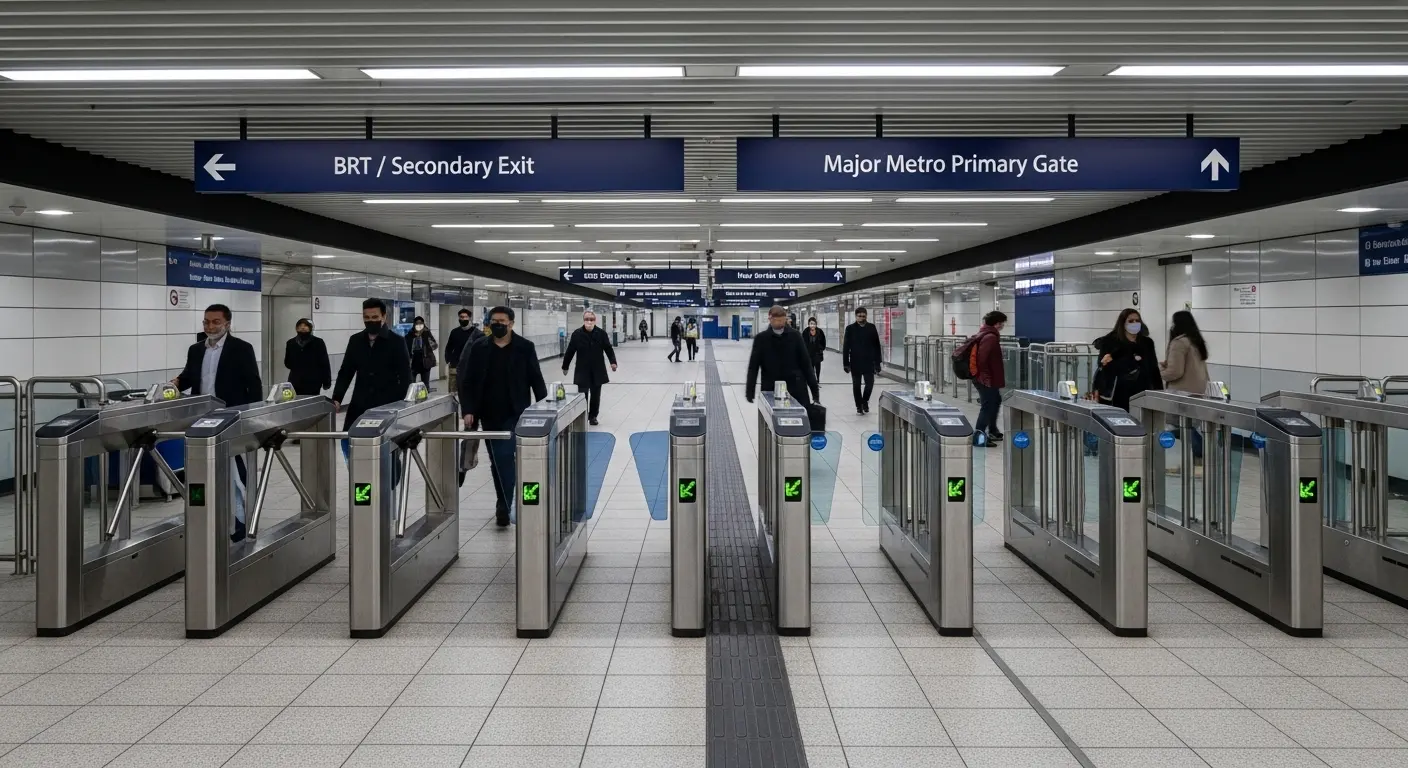
Flap barriers are now the standard at London Underground, Hong Kong MTR, and Washington DC Metro primary concourses. However, even those systems continue to use tripod or mechanical arm gates at secondary positions, accessible gate overrides, and internal zone barriers.
Flap barriers use 10 or more pairs of military-grade infrared sensors for anti-tailgating detection. That sensor architecture adds both capability and cost. For secondary transit positions where sensor-based anti-tailgating is not operationally justified, tripod delivers adequate deterrence at a significantly lower specification cost.
For a detailed ROI comparison between tripod and flap barrier hardware, see the flap barrier value guide comparing long-term total cost of ownership.
Where in a Subway Station Should Tripod Turnstiles Be Installed?
Tripod is the correct specification for BRT fare gates, secondary exits, internal zone barriers, and primary concourse positions at lower-volume metro stations. Every controlled access array must include at least one wide-aisle accessible gate for ADA and equivalent accessibility compliance — tripod's 430–520mm opening is not wheelchair accessible.
| Station Zone | Recommended Gate | Primary Reason |
|---|---|---|
| BRT fare gate (all positions) | Tripod | Global standard; throughput sufficient |
| Smaller metro primary gate | Tripod or flap barrier | Depends on peak-hour volume |
| Major metro primary concourse | Flap barrier | 60 ppm required at peak |
| Secondary exit | Tripod | Throughput not critical; cost-effective |
| Internal zone barrier | Tripod | Fare zone separation; lower traffic |
| Accessible passage | Swing gate or wide-aisle flap | ADA/accessibility compliance mandatory |
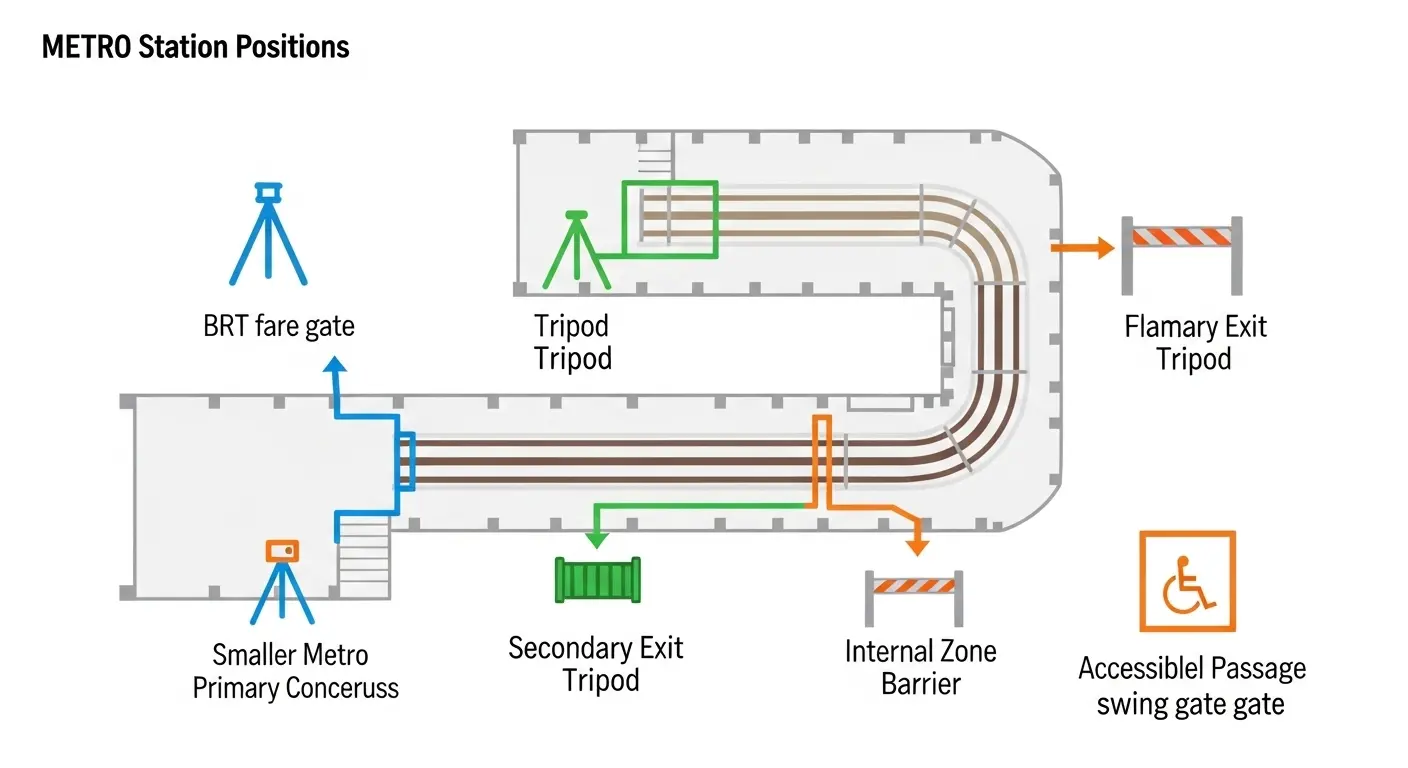
In practice, most mixed-gate deployments specify flap barriers at main entry concourse positions and tripod at all other positions. This architecture balances capital cost against throughput performance at each specific location.
Every controlled access bank must include at least one ADA-compliant accessible gate alongside the standard lanes. This is a legal requirement under ADA in the US and equivalent regulations in the EU, UK, and most other markets.
How Does a Subway Tripod Turnstile Integrate with an AFC System?
A subway tripod turnstile connects to the station's Automatic Fare Collection system via RS485 (point-to-point or daisy-chain to the station control unit) or TCP/IP (network connection for real-time monitoring and remote commands). The AFC system validates the credential and returns a pass or fail signal in under 300ms.
AFC response time is under 300ms per transaction, fast enough that properly configured lanes produce no perceptible delay for passengers presenting smart cards or mobile credentials.
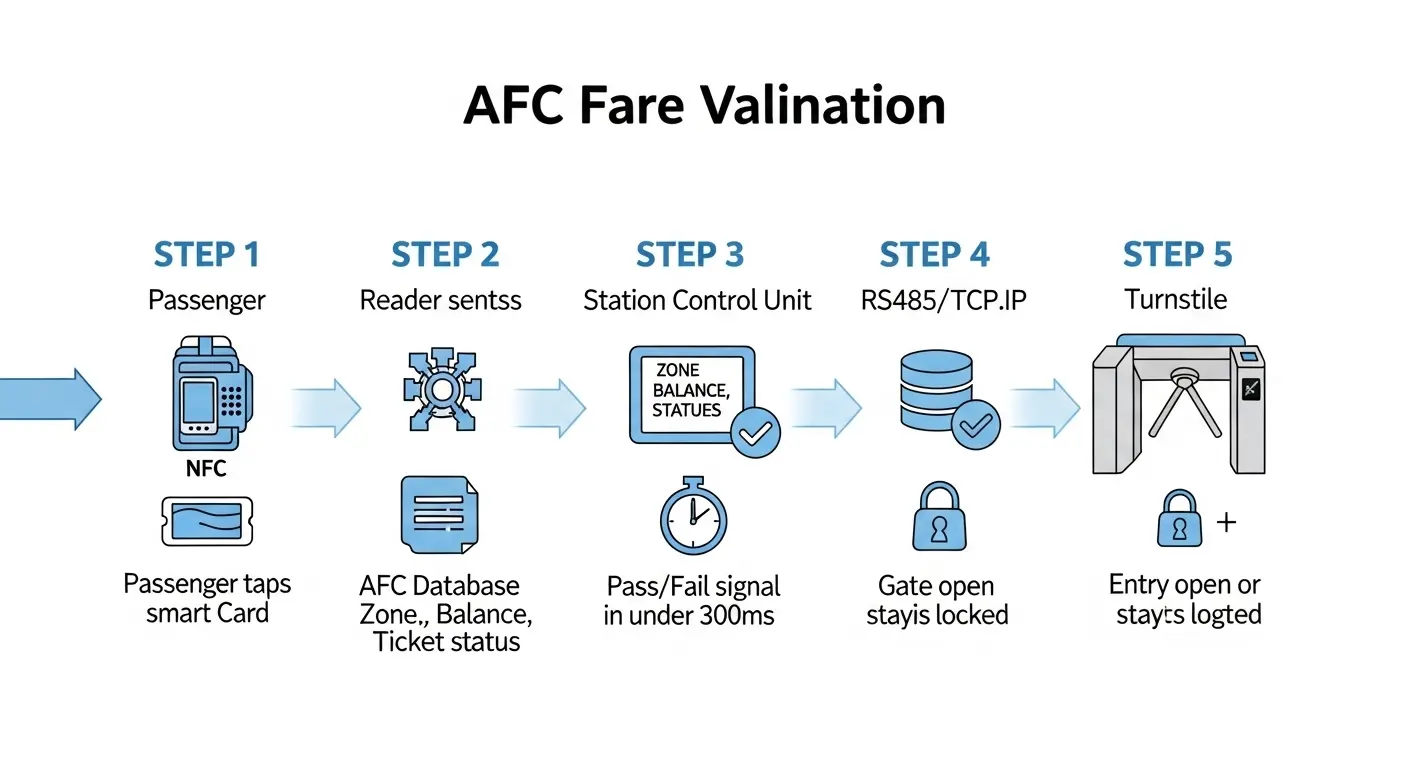
The complete AFC integration workflow:
- Passenger presents credential — smart card, QR code, NFC mobile, or paper barcode — to the reader mounted on the turnstile
- The reader transmits the credential data to the station control unit (SCU) via RS485 or TCP/IP
- The SCU validates the credential against the central AFC database: zone eligibility, card balance, single-use status
- Pass or fail signal returns to the gate controller in under 300ms
- Gate opens (pass) or remains locked (fail); entry event logged with timestamp, credential ID, gate ID, and fare deducted
Beyond basic validation, the integration enables real-time gate status reporting to the station control room, remote lock and unlock commands for emergencies, and passenger flow analytics from entry/exit event data.
Credential Types for Transit Turnstile Access
| Credential | Status | Notes |
|---|---|---|
| Contactless smart card (RFID/NFC) | Standard | Most common in metro; 13.56MHz |
| NFC mobile (smartphone/watch) | Growing | Apple Pay, Google Pay transit integration |
| QR code | Common in Asia and newer systems | Scanned via integrated camera reader |
| Barcode (paper ticket) | Legacy | Being phased out in major systems |
| Single-use token | Supplemental | Still used in older transit systems |
For tripod models with multi-credential smart card and QR fare reader support, see the QR code turnstile range for transit and fare validation deployments.
What IP Rating and Service Life Should You Specify?
Specify IP54 minimum for indoor metro positions. For above-ground or outdoor station gates, specify IP65 minimum. Transit-grade tripod service life should exceed 5 million cycles. SUS304 stainless steel is standard for most environments; SUS316 is recommended for coastal or tropical climates.
IP54 is the standard protection classification for turnstiles deployed in transit environments, covering complete dust protection and resistance to water splashing from any direction — conditions found in most enclosed metro stations.
Above-ground and semi-outdoor positions face direct rain, wind, and temperature cycling. IP65 minimum applies at those positions: fully dust-sealed and protected against directed water jets.
For service life, a busy metro station processes 400–800 passages per gate lane per peak hour. At 8 peak hours per day across 300 operating days annually, that exceeds 1 million cycles per year. Specify 5 million MCBF minimum for any transit-facing tripod installation. Brushless motors are the correct drive mechanism at transit scale — they run quieter, require less maintenance, and have significantly longer service life than brushed motor alternatives.
Also confirm that any transit-grade model includes self-diagnosis and fault code display. In a transit environment, maintenance staff need to identify and resolve gate faults quickly during service hours — self-diagnosis eliminates the need for manual fault tracing at each gate.
For compact transit tripod models suited to tighter station footprints, see the short-bodied turnstile gate range with transit-grade specifications.
Expert Tip: A common specification error on transit projects is confirming the gate's IP54 rating without checking whether the credential reader module carries the same rating. Readers are often sourced separately and may carry only IP52 or lower. In a transit environment where cleaning crews use pressure water near gate banks, an underrated reader is your first maintenance failure. Confirm matched IP ratings for the gate body and the reader module before finalizing your procurement spec.
Frequently Asked Questions
What type of turnstile is used in subway and metro stations?
Both flap barriers and tripod turnstiles are deployed in metro stations. Flap barriers are the standard at major urban primary gates — London Underground, Hong Kong MTR, Washington DC Metro. Tripod remains the dominant gate type in BRT systems and smaller metro networks globally, and at secondary positions in large metro systems.
How many passengers per minute can a subway tripod turnstile handle?
A standard tripod handles 25–40 passengers per minute per lane based on ITDP transit planning data. Retractable wing gates deliver 60 ppm. For peak-hour planning, divide expected 30-minute peak volume by 30 ppm to calculate minimum lane count, then add a 15–20% buffer.
What is the difference between a tripod and a flap barrier in a subway station?
Tripod delivers 25–40 ppm with a mechanical arm; flap barriers deliver 60 ppm with sensor-based anti-tailgating and a wider lane opening. Tripod costs less and is simpler to maintain; flap barriers offer higher throughput and better accessibility clearance. Most large metro systems use both types at different positions.
How does a subway tripod turnstile connect to an AFC fare collection system?
Via RS485 or TCP/IP to the station control unit. The AFC system returns a pass or fail signal in under 300ms. Every entry event is logged with timestamp, credential ID, and gate ID for zone-based fare calculation, revenue reconciliation, and passenger flow analytics.
Are subway tripod turnstiles being replaced globally by flap barriers?
Only at the top tier of high-density global systems. NYC MTA is piloting modern fare gates at 20 stations in 2025 and plans installation at 150 stations over the following years. BART completed its Next Generation Fare Gate rollout at all 50 stations in August 2025. In BRT and developing-market metro systems, tripod remains the actively specified standard.
What IP rating does a subway tripod turnstile need?
IP54 is the standard classification for transit environments — indoor metro stations with dust and occasional splash exposure. Above-ground and outdoor positions require IP65 minimum. Confirm that the credential reader module carries the same IP rating as the gate housing.
Does a subway station need an accessible gate alongside tripod turnstiles?
Yes. Every controlled access array requires at least one wide-aisle accessible gate — a swing gate or wide-channel flap barrier — for wheelchair users, passengers with luggage, and passengers with strollers. Tripod's 430–520mm opening does not meet ADA or equivalent accessibility requirements in any jurisdiction.
Ready to Specify Your Transit Gate Configuration?
Transit fare gate deployments vary significantly by station type, passenger volume, AFC system platform, and accessibility requirements. Turboo's transit access control specialists can review your station layout, throughput requirements, and AFC interface specification and recommend the right tripod configuration for your project.
Explore the full range of pedestrian passage management equipment for transit or contact us for a transit-specific specification and project quotation.