


Semi Automatic Tripod Turnstile: Complete Buyer's Guide for 2026


A semi automatic tripod turnstile is one of the most widely deployed access control gates in the world — and for good reason. It balances mechanical simplicity, reliable security, and low operating cost in a compact three-arm design that fits almost any facility. Whether you're equipping a factory, school, stadium, or corporate lobby, this guide covers everything you need to make the right decision.
You'll learn exactly how it works, how it compares to fully automatic models, which features matter most, and which Turboo models are worth considering.
What Is a Semi Automatic Tripod Turnstile?
A semi automatic tripod turnstile is a waist-height, three-arm gate that uses an electromechanical solenoid to release its arms after receiving a valid access signal. The person then pushes the arm through the passage manually, at their own pace.
This design is distinct from fully automatic models, which use a DC or brushless motor to actively rotate the arms independently. In the semi-automatic version, the solenoid simply unlocks the arm — the pedestrian provides the push.
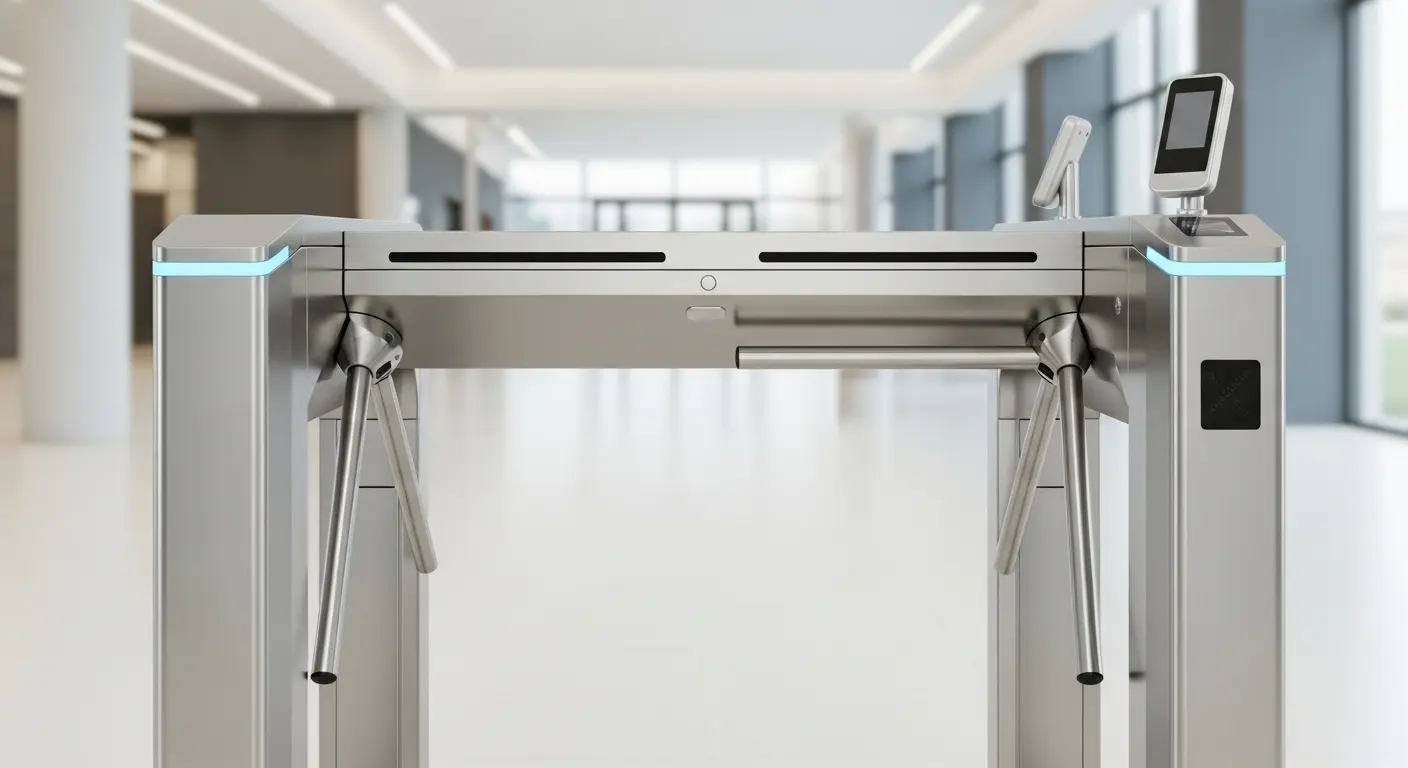
Core specifications at a glance:
- Drive type: Solenoid-based electromechanical release
- Arm movement: User-initiated push after electronic unlock
- Reset: Automatic return to locked position after each passage
- Direction: One-way or bi-directional, depending on configuration
- Typical pass rate: 25–35 persons per minute
For a full overview of tripod gate types and configurations, explore Turboo's complete tripod turnstile range.
How a Semi Automatic Tripod Turnstile Works
The operation is simple and predictable. First, the pedestrian presents a credential — an RFID card, QR code, fingerprint, or face — to the attached reader. The reader then sends a dry contact or RS485 signal to the turnstile's control board. Next, the solenoid releases the arm lock, allowing free rotation. The person pushes gently and passes through. Finally, after a preset time window, the arm automatically resets to the locked position.
This "push-to-pass" mechanism is, in fact, an active anti-tailgating measure. Because the arm requires a deliberate push from the authorized user, a second person closely following behind cannot slip through on a single credential. Furthermore, in any power-off scenario — such as a fire alarm — the arms drop automatically, enabling unobstructed evacuation. This satisfies fire safety regulations in most commercial and public environments.
Semi Automatic vs Fully Automatic Tripod Turnstile
Choosing between these two types comes down to throughput, budget, and maintenance priorities.
| Feature | Semi Automatic Tripod Turnstile | Fully Automatic Tripod Turnstile |
|---|---|---|
| Drive Mechanism | Solenoid (electromechanical) | DC / brushless motor |
| Arm Movement | User pushes after unlock | Motor rotates arms automatically |
| Pass Rate | 25–35 persons/min | 35–50 persons/min |
| Power Consumption | Lower | Higher |
| Maintenance Cost | Lower | Moderate to high |
| Noise Level | Very low | Moderate |
| Anti-tailgating | Strong (push required) | Moderate (speed-dependent) |
| Price | More affordable | Higher |
| Best For | Factories, offices, schools, gyms | Metro stations, transit hubs |
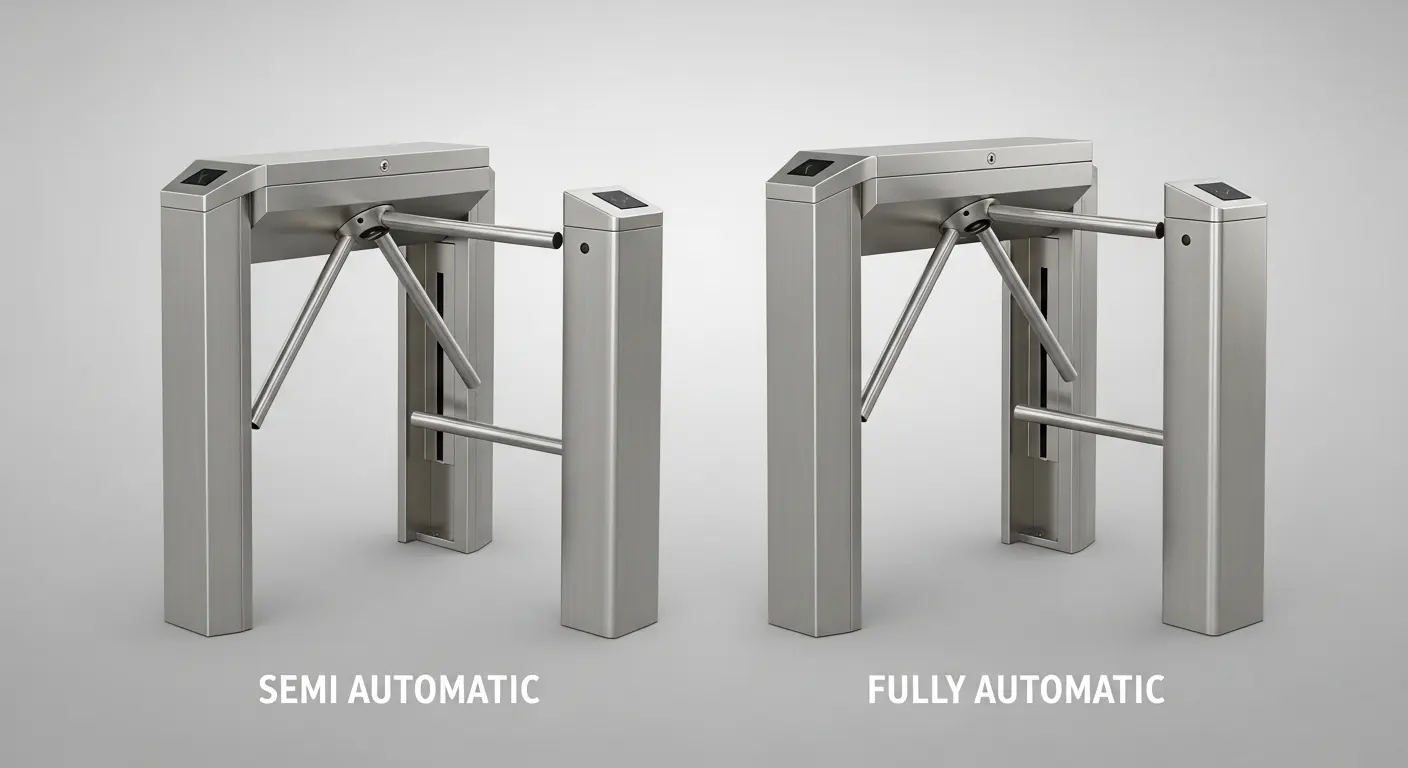
For most commercial facilities, the semi automatic tripod turnstile is the practical, cost-efficient choice. However, if your location processes thousands of people per hour — like a subway entrance — a fully automatic motorized model may justify the added cost. Check Turboo's specialized tripod turnstile for metro station configurations for high-volume transit applications.
Key Features of a Semi Automatic Tripod Turnstile
When evaluating models, don't just compare prices. Instead, check these specific technical attributes:
1. Cabinet Material
SUS304 stainless steel is the standard for commercial use. For outdoor environments, look for a wall thickness of 1.2mm or more. Thinner cabinets dent and corrode faster under constant use.
2. Arm Material
Arms should also be stainless steel (SUS201 or SUS304). Avoid polymer arms for any commercial deployment — they wear down significantly faster under daily traffic.
3. IP Rating
For outdoor or semi-outdoor installations, target IP54 as a minimum. This rating ensures protection against dust ingress and water splashing from any direction. Moreover, anything below IP54 risks electronics failure within months in exposed environments.
4. Passage Width
Standard width is 550mm. However, if your facility regularly handles people with bags, tools, or mobility aids, consider models offering 600mm+ clearance.
5. Communication Interface
Modern semi-automatic models support both dry contact and RS485. Dry contact works with virtually any third-party reader. RS485, on the other hand, allows integration with access management and time-and-attendance software for real-time data logging.
6. Emergency Drop-Arm Function
This feature is non-negotiable. All arms must drop automatically on power failure to allow safe, unrestricted exit. Confirm this before purchasing any model.
7. Anti-Tailgating and Anti-Reverse
These functions prevent double-entry on a single credential and block passage in the unauthorized direction. Consequently, they are essential for any security-sensitive installation.
Where Semi Automatic Tripod Turnstiles Are Used
The semi automatic tripod turnstile covers a broad range of real-world settings. Below are the most common applications:
Factories and Warehouses
Control employee entry, track shift attendance, and block unauthorized access to restricted production zones. The semi-automatic mechanism handles high daily traffic reliably, with minimal maintenance between service intervals.
Corporate Office Buildings
Manage employee and visitor access at lobby entrances. These units pair naturally with RFID readers and attendance management platforms, giving HR teams real-time entry data.
Schools and Universities
Regulate student and staff entry at campus gates or building entrances. Student ID cards, mobile QR codes, or biometric readers all integrate easily with standard semi-automatic control boards.
Sports Stadiums and Event Venues
Validate tickets at entry points and manage crowd flow. The push-to-pass mechanism naturally slows rushed entry, which in turn reduces crowding incidents at peak arrival periods.
Metro and Transit Stations
For mid-volume transit stations, a tripod turnstile for metro station use offers a cost-effective alternative to full motorized fare gates. Turboo offers specific configurations optimized for transit-grade daily cycles.
Gyms and Recreation Centers
Manage member-only access using RFID membership cards or app-generated QR codes. The compact footprint is ideal for tight lobby spaces.
Turboo's Semi Automatic Tripod Turnstile Models
Turboo manufactures a purpose-built range of semi automatic tripod turnstile gates, each designed for specific installation conditions:
Bridge Tripod Turnstile (Y148)
Turboo's flagship bridge tripod turnstile uses a semi-automatic movement with anti-pass back function. It supports IC/ID cards, QR codes, and face recognition, and achieves a pass rate of 35–50 persons per minute. The δ=1.2 SUS304 stainless steel cabinet handles both indoor and canopied outdoor installations.
Narrow Mechanism Bridge Tripod Turnstile (ES1216)
The narrow mechanism bridge tripod turnstile is built for space-constrained installations. Its compact internal mechanism delivers full anti-tailgating, bi-directional control, and RS485 integration without requiring a wide equipment footprint.
Vertical Tripod Turnstile Gate
For settings where a smaller, upright profile is preferred, the vertical tripod turnstile gate delivers strong access control in a reduced physical footprint. It works especially well in building lobbies, fitness centers, and school entrances.
Classic Tripod Turnstile Gate
The tripod turnstile gate is Turboo's reliable entry-level model — built for high daily-use environments that don't need advanced smart features but do need consistent performance year after year.
For facilities that also need a premium aesthetics option at reception areas or executive floors, Turboo's flap barrier stainless steel and custom flap barrier gates offer a step up in both appearance and access speed.
What Access Systems Are Compatible?
A properly designed semi automatic tripod turnstile is reader-agnostic. The control board accepts a dry contact signal (normally open or normally closed) from virtually any third-party reader. Compatible systems include:
- RFID card readers (HID, IC, ID, NFC formats)
- QR code and barcode scanners
- Fingerprint authentication terminals
- Face recognition cameras and modules
- Coin or token acceptors for transit and paid venues
- Ticket validation systems for stadiums and attractions
For installations requiring centralized access management or multi-gate coordination, RS485 communication enables the turnstile to report pass events to a host software platform in real time. This is specifically valuable for time-and-attendance applications in factories and corporate campuses.
How to Install a Semi Automatic Tripod Turnstile
Installation is straightforward, but a few details determine long-term reliability:
- Prepare the floor surface. The mounting area must be level and capable of holding M12 anchor bolts at the turnstile's preset bolt positions.
- Plan lane width. Allow 600–800mm between two adjacent cabinets for smooth, unobstructed pedestrian flow.
- Wire the reader. Connect the reader output to the control board's input terminals. Match the wiring protocol (dry contact or RS485) to your specific reader.
- Connect power. Most models run on AC 110–240V, 50/60Hz. Use a stable, properly grounded power source.
- Run function tests. Perform at least five test passes in each direction. Verify anti-reverse blocking and the auto-reset timer.
- Test emergency drop. Simulate a power-off condition and confirm all arms drop freely to the lowered position.
For outdoor installations, always mount a weather canopy above the unit. Even IP54-rated models will have a longer service life when shielded from direct rainfall.
FAQ: Semi Automatic Tripod Turnstile
What is the difference between a semi automatic and a fully automatic tripod turnstile?
A semi automatic tripod turnstile uses a solenoid to release the arm lock, after which the user pushes through manually. A fully automatic model uses a motor to rotate the arms on its own after receiving an access signal. Semi-automatic units are quieter, more affordable, and easier to service; fully automatic models offer higher throughput speeds for transit-grade applications.
Can a semi automatic tripod turnstile be used outdoors?
Yes. Models with an IP54 or higher rating handle outdoor environments effectively. However, install them under a protective canopy to guard against direct rainfall, which accelerates wear on electronic components over time.
How many people can pass through per minute?
Most semi automatic tripod turnstile models process 25–35 persons per minute. Turboo's bridge tripod turnstile (Y148), for instance, achieves 35–50 persons per minute under normal operating conditions.
What happens during a power outage?
The arms drop automatically to the lowered position, allowing free and unrestricted pedestrian passage. This is a standard safety function that satisfies fire evacuation requirements in commercial buildings.
Can it integrate with my existing access control system?
Yes. Semi automatic tripod turnstiles accept dry contact input signals from nearly every major access control reader, including RFID, QR code, biometric, face recognition, and ticket validation systems.
How long does a semi automatic tripod turnstile last?
Quality units are rated for 5 million or more arm rotations. At a rate of 500–1,000 passes per day, that translates to well over 10 years of reliable commercial service.