


Employee Access Tripod Turnstile: The Complete Guide for Facility Managers

An employee access tripod turnstile solves three problems at once: unauthorized entry, slow shift-change queues, and inaccurate attendance records. If you manage a workforce that moves through a gate every single day, this guide is written specifically for you — not for visitor management, not for crowd control, but for the recurring, credential-based, data-driven reality of employee access.
We cover the full employee access lifecycle: onboarding a new hire's badge, managing daily shift flows, connecting the system to your HR software, and revoking access on an employee's final day. Every section is built to help you make a confident purchasing or specification decision.
For a foundational overview of how turnstile mechanisms work in general, see our guide on what is a turnstile before continuing.
Why Employee Access Requires a Different Turnstile Setup
Employee access is fundamentally different from visitor access. Visitors arrive once, pass through supervised reception, and leave. Employees, however, arrive at least twice daily — often during compressed shift-change windows — with credentials that must stay active, trackable, and instantly revocable.
That distinction drives completely different configuration requirements. Employee systems need badge enrollment workflows, shift-schedule-based access windows, attendance log exports, and HR platform integration. A standard turnstile setup handles none of these automatically.
Employee Access vs. Visitor Access at a Glance
| Factor | Employee Access | Visitor Access |
|---|---|---|
| Frequency | Daily, recurring | One-time or infrequent |
| Credentials | Enrolled badge or biometric | Temporary pass or QR code |
| Attendance tracking | Required | Not required |
| HR integration | Essential | Not applicable |
| Access revocation | Must happen on offboarding | Automatic expiry |
Understanding this difference is the first step toward specifying the right system. For office lobby configurations specifically, our office entrance turnstile guide covers reception-area deployments in detail.
How an Employee Access Tripod Turnstile Works
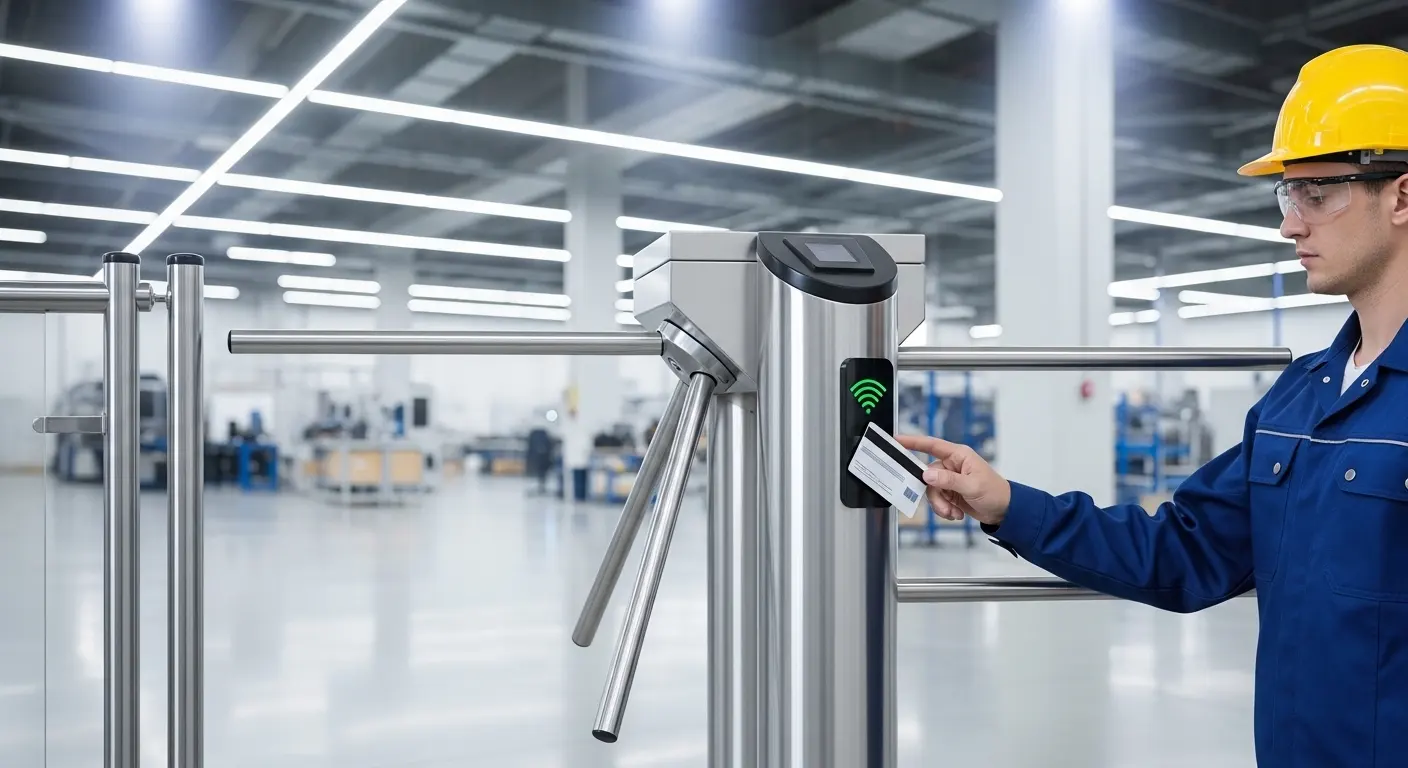
An employee access tripod turnstile verifies credentials and logs each entry event in under 0.5 seconds — entirely without manual intervention. Here is the exact process from credential scan to attendance record:
The Step-by-Step Entry Sequence
- The employee presents their credential — RFID card, fingerprint, or mobile QR code.
- The reader validates it against the access control database in under half a second.
- The three arms unlock for single-direction, single-person passage only.
- The arms auto-reset and re-lock immediately after that one person clears the gate.
- The system logs the entry event: employee ID, timestamp, and gate number.
- That record pushes automatically to the connected attendance platform.
- Unauthorized or unverified attempts keep the arms locked; an alarm can trigger optionally.
The mechanical three-arm design is essential here. It physically prevents two people from passing on a single credential. No software configuration can replicate that physical barrier.
What Happens During a Shift Change?
Shift changes are where employee access tripod turnstiles earn their value most visibly. A single lane processes 20–25 persons per minute, based on Turboo's product specifications. Therefore, a 300-employee shift change within a 15-minute window requires only three lanes to clear without congestion.
Multi-lane configurations spread the load evenly. Motorized fast-pass modes reduce arm cycle time for pre-verified employees. As a result, peak-hour queues disappear — without adding any staff at the gate.
For high-throughput factory environments specifically, Turboo's factory access control turnstile solutions are purpose-built for industrial shift-change volumes.
Employee Credential Options: RFID, Biometrics, and More
The credential type you choose determines your system's security level, onboarding speed, and daily convenience — so it pays to match the technology to your specific workforce.
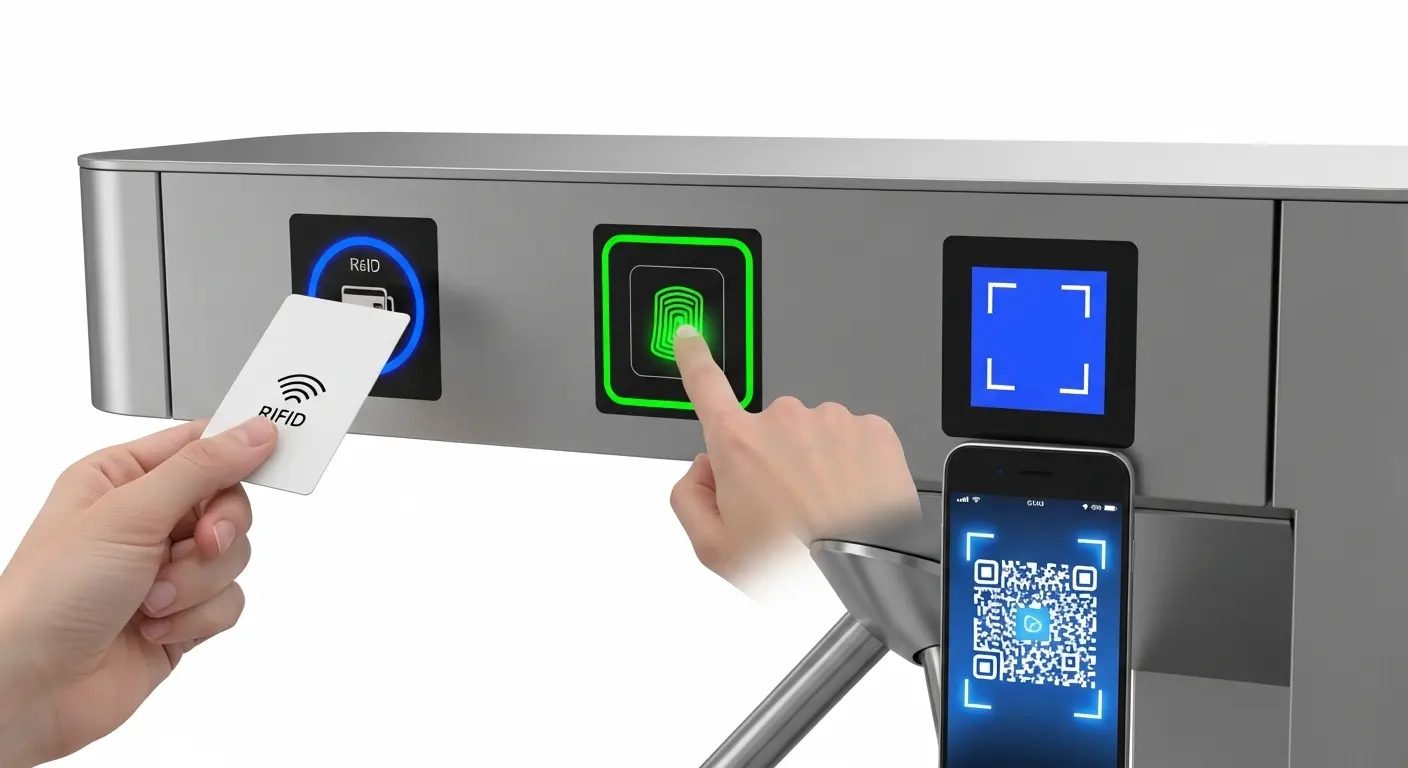
Comparing the Four Main Credential Types
| Credential Type | Speed | Security Level | Best For |
|---|---|---|---|
| RFID Badge | ⚡⚡⚡ Fast | Medium | Large workforces, daily employees |
| Fingerprint | ⚡⚡ Moderate | High | Sensitive areas, no-card policies |
| Facial Recognition | ⚡⚡⚡ Fast | High | PPE environments, hands-free access |
| QR Code (Mobile) | ⚡⚡ Moderate | Medium | Contractors, temporary staff |
RFID badges are the most scalable option for large employee populations. Enrolling a new hire takes minutes, and replacing a lost card costs very little. However, RFID alone does not eliminate buddy-punching — an employee can hand their badge to a colleague.
When to Add Biometric Verification
Biometric verification solves the buddy-punching problem entirely. A fingerprint or facial scan tied to the same gate confirms that the badge carrier and the physical person match. Consequently, payroll fraud via proxy check-ins becomes effectively impossible.
For high-security zones, combining RFID with biometrics creates a two-factor entry requirement. Turboo's biometric tripod turnstile range supports both fingerprint and facial recognition directly at the gate — no separate reader hardware required.
Attendance Tracking and HR System Integration
An employee access tripod turnstile transforms every gate event into a timestamped attendance record, eliminating manual clock-ins and the payroll errors they create.
According to the American Payroll Association, buddy-punching costs U.S. employers an estimated 2.2% of gross payroll annually. An integrated tripod turnstile removes that loss entirely at the point of entry.
How Data Flows from Gate to Payroll
Here is the standard integration path for a typical deployment:
- Employee scans credential at the gate.
- The access controller logs the entry event — ID plus timestamp.
- The controller exports that data via RS485, TCP/IP, or open API.
- The attendance management platform receives and processes the records.
- The HRM or payroll system syncs at scheduled intervals — zero manual entry at any stage.
In our experience working with manufacturing clients, the biggest operational win after installation is not the security improvement. It is the hours saved each pay period reconciling attendance disputes that no longer happen.
Zone-Based Access and Shift Windows
Beyond attendance logging, employee access tripod turnstiles enforce zone-based rules. An assembly-line worker's badge can grant access to the production floor but deny entry to the server room or finance wing.
Furthermore, access windows tied to shift schedules mean credentials only activate during assigned hours. When an employee leaves the company, one system update revokes all access instantly — across every networked gate, simultaneously. No physical key collection needed.
Anti-Tailgating and Physical Security Features
Tailgating — where an unauthorized person follows an employee through an open gate — is one of the most common access control vulnerabilities in workplaces. The Security Industry Association identifies tailgating as a primary failure point in industrial and commercial access control programs.
The three-arm mechanical design of a tripod turnstile directly addresses this risk. Each arm rotation admits exactly one person, then locks immediately. There is no gap, and there is no follow-through opportunity.
Built-In Security Mechanisms
- Anti-reverse arms: The gate cannot be pushed backward to allow unauthorized entry through the exit lane.
- Alarm output: Forced-entry attempts or reverse-passage attempts trigger an alarm signal, which connects optionally to a CCTV system.
- Audit trail: Every entry and every denied attempt creates a timestamped log. Disputes resolve in seconds with real data.
- Emergency mode: In fire evacuation scenarios, motorized arms retract automatically when linked to a fire alarm panel.
These mechanisms work together. Therefore, unauthorized access incidents fall significantly without requiring additional security staff at the gate.
How Many Lanes Do You Need? A Practical Sizing Guide
The number of employee access tripod turnstile lanes you need depends on your shift-change window, not just your total headcount — this is the calculation most buyers get wrong.

Use this table as a starting point for your specification:
| Workforce Size | Shift Change Window | Recommended Lanes |
|---|---|---|
| Up to 100 employees | 15 minutes | 1–2 lanes |
| 100–300 employees | 15 minutes | 2–4 lanes |
| 300–600 employees | 10 minutes | 4–6 lanes |
| 600–1,000+ employees | 5 minutes | 6–10+ lanes |
These figures assume a throughput rate of 20–25 persons per minute per lane. For example, a 500-employee facility with a 10-minute shift window needs a minimum of 4 lanes to clear the queue without buildup.
Additionally, consider bi-directional lanes if employees exit and re-enter through the same gate during breaks. A single bi-directional unit can replace two single-direction lanes in some configurations — reducing hardware costs without reducing throughput.
Turboo's high-efficiency pedestrian tripod turnstile models are specifically engineered for high-volume employee environments where throughput speed is the primary constraint.
Tripod Turnstile vs. Speed Gate for Employee Access
Both tripod turnstiles and speed gates control pedestrian access. However, they serve very different environments, and choosing the wrong one wastes budget or creates operational problems.
Side-by-Side Comparison
| Feature | Tripod Turnstile | Speed Gate (Optical Swing) |
|---|---|---|
| Purchase cost | Lower | Higher |
| Throughput | 20–25 ppm | 40–60 ppm |
| Physical deterrence | Mechanical arms | Sensor detection |
| Outdoor suitability | Yes (IP-rated housing) | Limited |
| Aesthetics | Industrial, functional | Sleek, modern |
| Best environment | Factories, warehouses, offices | Corporate HQs, tech campuses |
For most employee access scenarios in manufacturing or industrial settings, a tripod turnstile is the correct choice. It costs less, provides a physical barrier, and withstands harsh environments far better than glass-panel speed gates.
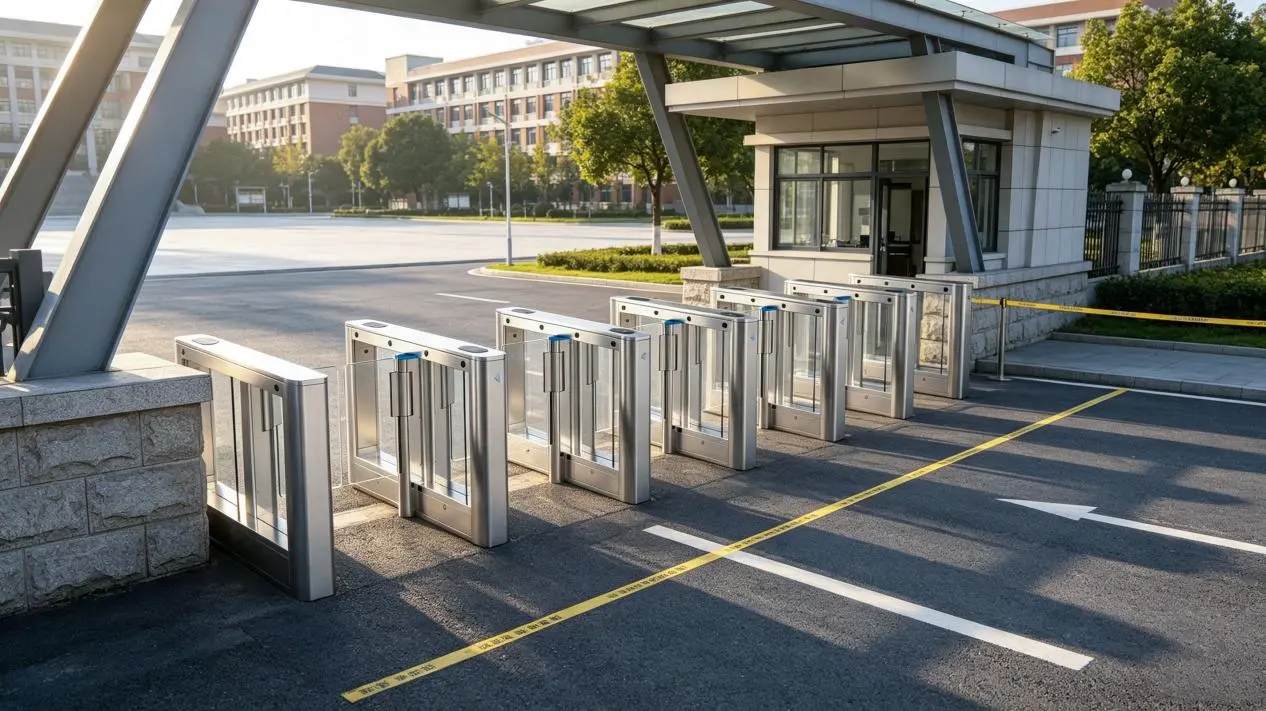
However, if your main entrance is a premium corporate lobby where aesthetics matter to clients and visitors, a speed gate may be more appropriate. Turboo's optical swing turnstile range is designed for exactly that use case.
ROI of Installing Employee Access Tripod Turnstiles
Most facility managers know a tripod turnstile improves security. Fewer have calculated exactly where the cost recovery comes from — and it is faster than most expect.
Four Sources of Financial Return
- Eliminated gate staffing: One or two security staff managing a manual entry point can cost $40,000–$80,000 annually in combined wages and benefits. A turnstile replaces that function continuously, 24 hours a day.
- Payroll fraud reduction: At 2.2% of gross payroll lost to buddy-punching (per the American Payroll Association), a 200-person facility recovers a meaningful sum annually once biometric verification is in place.
- Low maintenance cost: Tripod turnstiles have minimal moving parts. With basic servicing, operational lifespan reaches 5–10 years or more.
- Reduced incident liability: A complete, timestamped access log dramatically reduces the cost of investigating unauthorized access events or defending related claims.
Most mid-size facilities recover the hardware and installation investment within 12–24 months. Therefore, even a conservative ROI projection supports the business case at entry-level configurations.
Frequently Asked Questions
Q1: How does an employee access tripod turnstile control entry?
An employee access tripod turnstile verifies each worker's credential — RFID badge, fingerprint, or QR code — against an access control database in under 0.5 seconds. When verified, the three-arm mechanism rotates to admit one person, then immediately re-locks. Every entry event is logged with the employee's ID and a timestamp. Unauthorized attempts keep the arms locked and can trigger an optional alarm signal.
Q2: Can I integrate a tripod turnstile with my existing HR attendance software?
Yes. Most tripod turnstile controllers export data via RS485, TCP/IP, or open API. That data — employee ID plus timestamp — flows directly to your attendance management platform and onward to HR or payroll software. In our experience with manufacturing clients, integration with standard HRM systems is completed during commissioning. No manual data entry is required after initial setup.
Q3: What happens to the turnstile if the power goes out during a shift change?
Motorized tripod turnstile models can be configured to fail-safe (arms release for free passage) or fail-secure (arms remain locked), depending on your safety and security policy. Most employee access facilities choose fail-safe mode to comply with fire evacuation requirements. Additionally, a UPS or battery backup system maintains gate operation during brief power interruptions.
Q4: How do I prevent tailgating at employee entrances?
The three-arm mechanical design physically prevents tailgating without any software setting. Each arm rotation admits exactly one person, then locks immediately. No follow-through gap exists in the physical geometry. For added assurance, optical sensors on select models detect two-person passage attempts and trigger an immediate alarm.
Q5: Are tripod turnstiles suitable for outdoor factory entrances?
Yes, when specified with the correct IP rating. Outdoor industrial installations require IP54 or higher rated housing to handle rain, dust, and temperature variation. Stainless steel housing — 304 or 316 grade — provides corrosion resistance in harsh environments. Always confirm the specific model's IP rating before deploying it outdoors.
Conclusion
An employee access tripod turnstile does more than secure a door. It creates a real-time data layer connecting physical entry to attendance records, HR workflows, and payroll accuracy — automatically, at every shift, every day.
Three things to take forward: first, size your lane count against your shift-change window, not just headcount. Second, match your credential type to your security level and workforce size. Third, integrate the system with your attendance software from day one to capture the full operational and financial ROI.
If you are ready to specify a system for your facility, explore Turboo's complete range of tripod turnstile solutions or contact our access control team for a configuration consultation.