


Motorized Tripod Turnstile: RFID + QR Integration Explained

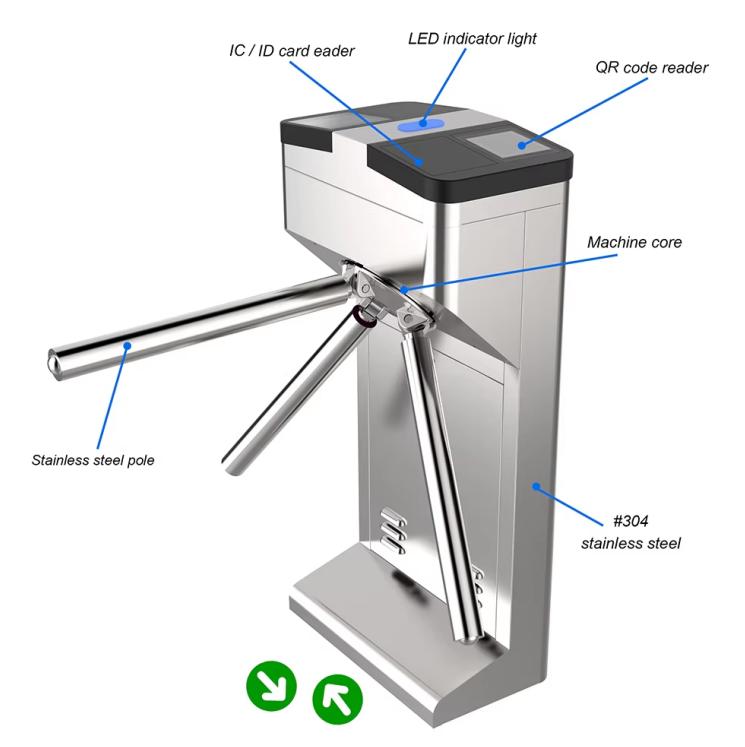
Motorized Tripod Turnstile solutions become truly practical when RFID + QR integration is designed as one complete workflow, not two separate add-ons. At Turboo, we build the YL121 vertical Motorized Tripod Turnstile for sites that must serve both long-term users (RFID cards) and short-term users (QR passes) in the same lane—smoothly, safely, and with predictable rules.
Why RFID + QR Belong in One Motorized Tripod Turnstile Lane
In real projects, “one credential type” is rare. Employees want a fast RFID tap. Visitors want a QR code on a phone. Contractors may switch between cards and temporary codes. If the lane only supports one method, you end up with extra guards, manual checks, or multiple entrances.
A single Motorized Tripod Turnstile that accepts RFID + QR helps you standardize entry rules for everyone:
• RFID supports daily, repeatable access with low friction.
• QR supports temporary, trackable access for visitors, events, and short-term authorization.
When both methods feed into the same lane logic, you get consistent behavior: one authorization equals one passage.
How RFID + QR Integration Works In Plain Language
Think of the system as three steps: Identify → Decide → Allow Passage.
• Identify
RFID reader detects a valid card. QR scanner reads a code from a phone screen or paper.
• Decide
Your access control system confirms permission (valid time window, user type, account status).
• Allow Passage
The lane receives the “open” signal and the Motorized Tripod Turnstile unlocks for a controlled entry.
The YL121 supports this by using a unified and standard external electrical interface, which is important for integration. It reduces wiring confusion, speeds up installation, and helps integrators connect common access controllers without custom work.
RFID Cards: Fast Flow for Daily Users, With Config You Can Tune
RFID is popular because it is quick. People do not need to open an app or adjust screen brightness. They tap and move. But even with RFID, the best user experience comes from the right settings.
On the YL121, the card logic can be set to “with memory” or “without memory.” This matters most during peak hours:
• With memory can feel more forgiving when users tap and step forward naturally.
• Without memory can feel stricter and may suit scenarios where you want tighter control.
The goal is not a “better feature,” but a better match. RFID should feel effortless for employees while still producing clean access records for attendance or security.
✓ Tip for beginners: if your site has morning rush traffic, start testing with “with memory” to reduce re-taps and hesitation.
QR Codes: Flexible Access for Visitors, Events, and Temporary Permissions
QR is the most flexible credential type because you can issue it instantly. For many sites, QR becomes the best answer for visitor management:
• Pre-registration creates a time-limited QR pass.
• A receptionist can generate a QR code for a guest.
• Event tickets can be converted into entry QR codes.
The risk with QR is not the code itself—it is inconsistent enforcement. If one QR code unlocks the lane and the gate stays open too long, it becomes easy for misuse.
This is why lane-side features matter. The YL121 supports automatic reset: after permission is granted, the gate returns to locked state if the user does not pass within the time set. For QR-based entry, this is a practical security control because many QR scenarios involve unfamiliar visitors who may stop, look around, or step aside.
✓ Real-world benefit: automatic reset helps stop “open lane” moments that can happen when visitors scan but do not move.
Making RFID + QR Feel Consistent: Indicators, Rules, and Anti-Abuse Logic
A successful RFID + QR lane should feel consistent for everyone. Users should know immediately if they are allowed, and the lane should prevent obvious misuse without creating drama.
The YL121 provides LED indicators:
✓ Valid credential shows green
✓ Illegal credential shows red
This supports RFID and QR equally. It reduces confusion and shortens queues.
For rule enforcement, the YL121 includes core protections such as:
• Anti-tail (anti-tailgating): discourages “follow-through” entry behind an authorized user.
• Anti-reverse pass: blocks wrong-way movement after authorization.
These functions matter more in mixed-credential lanes. When you allow QR visitors, you often increase the variety of user behavior. Anti-tail and anti-reverse help keep the lane orderly even when people are new to the system.
Integration Outcomes: What You Gain When RFID + QR Are Done Right
When RFID + QR integration is planned well, you do not just add convenience—you improve operations.
Here is what customers typically gain from a single integrated Motorized Tripod Turnstile lane:
✓ One lane supports staff cards and visitor QR without separate entrances
✓ Cleaner access records for access control, attendance, or fee-based entry
✓ Faster installation and easier controller connection via standard interface
✓ Better queue behavior with clear LED feedback and consistent lane rules
✓ Stronger control with auto-reset plus anti-tail and anti-reverse logic
The YL121 is also designed for practical deployment needs: it can be used outdoors completely, and one machine can be used as a lane, which helps reduce site construction complexity.
CTA: For combined RFID (staff) and QR (visitor) access, reach out to Turboo for the YL121 integration package. Send your reader choice (RFID + QR), site type (office/factory/campus/venue), and whether it’s an outdoor install. We’ll advise on wiring, lane logic configuration (“with memory” or “without memory”), and a deployment plan that’s fast, secure, and easy to oversee.