


5 Trends Defining High-Security Access in 2026| Full-Height Turnstile Manufacturers

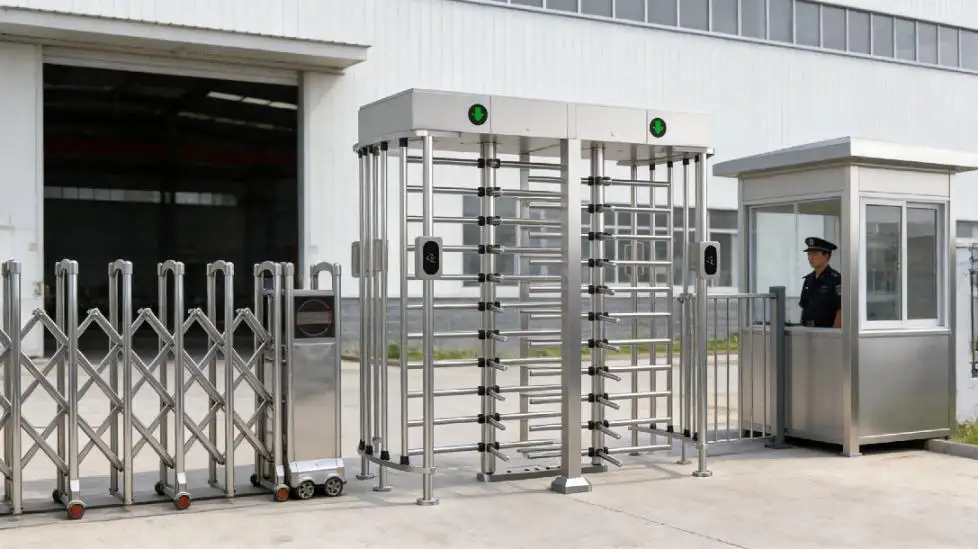
Full-Height Turnstile Manufacturers are facing the reality of a market that has changed quite a bit in three years. For procurement specialists and security directors and facility managers evaluating pedestrian access control solutions, the 2026 buying criteria will be different. While the raw barrier strength will continue to be important, the decisions will be more influenced by factors such as interoperability, data intelligence, and lifecycle value.
In the following, we specify the five key trends that the leading full-height turnstile manufacturers are responding to. We also indicate what these trends will mean for your next procurement cycle.
��� Trend 1: From Deterrence to Hardened Perimeter Enforcement
The most fundamental trend is the shift away from treating full-height turnstiles as a secondary security layer. Across critical infrastructure sectors—power plants, data centers, logistics hubs, ports, and industrial facilities—full-height units are transitioning from “optional upgrades” to baseline requirements.
Why the change? Because the nature of the threat has evolved. Lowered turnstiles and waist-high barriers can regulate flow, but they do not fully prevent climbing, vaulting, or misuse by determined intruders. A full-height model expands the physical border recess and adds controlled enclosure to the access points.
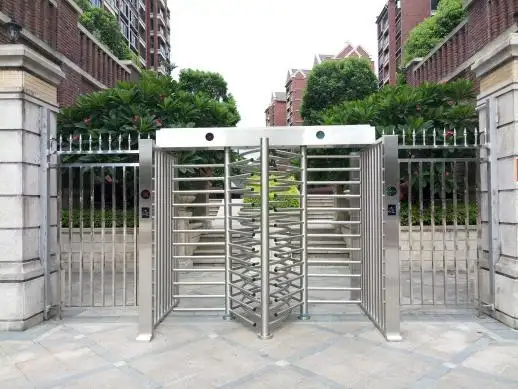
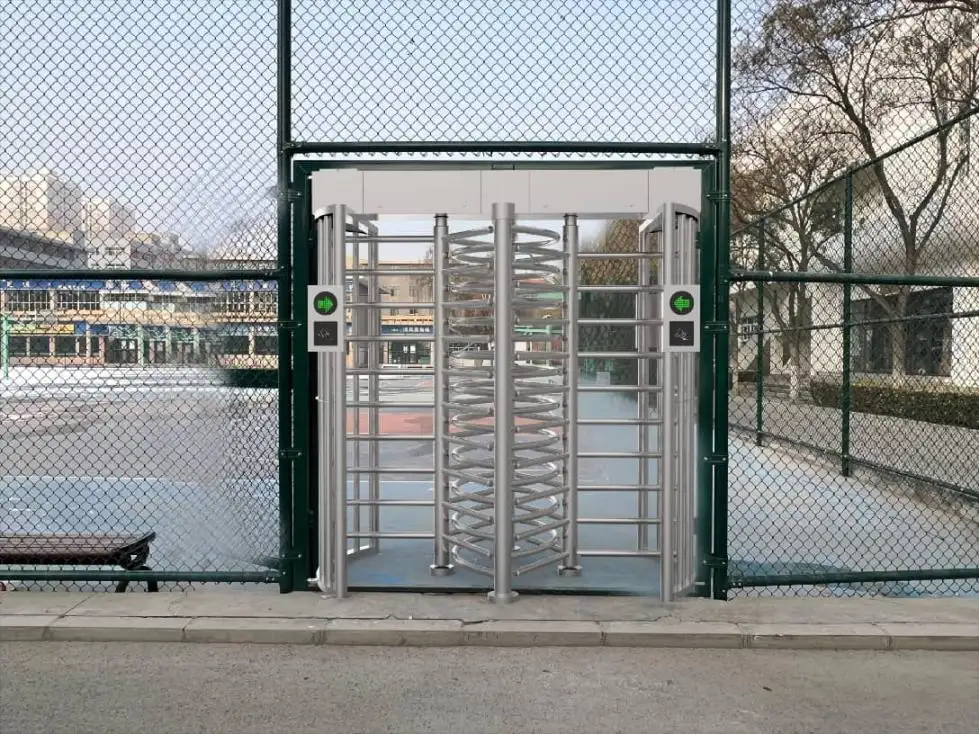
Regulatory imperatives and insurance underwriting mandates are deepening the trend. Higher premiums and increased scrutiny of compliance requirements are imposed on organizations that cannot demonstrate strong perimeter access controls. For manufacturers of full height turnstiles, the design response has been clear: structural integrity must remove climbing footholds with smooth, stainless steel bodies with no handgrip arms or rotational mechanisms with step points.
✅For the buyers: in the evaluation of full height solutions, preference should be given to units with 360° physical enclosure and ISO tested corrosion resistance (2000 hour salt spray test) for external use with weather exposure.
✅For manufacturers: The market is rewarding those who treat full-height turnstiles as perimeter architecture first, access readers second.
��� Trend 2: Intelligent Anti-Tailgating as a Non-Negotiable Feature
Tailgating remains one of the most exploited vulnerabilities in physical security. One credential holder holding the gate open for an unauthorized follower—this simple act undermines entire access control investments. A full-height turnstile stops tailgating mechanically because its one-person-per-cycle design physically prevents a second person from slipping through.
But buyers in 2026 want more than just mechanical solutions. They want active, intelligent detection.
Modern Full-Height Turnstile Manufacturers are embedding sensor arrays—infrared and time-of-flight (ToF)—that monitor direction, rotation, and passage density in real time. When the system detects a tailgating attempt, it can:
•Stop rotation immediately
•Trigger audible and visual alarms
•Send a signal directly to the security management platform
These features address a persistent frustration among facility operators: cameras record tailgating events, but they do not physically block anyone. Intelligent full-height turnstiles do both—they record and intervene.
✅For buyers: Specify anti-tailgating detection as a core requirement, not an optional add-on. Confirm that the system’s sensors operate reliably under peak traffic volumes.
✅For manufacturers: Differentiation now comes from detection accuracy and low false-alarm rates, not just barrier strength.
��� Trend 3: Biometric and Multi-Factor Integration at the Lane Level
The global access control market is projected to grow from USD 10.62 billion in 2025 to USD 15.80 billion by 2030 at an 8.3% CAGR, driven in large part by the rising demand for biometric access solutions, cloud-based platforms, and mobile credentialing. Full-Height Turnstile Manufacturers cannot afford to treat biometric integration as a future consideration—it is a present requirement.
In 2026, leading manufacturers are equipping their units with open-architecture controllers that accept:
•RFID cards and wristbands
•QR codes (printed or mobile display)
•Facial recognition
•Fingerprint and iris scanning
•Mobile credentials and PIN codes
The key word here is integration. A turnstile lane that supports one credential type is functionally obsolete. A lane that supports five credential types, with the ability to add more via software updates, is future-proof.
Beyond convenience, biometric integration delivers measurable security improvements. Facial recognition eliminates credential-sharing. Fingerprint authentication binds identity to passage. When combined with a full-height barrier that enforces one-person-per-cycle, the result is a closed-loop identity verification system.
✅For buyers: Insist on standard communication protocols (Wiegand, OSDP) and open SDKs that allow third-party biometric systems to be integrated without vendor lock-in.
✅For manufacturers: The winners in 2026 will be those who offer “credential-agnostic” lanes—hardware that works with any authentication method the site requires.
��� Trend 4: Emergency Breakaway & Fail-Safe Design
Security professionals have long faced a perceived trade-off: a turnstile that prevents unauthorized entry might, in theory, impede emergency evacuation. Leading Full-Height Turnstile Manufacturers have resolved this tension through intelligent fail-safe engineering.
Contemporary full-height units have advanced safety features:
•Fail-safe open (FSO) mode: when the power goes out, the rotor is free and allows safe exit without obstruction
•Fire alarm interface: turnstile is unlocked when a fire alarm is pulled due to an absence of voltage lock from the fire detection systems
•Infrared anti-clip function: injury is prevented during exit due to the sensors detecting obstruction which cause the rotor to cease or reverse
•Locked state is renewed automatically due to the turnstile reset logic: if a person fails to pass through the turnstile in the set time, the turnstile resets to a locked state, efficiently preventing perimeter control breaches
These features help satisfy fire codes and NFPA recommendations while not affecting perimeter control. During safety audits, a full-height turnstile containing all of the above features is not a safety concern.
✅For buyers: Buyers must obtain fail-safe documentation that explains the turnstile's function in a power fail and in fire alarm situations. Turnstile specifications must follow local codes.
✅For manufacturers: Have to be more open about how they build their turnstiles and provide certification of third-party testing. If they don't, they'll lose all of their contracts and, hence, sales.
Trend 5: Serviceable Turnstiles and Modular Design
The last trend shaping the end of the full-height turnstile manufacturers’ market are serviceable and modular designs. Purchasers no longer focus on how much the product costs in a ten-year window. Instead, they evaluate the total cost of ownership of the product over the same ten-year window.
What does this look like?
•Less variety of parts: Manufacturers who streamline the various parts they use across their product lines, lead to less operational struggles to perform necessary maintenance and repairs.
•Targeted repairs are easier due to modular design and field replaceable units. Unlike in the past when an entire turnstile head had to be replaced, head repairs are now possible.
•Predictive maintenance readiness: Faced with the risk of unscheduled downtimes, Analytics let Systems users warn support teams before failure.
The evolution is in line with the evolvement of the physical security market as a whole. It is predicted that worldwide sales of physical security would grow in the next year from USD128.43 billion in 2025 to USD 139.45 billion in 2026, with an 8.6% CAGR. Ongoing service contracts in the form of integrated security platforms along systems of service could take an increasing portion of customer budgets.
✅ For buyers: Request mean time between failure (MTBF) guarantees from the manufacturers as well as guarantee of replacement parts, and include these in the ROI calculations.
✅ For manufacturers: Providing lifecycle cost transparency with an efficient and robust sales service is as valuable as offering a good product.
What This Means for Your 2026 Procurement Decisions
The market of Full-Height Turnstile Manufacturers has matured and is at an advanced state. According to industry surveys, over 90% of security professionals rate the current access control market positively, with 58% describing it as “very good” or “excellent”. This confidence reflects genuine product advances, not marketing hype.
When evaluating full-height turnstile suppliers for your facility—whether a metro station, data center, industrial plant, prison, or stadium—prioritize manufacturers who demonstrate depth across all five trends simultaneously:
Evaluation Criteria What to Look For
| Perimeter Enforcement | 360° anti-climbing design; stainless steel construction; weather-rated for outdoor use |
| Anti-Tailgating | Sensor-based detection with alarm output; one-person-per-cycle mechanical guarantee |
| Integration Flexibility | Open-architecture controllers; support for multiple credential types; SDK availability |
| Emergency Safety | Fail-safe on power loss; fire alarm linkage; anti-clip infrared protection |
| Lifecycle Value | Modular design; spare parts availability; documented MTBF and service response times |
Full-Height Turnstile Manufacturers who have embedded these capabilities into their product lines are not merely responding to trends—they are defining what high-security access control looks like for the remainder of the decade. The question for buyers is no longer whether to install full-height turnstiles, but which manufacturer’s engineering and support ecosystem delivers the most reliable, future-ready solution for your specific environment.
CTA
Looking for a manufacturer that delivers across all five trends? Contact Turboo for a consultation tailored to your facility’s security requirements.
Frequently Asked Questions
Q1: What is the average turnstile lifespan?
A: 8 to 12 years. Less traffic and a mild climate help. Stainless steel and modular components help even more.
Q2: Can my access control system work with full-height turnstiles?
A: Yes. Most of the Full Height Turnstile Manufacturers have a standard integration for the Wiegand, OSDP and RS485 protocols. They also have open SDKs for connecting third-party biometric systems, third-party readers, RIFD systems, and security management systems.
Q3: Are full-height turnstiles fire safety compliant?
A: Quality units include a fail-safe that unlocks and allows unrestricted rotation. Check local codes and request documentation of the tests.
Q4: How do I know whether I should get a full-height turnstile or a waist-high turnstile?
A: If you need Border Security (data centers, prisons, industrial sites, and transport hubs) get full-height, all others get waist-high.
Q5: What is the maintenance schedule for full-height turnstiles?
A: Moveable parts and sensors need to be checked every 3 months, as well as the joints being lubed. Modular designs help because a part can be replaced instead of the whole unit.