



2026 Guide: Optical Turnstiles with Full-Height Tempered Glass, Low-Noise Safety

Modern lobbies require clarity, control, and quiet. Optical Turnstiles are sensor-based pedestrian gates for controlled entry. They use infrared detection and servo drives to validate access without heavy barriers. As a manufacturer, Turboo created this guide to help security, facilities, and IT leaders evaluate full-height tempered-glass installations that lower noise, strengthen safety, and make every arrival feel seamless. By the end, you’ll understand:
- How full-height tempered glass changes both security posture and the look-and-feel of your lobby
- Why low-noise engineering matters for health, productivity, and brand perception
- The 2026 purchasing checklist, performance metrics, and mistakes that often derail projects
- Answers to common questions about Optical Turnstiles performance, safety, and upkeep
Why Full-Height Tempered Glass Improves Security and Design
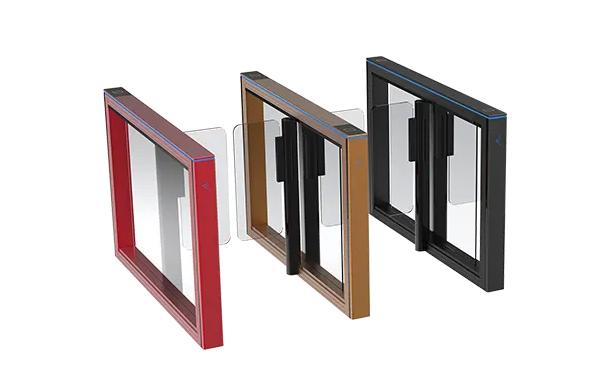
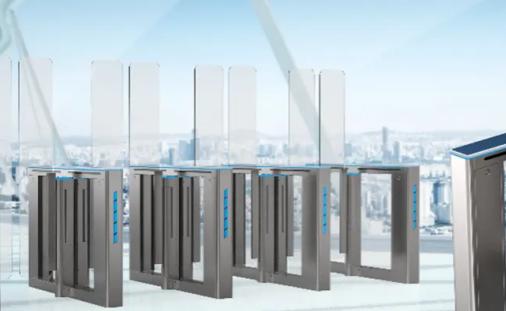
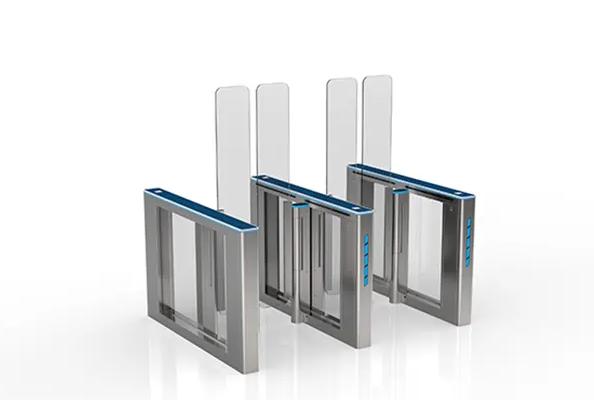
Full-height tempered glass turns Optical Turnstiles from simple checkpoints into refined, effective entry systems. Raising the glass discourages climbing and casual bypass while preserving an inviting, transparent environment. Visitors encounter a bright, modern lobby; your team gains a reliable physical boundary that doesn’t feel like a fortress.
Tempered glass is selected for predictable strength and controlled failure characteristics. In corporate and transit settings, 10 – 12 mm panels are typical because they offer stiffness without excessive weight. Edges are chamfered and polished, and hardware is designed to damp vibration so the assembly resists day-to-day knocks. Good engineering preserves optical clarity for years, which is critical for both aesthetics and surveillance.
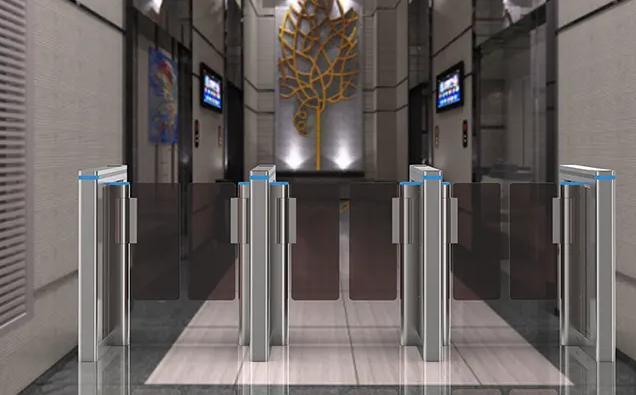
Clarity is a functional advantage. Reception teams and CCTV analytics benefit from unobstructed sightlines, which reduces confusion during rush hours. Full-height panels guide pedestrian movement naturally, cutting down on cross-traffic and accidental wrong-way attempts. Because the glass itself contributes to structure and visual identity, cabinets can stay slim, leaving more circulation space. That means smoother arrivals and less crowding – even where lobbies are tight.
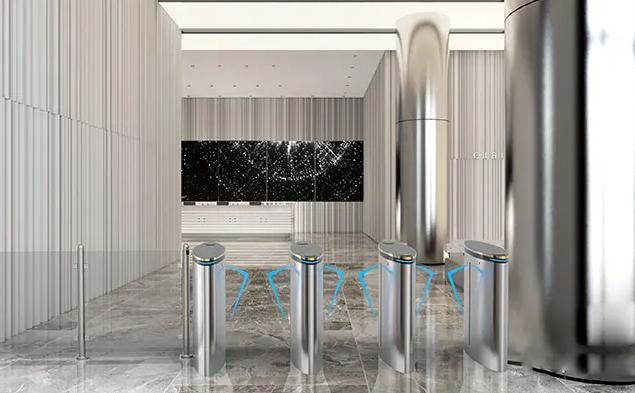
From a design perspective, the glass becomes a canvas for lighting and subtle brand accents. The result is a premium entrance that reads as high-end without heavy materials. In settings where architecture matters – HQs, universities, museums – this approach supports a welcoming, contemporary atmosphere while maintaining control.
Low-Noise Safety: From Drive Control to Infrared Protection
Quiet operation has become a specification, not a bonus. Many buildings now target mechanical equipment below roughly 50 dB at one meter in public spaces. Turboo’s servo-driven Optical Turnstiles use smooth motion profiles and torque control to suppress gear whine and vibration. Reducing mechanical shock extends component life and helps keep noise performance consistent over the product’s lifespan.
Safety lives in both the motion system and the sensing layer. Infrared anti-pinch coverage monitors the lane during opening and throughout movement. If a person or object enters the barrier’s path, the drive stops or reverses to avoid contact – preventing minor injuries and reducing friction between security rules and occupant comfort.
Life safety policies also demand predictable behavior under power events. Our lanes fail open when power drops, allowing immediate egress in line with typical fire code expectations. After service resumes, configurable auto-reset logic returns the lane to a secure state if no authorization is used within the set timeframe, eliminating unattended openings that weaken the perimeter.
Quiet matters beyond comfort. Lower background noise protects reception speech privacy, reduces cognitive strain, and maintains the lobby’s premium tone. With smoother motion and precision sensing, nuisance alarms and misreads diminish – so staff handle fewer overrides and experience a calmer workflow.
Smarter Operation: Anti-Tailgating, Memory, and Flow
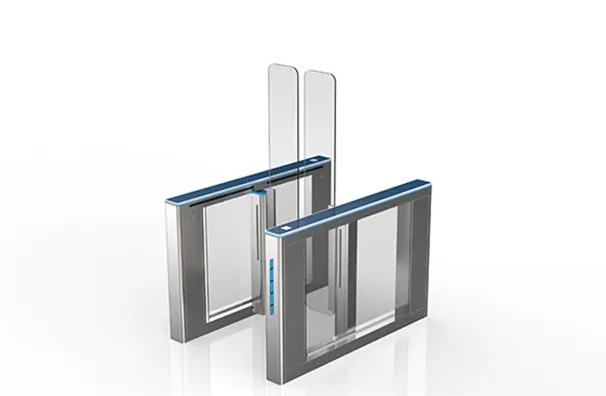
Optical Turnstiles rely on tightly spaced IR beams to build a real-time picture of passage. Tailgating detection is essential: the system tells apart a credentialed entrant from someone attempting to follow. On detection, the barrier remains closed or closes firmly and alerts staff.
Memory mode is a throughput boost. When multiple authorizations are presented in rapid sequence, the lane “queues” them and processes in order. This reduces the stop-and-go feeling during rush periods and shortens lines. In typical lobbies, one lane with memory enabled and trained users can manage roughly 35 – 45 people per minute, subject to lane width and policy. If a zone requires tighter control, memory can be disabled to enforce strict one-at-a-time passage.
Automatic reset prevents drift. When an entry is authorized yet unused, the gate closes itself back to secure within the timeout window, eliminating exposure from pauses or accidental reads.
Mode selection helps tune experience versus deterrence. Normally closed emphasizes the visible boundary and discourages casual attempts. Normally open creates a welcoming, free-flow tone in business hours – the barrier only closes on alarms or unauthorized attempts. Most properties program lane modes by the clock to balance throughput and control.
Integration and the 2026 Procurement Checklist
Modern security stacks benefit from unified identity and visitor handling. Optical Turnstiles should support IC/ID cards, guest QR credentials, and, where authorized, face recognition. Using standardized interfaces makes it easy to connect to access control and visitor platforms, and readers can be set for one-way or two-way use to suit flow. For analytics, confirm lanes can publish passage events to your SOC or BI environment to track occupancy and service levels in real time.
When buying for 2026, link procurement to clear metrics. Use this checklist to coordinate stakeholders and reduce back-and-forth:
•Acoustic assurance: ask for lab or factory noise reports targeting ≤50 dB at 1 m through standard open/close cycles.
•Egress behavior: confirm fail-open on power loss and fire-alarm – triggered emergency opening.
•Infrared safety: validate anti-pinch during opening and motion; perform soft-obstacle tests before acceptance.
•Anti-tailgating and anti-reverse: see live tight-follow scenarios to confirm detection and barrier response.
•Throughput planning: size lanes for your peak; with memory enabled, plan for ~35 – 50 persons/min per lane under steady flow.
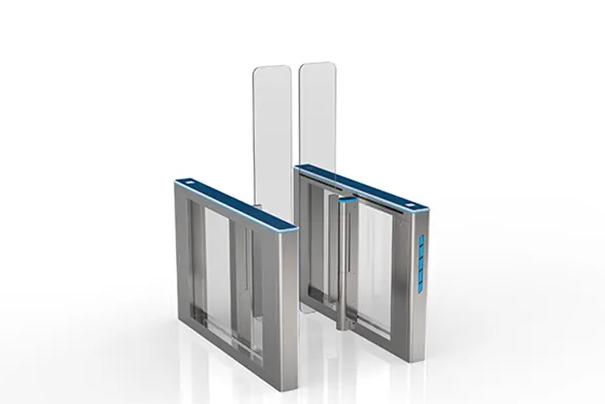
•Lane widths: standard 550 – 600 mm for staff; include ≥900 mm ADA/wheelchair lanes for deliveries and accessibility.
•Durability metrics: ask for cycle life (e.g., multi-million cycles) and confirm spare parts lead times.
•Integration mapping: verify compatibility with your IC/ID, QR, and face recognition stack; map event data to SOC/BI.
•Mode/policy alignment: document normal-open/normal-closed timetables and guard procedures to eliminate uncertainty.
•Compliance: confirm tempered glass safety ratings and the electrical approvals mandated in your locale.
Common pitfalls include chasing throughput at the expense of safety, ignoring evacuation behavior, discounting acoustic impact, and misjudging how many wide lanes are required for wheelchairs, carts, and service traffic.
Call to Action
Bring Turboo in early. Schedule a live demo, request an acoustics report, and run an integration workshop with your security and IT teams. Our engineers will help lock down lane counts, glass heights, sensing policies, and data interfaces so your Optical Turnstiles deliver stakeholder outcomes from day one.
Frequently Asked Questions
What sets Optical Turnstiles apart from tripod or flap barriers?
• They use sensor arrays and fast servo drives to verify passage with minimal physical friction, delivering higher throughput and a premium architectural finish. Full-height tempered glass adds a meaningful physical deterrent to climbing or bypass without resorting to heavy metal enclosures.
How do the lanes behave during a power outage or fire alarm?
• Barriers default to open on power loss, supporting immediate egress. When connected to the building fire system, the lanes enter emergency open mode on alarm. Afterward, the system resets to secure according to policy.
How quiet are well-engineered Optical Turnstiles?
• Quality systems operate near the 50 dB mark at one meter during typical cycles – similar to a quiet office conversation – appropriate for reception areas where acoustic comfort matters.
What’s the typical throughput per lane?
• With memory mode on and familiar users, plan for roughly 35 – 50 persons per minute per lane. Actual numbers depend on lane width, credential type (face recognition is typically fastest), and security policy.
How does infrared anti-pinch protection work?
• IR sensors monitor the passage zone continuously. If something is detected while the barrier is opening or moving, the drive stops or reverses to avoid contact, reducing injuries and wear.
Can the system support multiple credential types?
• Yes. It can integrate IC/ID cards, QR codes for visitors, and face recognition. You can configure one-way or two-way reading and mix credential types across lanes to suit flow and policy.
What maintenance is recommended?
• Schedule periodic inspections of drive assemblies, clean sensors, and care for glass with non-abrasive products. Keep firmware current. With routine maintenance, high-quality lanes deliver multi-year service with multi-million-cycle durability.
From Turboo: Built for 2026 and Beyond
As expectations rise, the entrance must be secure, calm, and transparent. By combining full-height tempered glass, quiet servo mechanics, and safety-centric sensing, Turboo delivers secure, efficient lanes. Anti-tailgating, anti-reverse, memory logic, auto reset, and power-off open convert into fewer incidents, shorter queues, and smoother audits. Out-of-the-box IC/ID, QR, and facial recognition integration lets your Optical Turnstiles operate seamlessly within identity and visitor workflows.
Planning an upgrade for 2026? Talk with our team. We’ll help you choose glass height, lane mix, operating mode, and integration path – and provide the validation data your stakeholders require. Request a demo and a specification review today.