



Faster Throughput in 2026: How to Specify and Operate a Biometric Swing Gate

Crowded buildings don’t slow down because people suddenly move faster – they speed up when the entrance lane removes hesitation. In 2026, the Biometric Swing Gate has become the anchor of high-traffic access control, and the best results show up when motion control, sensing, and credential logic behave as a single system. From a manufacturer’s view, sustained throughput is earned in the messy moments: mixed credentials in one queue, users arriving in waves, a stroller appearing mid-pass, or a brief power blip. Gates that validate clearly, move quietly, and recover predictably keep lines short and incidents rare.
What you will learn:
- How to integrate IC/ID cards, QR credentials, and face recognition in one unified lane
- Why BLDC motion control improves noise, smoothness, and service life for continuous duty
- How layered safety (anti-tailgating, anti-reverse, infrared anti-clip, auto reset) protects both people and flow
- How to choose operating modes and card memory logic for peak hours
- What to check before purchasing in 2026 – and the configuration mistakes that cause queues
- Practical answers to common questions from transport hubs, campuses, and workplaces
Integration Essentials: IC/ID, QR, and Face Recognition
A Biometric Swing Gate should not force people to pick a lane based on the credential in their hand. Employees with IC/ID badges, visitors with QR codes on their phones, and contractors registered for face recognition should all pass through the same point. That single-lane approach cuts friction and keeps space requirements down.
The controller’s job is to orchestrate readers and sensors so capture is quick, decisions are deterministic, and motion follows policy without lag. Visual cues (LEDs, on-screen prompts) and brief audio feedback reduce second guesses and eliminate double scans. Tolerance for variability matters in daily use:
• Card antennas should read reliably even when badges sit behind a wallet or next to a backpack zipper.
• QR scanners need stable illumination and obvious aiming so people don’t hunt for the sweet spot.
• Face recognition requires correct camera height and lighting. Good guidance helps users align naturally instead of stretching or stepping backward.
Policy logic directs the flow. Two-way reading keeps staff moving in either direction at the same lane during off-peak hours. Guide every entry in a single, predictable direction – easier to oversee, no cross-traffic even at rush. Need a clear-out or drill? Spin up free-egress windows and keep every event on the log.
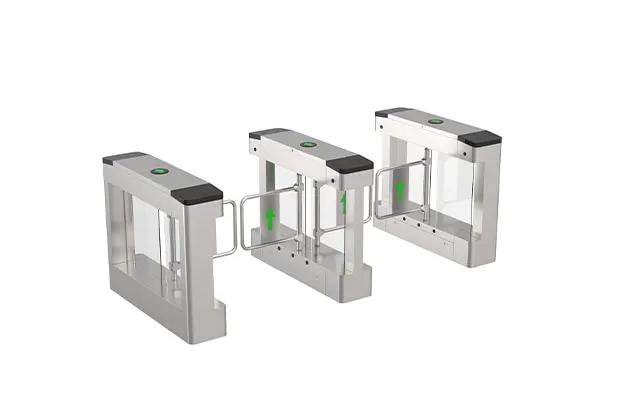
Capture Every Credential, First Time
• IC/ID cards: Read as you arrive; smart rules set direction and open fast.
• QR codes: Snap-and-go scanning with instant yes/no feedback.
• Face recognition: Purpose-built module validates and signals pass/fail in real time.
• Policy control: Tailor direction by group so staff cruise through and guests flow one way.
• BLDC inside: The smooth, quiet powertrain that delivers confident swings, precise control, and lasting reliability.
BLDC Advantages in Biometric Swing Gate
Brushless DC (BLDC) drives deliver low noise and a smooth torque profile that feels premium in offices, clinics, libraries, and transport corridors. Controlled acceleration and deceleration reduce vibration and prevent “jolts” at start and stop, which is when users hesitate most. Less hesitation at the leaf equals less backpressure at the reader.
Endurance matters, too. BLDC systems handle continuous stop – start duty with minimal wear, extending service intervals and keeping availability high. A well-designed lane doesn’t just open fast; it recovers well:
• Auto reset returns the gate to a secure state if a user validates but doesn’t complete the pass within the set time.
• Safe force limits and obstruction handling prevent damage and avoid panic stops that ripple into long queues.
• Diagnostics and firmware updates shorten mean time to repair and keep behavior consistent across lanes.
Noise, smoothness, and longevity are not separate checkboxes – they compound. Quiet lanes reduce stress for staff, smooth motion builds user confidence, and long life keeps unplanned downtime (and its hidden queue costs) off the calendar.
Safety Architecture
Safety and rule enforcement should be layered so the lane behaves the same way during trickles and surges. The most effective Biometric Swing Gate implementations combine sensing and logic to eliminate common failure modes:
• Anti-tailgating detects closely spaced individuals and refuses unauthorized following, a frequent source of loss and disputes at peak.
• Anti-reverse prevents users from pushing against the intended direction, limiting conflicts in the swing area and preserving accurate counts for billing or compliance.
• Infrared anti-clip provides human-centric protection. IR coverage monitors the passage while open and in motion; if a stroller wheel, suitcase handle, or elbow intrudes, the gate stops or reverses to prevent pinching.
• Auto reset closes the loop by restoring a locked state if a pass stalls, reducing the need for staff intervention.
The outcome is a calmer lane: fewer stoppages, fewer manual overrides, and fewer ambiguous moments that turn into lengthy queues.
Operating Modes and Card Memory Logic
Correct operating modes are a quiet superpower during peaks:
• Open or closed mode: In open mode, wings can remain open under defined conditions to accelerate supervised flows, while credentials are still validated. Closed mode keeps the wings locked until a valid event – ideal for secure portals.
• Card memory: “With memory” holds a valid event for a short window so users can collect belongings and pass without re-presenting. “Without memory” requires active validation during movement for areas with stricter control.
The pairing matters. If you enable one-way visitor flow but also enable memory with a long timeout, you risk “bounce-back” behaviors where users re-enter unintentionally. Tune the timeouts to the real walking distance and reader position so the experience feels natural.
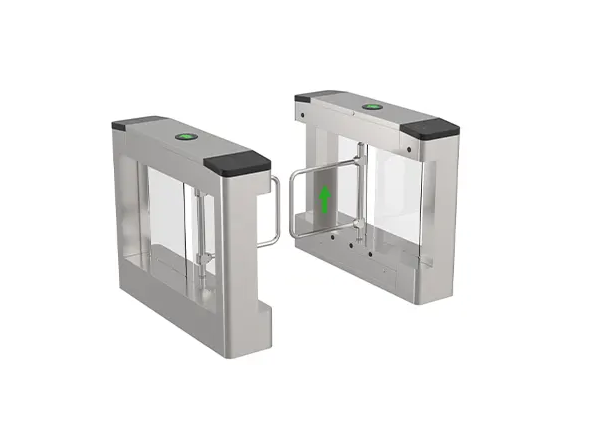
A 2026 Purchasing Guide for Faster Throughput
Ask vendors to demonstrate, not just describe. Validate behavior under the conditions you expect on site.
Key Checks
• Unified credentials: Native, simultaneous support for IC/ID, QR, and face recognition in one lane, with clean handoffs between methods.
• BLDC performance: Low noise, smooth motion, and demonstrated longevity under high stop – start cycles.
• Safety stack: Proven anti-tailgating, anti-reverse, infrared anti-clip, and auto reset during both opening and closing.
• Mode flexibility: Open/closed operation, configurable timeouts, two-way and one-way policies per user group.
• Card memory control: Clear options for “with memory” and “without memory,” plus guidance on tuning for ergonomics and risk.
• Maintainability: Tool-less service access, firmware updates, and actionable diagnostics that reduce downtime.
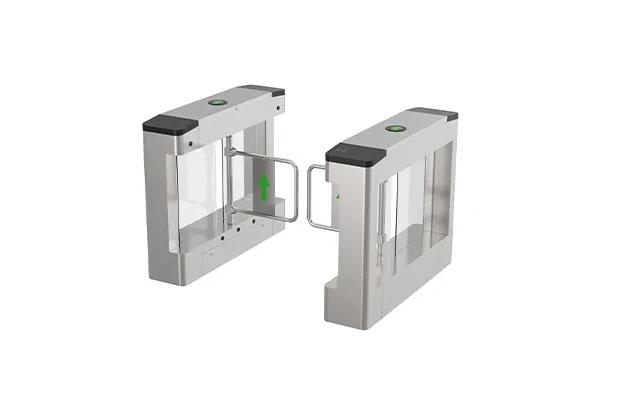
Avoid These Operational Missteps
• Speed-first configs that compromise safety, increasing incidents and claims.
• Single-credential policies that force awkward detours and slow the line.
• Non-BLDC motors that add noise, vibration, and shorten service life.
• No live proof of obstruction handling and auto-reset, resulting in mid-peak lockups.
• Direction and memory settings that aren’t in sync, confusing newcomers and driving repeat scans.
Call to Action
Turboo helps operators translate written policy into lane behavior that is fast, safe, and consistent. If you are planning a new lobby, upgrading a transit corridor, or unifying staff and visitor flows, request a site assessment and live demonstration. We will map your IC/ID, QR, and face requirements to a Biometric Swing Gate configuration, verify safety behavior on site, and recommend settings that reduce retries and keep queues moving.
Frequently Asked Questions
Q1: Can one Biometric Swing Gate handle IC/ID badges, QR codes, and face recognition together?
A: Yes. A unified controller coordinates multiple readers so users do not change lanes based on credential type.
Q2: How does anti-tailgating hold up during rush hour?
A: The system tracks spacing and passage state; if a second person follows without authorization, the lane denies entry and maintains a secure state without manual intervention.
Q3: What value does infrared anti-clip add?
A: IR coverage protects people and equipment by stopping or reversing when an obstruction is detected, both while the wings are open and during movement.
Q4: When should I enable “with memory” on cards?
A: Use it where ergonomics matter – lobbies with bags, turnarounds, or baggage claims – so a valid event remains for a short window. Disable it in stricter areas that require active presentation during the pass.
Q5: Does open mode weaken security?
A: Open mode is still governed by policy and credential checks. It accelerates supervised flows; closed mode remains the default for security-critical points.
By focusing on unified credentials, BLDC motion, layered safety, and well-tuned operating modes, your Biometric Swing Gate can turn peak-hour uncertainty into a predictable, high-throughput experience – without sacrificing security or comfort.